11.01.2009

Place Holder

I was going to throw up something rather substantive this weekend, but instead I was occupied with something I might write about in the future. Or not. (It was boring, don't worry.) Two quick thoughts:

(1) I generally get annoyed when people cross subjective and objective types of reaction to art - actually, it pisses me off to an unreasonable degree. I especially find it annoying when people express a strong subjective opinion as objective fact, especially immediately after someone expresses exactly the opposite opinion. This bugs me most, because it seems most misplaced, with acting. If someone's just said that Joshua Jackson is really good on Fringe, and your experience is that he's an unwatchably bad actor, shouldn't you consider the fact that lots of people disagree? Shouldn't you say "Jackson just doesn't work for me, for reasons x, y, and z, and I'm somewhat perplexed that people think he's really good?" Why would you say "Joshua Jackson is wrecking this show with a horrible performance"?

I think I notice it here most because I often seem, on the one hand, less bothered by performances other people find bland or unconvincing, and on the other hand not especially impressed with performances other people thought were transcendent. This surely has to do with my own experience as an actor, which gave me lots of opinions (not necessarily any insight, though! - I wouldn't claim for a heartbeat to speak for other actors, or actors in general). So when everyone's bagging Anna Torv's performance in the pilot of Fringe, which I watched yesterday, I didn't feel one way or the other about it. And (uh oh!) when everyone was applauding Heath Ledger in The Dark Knight, I wasn't especially impressed. I'm not going to be the "provocative" guy who claims that Ledger only got the acclaim because he died - I don't think that's true, except perhaps at the margins. And I thought the Joker character was very well portrayed/presented/whatever onscreen. It was very effective, and the thing that worked best about the movie for me.* But I felt a lot of it had to do with the writing and the costume and the makeup. Ledger's performance, in my opinion, was very very very good, and a lesser actor would have made a hash of it, but once you clear the hurdle of someone attempting to ham it up, I just don't think it was very hard. I don't think you needed to provide what the film required. There's multiple layers and complexities here - you could point out that much of the time a really great movie doesn't require Great Acting, and Great Acting in the way we understand it can seem kind of awkward and forced, which is how lots of people received, e.g., Sean Penn in Mystic River - but I just feel like whatever Ledger's considerable talents and potential, playing The Joker didn't sratch the surface. I have a suspicion that any of the other actors considered for the role would've evoked more or less a similar response. But all of that has to be filtered through my personal conviction that playing scary, creepy, and scarily creepily nuts isn't a particularly difficult thing to do, and that while Anthony Hopkins is enjoyable as Hannibal Lecter, he's just kind of dicking around artistically compared to something like Remains of the Day. (Which isn't a bad thing. Different movies have different requirements.)

*Which, incidentally, I liked more than the critics who hated it, but liked less than everyone who wrote hate mail to the critics who hated it; I thought it was inferior in conception and execution to Batman Begins. I have reasons for feeling that way, but they're incidental here and they don't add up to much that I would consider objective - well, I think my reasons are objective, I think it's a fact that the movie's plot doesn't work as well as its predecessor's, but whether that matters to you as much as it did to me is entirely up for grabs. The major reason I think The Godfather, Part II is better than The Godfather is because I think the sequel's story is infinitely superior in its construction - it's an artful structure, for one thing, and it manages to actually have a well-developed and coherent plot, as evidenced by one movie covering several months in some detail and the other one covering almost a decade in isolated scenes.

(2) I'm reading, and this will be entirely unsurprising, Bill Simmons' The Book of Basketball. Two things that I find kind of jarring: (a) typos. Multiple types in the first couple hundred pages. It's really kind of perplexing to me. (b) the book makes basically no concession to the notion that someone unfamiliar with Simmons' column might be reading. If you start reading someone's column it becomes clear, if they have a particular personality or schtick, that you've stepped into an ongoing narrative, sort of like picking up a TV show in season 3. There are things that aren't really going to be explained for you any more. I would've guessed that in writing a gigantic (and so far, very good) book, Simmons might've gone a little out of his way to be more accessible to someone who didn't read his stuff every week. I guess I shouldn't have thought that, since he's said on his press tour that it's basically the same voice he uses for ESPN, but R-rated. (So far I'd call it a soft R. Mild language, drug use, suggestive situations, brief nudity.) So he makes a gimmick of providing fake explanations of his pop culture references for readers in 2025, but much of the ephemera about Simmons' style really would be inaccessible to someone reading in 2025, and some of it would be inaccessible now. Given that one of the delights of the book is that some of the facts he dredges up about the pre-24 hour news era of professional basketball are the sort of thing that require footnotes to say "Seriously, I'm not joking," which make plausible other wild facts which require him to footnote that he is, in fact, joking, it's jarring to find him making other jokes that a somewhat less savvy reader might not realize weren't true. The subject of the book is intended to be somewhat timeless, and in its substantive approach I'd say it is, but a lot of the flourishes sort of float by weirdly; if in a column Simmons talked about the debut of the Ralph Samson Face, even if he had to explain the Sampson reference (which he does in the book), the general schtick is understood for readers of his column previously familiar with the Faces of Derek Lowe, Peyton Manning, etc. I mean, you can sort of work out what's going on, I presume, but it doesn't flow as easily as it does for the experienced Simmons reader. Just think it's an interesting choice; I wonder if it'll affect the perception of the book years down the road. (One of Simmons' reasons for writing the book is that he quite correctly feels that, compared to baseball, there's an embarrassing dearth of quality basketball books, and his pick for the best ever, John Halberstam's The Breaks of the Game, was out of print when I tried to buy it last year.)

Labels: , ,

10.16.2009

Sometimes You Didn't Know What You Were Looking For

I'm very glad my RSS reader came pre-loaded with a feed to the Wired website. It's been very interesting and informative over the past few months.

This one, about what we're finding at the border of the solar system, is just cool.

This one is really up my Alley of Pet Subjects; it's about how new studies appear to demonstrate that succeeding or failing at activities like field goal kicking, or putting, or shooting a basketball, may directly revise your perception of the size of whatever it is that you're trying to put the relatively small object through. It's a cliche for basketball players who are shooting well (there's another line of inquiry that suggests there is no such thing as a "hot streak" in sports - I tend to come away from reading about the subject with the opinion that people are variously over-interpreting the data or the concept of a hot streak) to say that the hoop starts to look bigger; this is taken as a metaphor for confidence, but it may actually be marginally true! I'm ever fascinated by, and influenced by, information about how the brain mediates our experience of the world. I've remarked recently on several occasions, in several contexts, that I think I'm probably much more likely than the average person to distrust the evidence of my senses, and I have been ever since my 11th grade physics teacher had the class do an exercise which revealed our blind spot. After that, everything I've read or heard about how the brain is interpreting sensory data rather than just opening a window to it has stuck with me. I haven't dragged this back around to metaphysical issues (I was rather unfocused and directionless as a philosophy undergrad, and my nascent interests lay in the realm of ethical and aesthetic inquiry), but this all goes to some very basic Problems of Philosophy shit that I'd probably love to read about.

(Shooting a basketball is funny; you're far enough away that very minor divergences in technique can have disappointingly large effects on the trajectory of your shot, but any experienced player - or a novice with a cheesily inspirational coach - knows that the hoop is actually quite big, big enough to fit two basketballs simultaneously with negative space left over. This isn't as big a ratio as trying to throw a football through a tire swing, but shooting a basketball is easier than putting a spiral on a specific target, or at least that's what I think as someone who knows how to shoot a basketball but throws a wobbly pigskin.)

When the people around me at work became aware of the plight of Falcon, The Auspiciously Named Balloon Boy, I was in the middle of trying not to explode for work-related reasons. People started making funny word-noises, I turned around and saw a colleague was displaying on her computer some streaming video of a big puddle of mylar traveling to the left, and I said something like: "Whu?" I was briefed on what was then thought to be the situation (poor Falcon!) and then I made an exasperated noise and returned to my work, feeling at the moment as though the Balloon Boy was an enemy agent sent to try and provide auxiliary annoyments to hamper my productivity. I would like to think, though, that had I been in a newsroom while this story was being covered for HOURS, without the troubling distraction of new information to interrupt my mylar-obsessed musings, that I'd have started to wonder about some of this.

Labels: , , ,

5.02.2009

And Somehow I Now Feel Let Down

It was a very good game, but not transcendent like the last three. It went the way very good games usually do; both teams kept fighting, but a small lead in the last two minutes has a way of becoming an inevitability, as the desperate measures required to cut into that lead with limited time inevitably fail more often than they succeed, which compounds the problem, which is how a five point game turns into a ten-point loss. As a Celtic fan I'm happy, but as a basketball fan this wasn't nearly the chest-tightening brain-scrambling emotion-effervescing experience the series deserved as a final act. Still one of the greatest series of all time and probably the best I've personally seen.

Side note: whenever possible, the production staff for sporting events like to come up with cutesy names for their informational bubbles, playing off the names of athletes or their teams. Tonight there was a statistical bubble entitled: "Bull-iant Play," or something like that, with the heavily forced pun on "Bull-iant" for "Brilliant." I instantly thought that there was a much better pun they left on the table, for virtue of being less forced: "E-Bull-ient Play," which actually would be spelled exactly like the word being evoked, but then I realized that 85% of the viewing audience would have no fucking idea what "ebullient" meant.

Labels:

Incidentally

One of my dad's favorite memories of watching basketball - and he's a lifelong basketball fan, much more so than any other sport - is of watching Game 5 of the 1976 NBA Finals, considered by many the greatest NBA game of all time. A triple overtime Finals game! And for him, of course, involving the Celtics. But the real value of the game for him is that my mother, who never cared about sports other than the occasional Olympic event and international soccer (rooting for Portugal and Brazil), was sort of waiting for the game to finish, and then became amazed that the game hadn't finished, and by the end was in rapt astonishment that both teams could just keep going, struggling on into the night, refusing to give up. In the end she was moved.

Now, the unhappy truth about sports is that most of the serious reasons sports fans would give you for loving sports and for the importance of watching sports (aside from trivial things like "because it's fun" and "it's a safe place for me to express irrationally tribal and xenophobic feelings") are usually not true. Most of the time sporting events aren't beautiful or inspiring or moving. But, as Bill Simmons wrote in one of his columns on the current Celtics-Bulls series, sports fans keep watching because you can never know when a transcendent moment will occur. You can't predict when greatness will reveal itself.

So. I was incredibly happy when the Celtics won the NBA Finals last year, and their series against the Lakers was a very good and exciting series, played by two teams that were very very good teams, near-great teams. But for all the reasons that people will write paeans to the transcendence of sport, that series doesn't exist in the same galaxy as this one. Neither team in this series is remotely as "good" a team as the ones that played in the 2008 NBA Finals. Neither team in this series is going to make this year's Finals. Whichever teams wins this series may well lose the conference semifinals and will certainly lose the conference finals. But: it is, as a basketball and a sports fan, one of the greatest, if not the greatest, sporting events I've ever seen in my life. It's thrilling, not simply because it's exciting but because I am thrilled, in my heart, to watch it. I have no idea what will happen tonight: perhaps it'll be a dull blowout, or perhaps one or both of these teams will finally remember what it's like to play badly. But right now two slightly-better-than-mediocre teams are playing at the absolute peak of their abilities, and bringing out the absolute best in each other, and it's beautiful. I can't promise that tonight's game will be nearly as good as the ones before it, but if you have any suspicion in your heart that you could enjoy watching a basketball game, I suggest you at least check out the fourth quarter to see what's going on.

Somebody wrote (I've read so much coverage of this series!) that in a way what makes it so compelling is laughably simple: both teams just keep making shots. In the end of a close game, somebody always misses a bunch of shots, but in this series both teams keep making shots until the final second. Which is to say: of course, basketball is just a game, and in this case a game played by wealthy men, for no stakes other than the ability to have pride for winning a game played by wealthy men before they go on to lose at the game to other wealthy men. But let's recognize that in that limited and trivial setting, there is no quit in these men. They are not giving up. They do not look at the score, and the time left, and hang their heads, and submit to what appears inevitable; they go out and do their work and set screens for Ray Allen and Ben Gordon to hit impossible shots. Absolutely impossible shots.

Dominance can be impressive: Russell and Chamberlain, Magic and Bird, Jordan, even the impressive defensive dominance of last year's championship Celtics team, the individual and at times invincible dominance of LeBron James. True dominance is a rare and therefore cherished quality for the sports fan to observe, but true dominance almost always prevents moments like this. If somebody someday asks me why sports could be worth watching, I'd cue up the fourth quarters and overtimes of games 1-3 and 4-6 of this stupid first-round basketball series and show them. Because I'm moved, and if I weren't so intentionally deadened to so much around me, I'd be inspired, because these silly men go out and play their silly game and will not lie down and say "enough". I'm, truly, awed.

Labels: ,

4.30.2009

Oh, Hi There

Been busy personally, professionally, mentally ... I've had the next two films in my final Lynchathon push in the apartment for a week and haven't watched either one. I'm basically working, coming home, going to the gym, watching basketball, staying up way too late to take advantage of my having gone to the gym, and then doing it all again and again and again.

Some brief thoughts:

Bulls-Celtics has got to be the best NBA playoff series ever in which neither team had a remote possibility of even making it to the NBA finals. It's astoundingly good and entertaining. There will be a seventh game. In the six games so far, there have been two single overtime games, one double overtime game, and one triple overtime game. There have never been so many overtime periods, or games with overtimes, in a playoff series before. I of course want the Celtics to win, and I'm not sure I can even bear to watch game 7 because of it (though of course I almost certainly will) but I almost don't care who wins the series, I just want to watch as much of it as I can. As weird as it sounds, right now these teams are both playing ridiculously good basketball considering that they're somehow overmatched against each other; the Bulls simply don't have the talent and skills (YET - get back to me in a year or two) to hang with the Celtics, but the Celtics are too injured and thin on the bench to be able to hang with the Bulls. I just watched a triple overtime game and then spent five minutes on the phone with my dad detailing my theories about whether or not a player's foot was on the three point line when he made a clutch shot. (My answer: it wasn't when he began taking the shot, but it was when he finished taking it.)

Also of some currency; there was just a training session and test for a lot of the staff working for my employers on a specific facet of what we do. The test was admittedly, by its designers, intended to be easy and passable, and the training session was geared specifically towards the knowledge necessary to pass the test. (Important clarification: I'm, for these purposes, on the QC team [three people], which had to take the test, because we have to be able to QC the work performed by the actual frontline staff [about twenty-five people, more or less].) The person running the training program told me that I had the high score. Apparently a bunch of the frontline staff did poorly on the test. Like, a bunch of them. Now:

I've gotten very good, for a variety of reasons, at reflexively deflecting apparent high achievement on my part when compared to subpar achievement from others; I'm quite facile at finding flaws in methodology and process and explaining away other people's poor performance. Partly because while I'm intellectually confident, I don't think I'm conceited; partly because I don't want people to think I'm conceited; partly because I think some of my deflections are accurate; partly because I honestly believe that a lot of what people perceive as evidence of my intelligence isn't actually evidence of my intelligence. It's evidence of my ability to notice, absorb, and retain much more information across a much broader spectrum of topics than the average person. Now, I wouldn't be surprised if curiosity and strong memory were highly correlated with other traits that I consider more authentically "intelligence," because that's a cluster of skills that complement each other well, but I think I'm smart because I can rapidly assimilate new information that's not just factual but procedural or argumentative, I can perceive different angles from which to view a problem, I'm good at disassembling arguments [better at that than creating them, which is why I hoped to become the poor man's Sidney Morgenbesser], and a bunch of other things, some of which I only notice by comparison to other people, like - in the training session for this test - how frustrated and confused a lot of people seemed to be by having a process they understood in one context presented to them in another context. The point being that people who don't know me that well think I'm intelligent because I know who John Jay was, whereas I don't understand why everyone else who took U.S. History in high school [which is to say: everyone] doesn't remember who John Jay was, since he certainly came up once or twice.

ANYWAY the point being that I can see a whole bunch of reasons why my getting the high score despite first attempting to learn the necessary information a couple of weeks before the test, while people who'd been actually doing the job for years performed poorly, isn't actually a valid indication of our relative ability to perform the task at hand in a real world situation. I've thought of lots of them. Because frankly it's sort of frightening that I should have done better on the test than someone who's had that job for thirteen years. I actually didn't want to be the high score on the test; I wanted to do very well, for a variety of reasons, but I really wanted for entirely selfless reasons to have a score that looked good but wasn't as good as the scores achieved by people who'd been performing the relevant tasks for thirteen years. It's, honestly, kind of scary to contemplate, because those are the people who are actually doing the work, and have been considered competent (well, there are issues there, but) to do the work for years, in some cases. But here we are. (By the way: I scored a 92, so it's not like I rocked the shit out of it. I've actually got a good guess as to what questions I missed and what questions the experienced employees missed; I bet I missed a few of the questions that required knowing all the many details of abstract policy - who qualifies for what deduction - that I could only partially stuff into my head because some of them are honestly so freaking arbitrary, while they missed the complex and crafty calculations stuff that I found easy because all I had to do was follow the damn direections.) Sigh.

Labels: , , ,

8.13.2008

Confluence

At Lawyers, Guns and Money (I go back and forth on whether or not to italicize website names, which I would prefer to do but is apparently not the evolved standard) Scott Lemieux has a post up concerning Anthony Kennedy's opinion in Carhart II. The money quote:

While we find no reliable data to measure the phenomenon, it seems unexceptionable to conclude that some women come to regret their choice to abort the infant life they once created and sustained. Severe depression and loss of esteem can follow.

Except, that, per the APA, it is exceptionable to conclude this. Unless you allow the word "some" to do a great deal of mealy-mouthed work (of course "some" women experience depression and loss of esteem after an abortion; "some" women also experience depression and loss of esteem after successfully giving birth, or at least that's what Brooke Shields would have you believe) this is actually a baseless claim. The APA's studies suggest that post-abortion depressive symptoms are about statistically on par with the occurence of the same symptoms among women who proceed with unplanned pregnancies, which is to say that getting pregnant when you weren't trying to is sometimes really shitty whatever you choose to do.

I say it's "baseless" but of course Justice Kennedy's "base" is in his intuition; he writes that it's "unexceptionable" because it seems evident to him and I'll bet it also seemed evident to most people he asked or would have asked if he did take an informal opinion poll. Hell, I would've guessed that there was some significant proportion of women who suffered depressive episodes post-abortion, although I like to think I would've made the logical leap to unplanned pregnancies in general. It's the sort of statement that unless you empirically know it to be false, or have differing intuitions, just "intuitively" seems reasonable.

And I say "confluence" in the post title because two minutes before I read the LGM post above I read this thread (which is actually about the best advice posters received from professional musicians) where one person relates studying with a mathematician who told him, "You rely a lot on intuition. That's good, because it sharpens your insights. Unfortunately, intuitions are usually wrong." The mathematician, of course is right.

My favorite example is the Monty Hall problem, which you can read about in some depth here, or to get an engaging story about the most famous public explication of the problem and insight from Mr. Hall himself, here. Now, as a mathematician in the second link suggests, the human brain seems particularly ill-wired to sort out issues of probability (I wonder if this is why 99.99% of reporters don't understand statistical margins of error). But even if this is an extreme example, not only of the failure of intuition but also the capacity of people convinced of their correctness to be insufferably arrogant and gracelessly self-righteous, the general point really does stand; human intuition usually isn't worth much.

Well, it's worth something because, for one thing, if you're interested in the functioning methods of human cognition it's probably interesting to think about why common intuition is wrong in one instance or another. And, of course, intuition is sometimes right, brilliantly so, transformatively so, although I'd (intuitively!) suggest that most of the great intuitive leaps of human achievement have resulted from the intuitive moment of someone who had spent a significant amount of their time thinking about related problems and not from someone who idly thought about a subject for a few minutes before coming to a radical insight. I'd also (intuitively!) suggest that commonly held intuitions are more likely to be borne out the softer the subject matter; ergo, it's more likely that an APA study would vindicate Justice Kennedy's intuition about the psychological effects of abortion than that someone's intuition about probability games would turn out to be accurate. And yet we're still wrong all the time. One facet of the human condition which has gathered a great deal of philosophical literature about itself (and with which literature I'm not very familiar) is the tricky problem of self knowledge. Sidestepping self knowledge for its own sake, all we have to go on when attempting to intuit human reactions and emotions in others, or in populations, is our lifetime of interpersonal experience, which is created by imperfectly and often incorrectly interpreting a statistically insignificant sample of other people's behavior, and the cautious application of our own self knowledge to others. And yet we frequently don't know ourselves at all! (Actually, I think I know myself pretty damn well, but then I've spent a lot of time thinking about myself, which in the end probably hasn't been good for me.)

Somewhere I had a point, but it's long lost. I just thought the confluence of reading those two snippets so close to each other would be an opportunity to ramble briefly on a subject that interests me. Two related addenda:

(1) I wish I knew more about, or would take the time to learn more about, the relatively new subfield dubbed "experimental philosophy." I could be completely wrong but my impression is that experimental philosophy is largely concerned with actually asking people their opinions of philosophical questions and incorporating the "folk wisdom" of an average collective response into philosophical work. If I've characterized it accurately, and even if my characterization is accurate it's probably insufficiently nuanced to be fair, you can guess that I'm going to take a dim view, unless the purpose of seeking out the "folk wisdom" is to talk about human perception of philosophical issues rather than the issues themselves. To give an example, I mean the difference between (a) describing human intuitions about ethical obligations and (b) describing ethical obligations, or even (b-1) describing the reasons for human intuitions about ethical obligations.

(2) Link-within-a-link! In the Monday Bullets from about six weeks ago basketball blogger extraordinaire Henry Abbott notes that:

It's the job of an NBA GM to take all the available data, interpret it, and make tough personnel decisions. But some of the available data these days is extremely intense. I suspect some of the best research is really not properly understood by the people at the top on some teams. And today I learn that same thing happens in the U.S. Supreme Court.

In general I think the issue/problem of judges and justices basing their decisions and opinions on data which they don't understand is interesting especially because I can't intuit a good solution. Outside of the Supreme Court, probably the most recognized jurist out there in the US is Richard Posner; at the least he's the most recognized jurist within academic circles regardless of discipline, because Posner is an academic and something of a polymath. Actually, despite the highly respected quality of his jurisprudence, his academic recognizability is undoubtedly due as much to his eager and broad pursuit of various intellectual avocations as it is to anything else. The problem is that as polymaths go he's not actually that impressive; at the least, he's not a very good literary critic because he's not actually a particularly sensitive or insightful reader. He may be better than the average adult American, but based on what I've read of his in the field he wouldn't rate as an actual English professor. All of which, tied together with Kennedy's cheerfully confident errors above, point to what is perhaps my ultimate point: lawyers aren't all that smart, as a class, and even though judges are presumably selected from among the smarter lawyers, "the smarter lawyers" is saying very little in the scope of human intellectual achievement.

Labels: , , ,

8.09.2008

Why I Want Silver Or Bronze

Well, for one thing, I've always preferred the appearance of silver (and white gold, and platinum) to traditional yellow gold.

But no, I'm here to briefly talk about why I want the US Men's Basketball Team to not win the gold medal they are being widely, if cautiously, favored to win. I think the so-called "Redeem Team" needs to lose, and American men's basketball needs to keep losing, for it's own good. I don't want them to win until they've gotten it right and won for the right reasons.

The original Dream Team, and the only one worthy of the name, was the team we sent to the 1992 Olympics in Barcelona, the first time the US had sent a team of professionals to international competition. The Dream Team was, first of all, that; more than any other international team it truly had a near-lock on the consensus best American-citizen NBA players of its era; the current team doesn't compare because it doesn't have guys like Tim Duncan or Kevin Garnett on it. Not only was the Dream Team almost exclusively composed of the very best players of its era, it also happened to represent a moment of particularly rich talent from the 80s/early 90s era of American basketball which hasn't been equalled until the last few years. TEN of the guys on that team were also on the NBA's 50 Greatest Players (from the first fifty years) list compiled in, I think, 1996. So the Dream Team was Dream-y. They also didn't really give much of a damn about their competition, and frankly they didn't need to. Famously, Charles Barkley was asked what he knew about their upcoming opponents, the Angolan team, and Barkley responded something like "I don't know much about them except that they're in trouble." It's vaguely possible that the coaching staff did some scouting, but I highly doubt the players listened to it; the talent gap was so enormous that the concept of having to spend time thinking about the best way to defeat an opponent would have been received as mildly insulting by someone like Larry Bird or Michael Jordan. The opposing players, too, were star-struck. Many asked for autographs, and Toni Kukoc, soon to be of the Chicago Bulls but currently playing for the Yugoslavian team and one of the best non-American players in the world, pissed off a lot of people by claiming that if the American Dream Team played an international Dream Team assembled from the best players from every other country, the Americans would still kick ass and take names (and sign autographs). And he was almost certainly right.

That wouldn't be the case today. I'd have to think more about the composition of a global non-American All Star team, but any team with a starting lineup of, say, Yao Ming, Dirk Nowitzki, Andrei Kirilenko, Manu Ginobili, and Steve Nash, and guys like Pau Gasol, Tony Parker, and Hedo Turkoglu coming off the bench, is at least a fair matchup for the current Olympic team. Over the past ten years there's been a shift in the public attitude of American basketball players, from the continuing casual assumption that they're the best of the best and they don't need to worry about it to the current proclamation that "Hey, these other guys are really good, we believe we're going to win but we absolutely respect these players and can't take them lightly." The problem is that I don't really believe that to be true. NBA players obviously respect their All-Star fellow peers, guys like I named in the imaginary starting lineup, but nobody on the American team in 2004 gave a moment's thought to the burning question of "How are we going to stop Carlos Arroyo?" The result was that the Puerto Rican point guard carved up the Americans and absolutely humiliated them, which was doubly depressing because Arroyo was an NBA player and not an especially good one. (Arroyo continued to play in the NBA, winning bigger contracts but never quite equalling the performance he gave in that game and never cementing his status as starting-quality. He just this summer signed a contract to play in a Spanish league.) I believe that the players actually do read and think about scouting reports now, but I still think there's an attitude on their part that needs adjusting; the mealy-mouthed clichés about how "We've just go to play as well as we can and show we're the best" barely pass muster as media-comment in the NBA, where you're at least expected to drop some Basketball 101 clichés as well.

But really, truly, I think the organization of USA Basketball needs an overhaul. It was apparently getting one four years ago when Jerry Colangelo, a figure of aging respect league-wide, the former owner (and current executive) of the Phoenix Suns, was made basically the American Basketball Godfather. However, all the talk about how they were going to implement a new approach, weren't necessarily going to recruit star player but were instead shooting for the best possible team, how you had to demonstrate a multi-year commitment to USA Basketball not only as a show of good faith and dedication but as a necessary attempt to replicate the chemistry the international teams have built up over years of playing with each other...all this has been overtly upheld but subtly undermined. I could say a bunch more, but I'll confine myself to note that some of the final player selections should be eyebrow-raising in light of the criteria I laid out above, and suggest playing favorites both with Colangelo and the team's coach, Mike Krzyzweski, but also on the part of the team's sponsor. Eleven of the twelve players have Nike contracts, and the sole non-Nike player, Dwight Howard, is marginalized in the semi-official video documentation of this team, and photographed in such a way that he can hide the offending logos on his shoes and, as a concession to his own shoe company, hide the Nike logo on his uniform. Supposedly the shoe companies are leaking some of their juice, but never ever ever underestimate how powerful they are in the world of basketball.

Labels:

6.24.2008

Restatement

Wow, that basketball post from yesterday was a mess. I changed directions about three times there. Maybe it's because I almost fell asleep on the bus home from work, so I was actually more alert later on, when I wrote about coy vampires. Anyway, I was trying to communicate, in the end, a few different things, which I'll do much more briefly this time around:

(1) You should read The Last Shot. Everyone should read it. It's a fantastic book, and if you're not interested in basketball just pretend it's about something else you're not interested in but willing to read a compelling and well written book about. It's reporting on events that happened, now, almost twenty years ago, but like its logical companion piece Hoop Dreams (aka the only three hour documentary I watched twice in one day because I was so blown away by it), all that's changed is that rap is more integrated into the mainstream and hairstyles are different. Since the NBA instituted its deplorable age limit, the situation is exactly the same. Except that people are getting paid a lot more now, and the sneaker-sponsored AAU summer league teams are possibly more influential now (though the sneaker market itself is shrinking; I don't know yet what this portends).

(2) I don't know why I went on about Marbury - not someone I spend much time thinking about, NBA-wise - except that, especially as viewed by reading The Last Shot and The Jump at the same time, he is a fascinating figure. I suppose I was trying to complicate the kneejerk reaction towards a particular kind of athlete by saying that his context and upbringing account for a lot of what makes him difficult to like today; if he didn't have those negative qualities, he might well have gotten lost before making it as an NBA player, instead of getting lost after making millions of dollars. Plus I accidentally stumbled into something else: in The Last Shot, one heartbreaking refrain is that parents and educators alike continually wonder if there's something specially wrong with their neighborhood: why, when Lincoln High has been a dominant force in the Public School Athletic League for years, had it never sent an athlete to a Division 1 program? Why do they all struggle to make the 700 on their SATs? The average background for an NBA All-Star is probably something like "poor and disadvantaged but not hopeless." Coney Island at the time of The Last Shot was hopeless. The extra hurdles and damages incurred for a talented athlete to survive Coney Island vs. a rough neighborhood in Oakland in the same time period may account for a lot of the difference between Stephon Marbury and Gary Payton.

(3) One of the main reasons why I was spurred to try and write that post is because I was trying to articulate why, beyond my pure love of the game, I find basketball so engrossing: more than any other sport, the matrix of social issues that surround pro basketball is to my way of thinking indicative and relevant to a lot of things going on socially in America at large. (Or, alternatively, the social issues relevant to basketball are the ones I'm interested in.) The whole system of basketball education, development, and recruitment for - as ultimate goal - the pro game is broken, corrupt, exploitative, and, as I said in the prior post, fetid, rotten, ill. But that's not just of interest to basketball; the System here is an extension, and expression, of the Larger System affecting America overall, and by understanding the exceptional specifics of this instance we find ourselves having larger discussions about race, class, education, social justice, and, to get broad and sentimental, what we want from our public figures and what we want for our children.

Labels: , ,

6.23.2008

Who Did You Think He Would Be?

(I know my small readership doesn't give a shit about basketball. The Finals are over! Your hometown team won! What's left to say? Well, I have like 2.5 basketball posts left in me, at least until the Olympics start, if I decide to write about the Olympics. Hopefully whatever I come up with basketball-wise here and in the near future will be a little more general interest.)

I somewhat accidentally started re-reading The Last Shot, by Darcy Frey (a freelance journalist who also wrote the article which inspired the movie Pushing Tin) the other day, and am unspurprisingly engrossed in it again. It's easily the best book I've ever read about basketball - though there are some other avowed classics I should check out, at least one out of print - and for human interest and literary quality absolutely crushes The Jump, its logical prose companion piece. The Jump is about Sebastian Telfair, of Coney Island and Lincoln High School, and follows him during his senior year of high school (class of '04) as he navigates the college recruitment process while simultaneously weighing the option to jump to the NBA, which he does. Telfair goes late in the lottery and the book closes on a high note that's probably well earned: Telfair has done extremely well for himself and, I hope, for his family, even though he's been an unmitigated disappointment thus far as a professional basketball player. My criticism of The Jump - which I read a few years ago and might be remembering unfairly - is that it treated the overwhelmingly rank and fetid bullshit people like Telfair need to go through for the one in a million shot at escaping Coney Island as a series of hurdles an aspiring kid could conquer, rather than the manifestations of a broken system that stifles and chokes everyone but the one player in a thousand who gets a shot at pro ball.

The other criticism is that Telfair isn't the most interesting guy in the book; his cousin is. His cousin was also in The Last Shot, which follows three seniors and one freshman on the Lincoln High basketball team during the 1991-1992 academic year. All of them have, in varying degrees, the basketball skills to at least earn a scholarship to a four year institution and maybe go pro. Without spoiling the book's heartbreaking afterward, this is what happened to the three seniors: one dropped out of junior college and as of 2004 is scraping by but actively pursuing his non-basketball related passions; one suffered a horrible car accident in the middle of his college career and is now physically and mentally disabled, working as a plumber and maintenance man; one is dead, a possible suicide. And the freshman? He's the most interesting character in The Jump, maybe the most interesting character in The Last Shot, Sebastian Telfair's cousin: Stephon Marbury. Multiple NBA All-Star, 20 points and 8 assists per game for his career (possibly still only the second man in league history with those marks, but I'm not going to check), over $100 million in gross lifetime earnings from basketball, let alone his endorsements.

Marbury is a shadow at the edges of The Jump, the cousin who made it, the model to follow, and yet a bitter and inscrutable man seemingly jealous of his cousin's impending success, also tagged with the label of someone who hasn't done enough to help those he left behind in Coney Island. Marbury's the closest thing to an enigma in The Last Shot as well; the preternaturally talented freshman who walks onto a team of extremely talented seniors and is, instantly, on their level if not better. He is, perhaps unintentionally, constantly marked and written as The Other in the book: he gets treated differently by the coaches, the other players kid on the square by saying things like, "Here comes Stephon, future of the neighborhood," and he himself is at fourteen astoundingly arrogant and aloof. On the other hand, people have known about his basketball ability since he was SIX YEARS OLD. What you need to know about Stephon Marbury is that he is the fourth and last Marbury brother who played basketball at Lincoln High and was considered a future pro, but he's the only one that made it (the others weren't able to either go pro or get a degree). The final hope of a storied family, into which all the weight of his brothers' failures has been poured, by his parents, his family, his neighborhood. What you need to know about Stephon Marbury is that a school custodian stopped him in the halls and told him, "Don't fuck up like your brothers." Marbury's father refuses to cooperate with Frey unless he gets paid. Burned by the supposed failures of three sons, he watches the development of his last hope with ferocity and a small-minded solipsism that, Frey eventually concedes, may be the most rational response to the world with which he's been presented. Marbury pére accuses Frey of buying the kids off in the same way college coaches are constantly slipping favors and cash and promises of more to come under the table, and in the moment of accusation he sounds like a fool and a pathetic man - "At the Seven-Eleven in Gettysburg: I saw you buying them slushies!...And now I suppose you want me to think you did it because you're just a nice guy. Oh, come on!"

Oh, come on indeed, Mr. Marbury. And yet: "having spent several months with Stephon, I am beginning to wonder how he and his father are supposed to act. The entire basketball establishment has been trying to buy Stephon for years." The Marbury response is to assume that they're being used and shamelessly demand that they get their in turn. If you want to make money off of me, you'll give me mine first. If I'm going to be used and exploited and then dropped when convenient like all these other kids, then I will have no shame in demanding my cut of the pie. And who can blame them, really?

This post has taken a more Marbury-centric turn than I intended, so I'm going to stay true to that. Originally I was going to focus more on college recruiting, but a single passage suffices to encapsulate the rotten heart of all this. Rollie Massimino, then the coach at Villanova, makes his pitch to one of Lincoln High's seniors by stressing the importance of family, the close relationships he has with his players, their mutual trust, etc. ad nauseam. Lincoln's coach, daringly, cuts through the bullshit for a minute: "But all you coaches are looking to move."

When a player signs a letter of intent to attend a certain school, the college's conference requires him to honor that commitment, whether or not the coach who recruited him stays around to honor his commitments. Now that many top coaches are compensated in the high six-figures...they regularly migrate from school to school, shopping for the best deal, unrestricted by the best rules that bind the players.

Massimino's response is to laugh and then seriously note that, when he was younger, he could've promised the player a forty year relationship if he signed with Villanova. Now, in his older years, Massimino can only offer a twenty year guarantee. "Ten years from now, you'll call me to talk things over...Because if you don't ... I'll kick your ass!" Frey observes that the player seems a little unimpressed by the appeal to loyalty, which is a good thing because "it is also a fact that were [he] to join the Villanova family next year, Massimino would be dispensing his help, guidance, and love three thousand miles away, to the players at the University of Las Vegas."

(Sidebar: this matters, not just because of the mendacity and double standards essential to the recruitment process and the treatment of coaches vs. players, but because a different coach with a different attitude may not provide the right opportunity for a player to grow and hopefully [for the talented few] sell themselves as NBA prospects. If you're a 6'8" bruiser and the coach who signs you promises to continue his school's proud tradition of pounding the ball in to the big man, you should be freaking out when he leaves and is replaced by someone known for a run and gun, guard heavy offense.)

This is the barest slice of what gets exposed about the filth involved in basketball development in The Last Shot. So imagine what it takes to rise above all that, to persevere and emerge not just from such a broken system but from the most broken feeder of that system, the basketball-obsessive wastelands of Brooklyn. (Notable that New York is always acclaimed the Basketball Capital of the World, that the city is in particular famed for its point guards, and yet over the past thirty years the Next Great Point Guards from NYC - Rod Strickland, Kenny Anderson, Stephon Marbury, Sebastian Telfair - have all been disappointments at the pro level. Chicago has produced a richer crop of guards in the last thirty years, but the undisputed [I should hope] two best point guards produced in the USA in the last twenty years grew up hooping in Oakland. It's worth noting as well, for the larger point I'm barely articulating in this post, that an off-hand tally in my head has very few of the most successful NBA players coming from the absolute blight of a place that Coney Island c.1990 was; the kids coming from the worst of the worst neighborhoods wind up as role players and troubled All Stars more than they do outright phenomena.)

And now think about Stephon Marbury - "Starbury" - an All Star talent with All Star numbers relentlessly decried as selfish, a loser, a team cancer, someone whose teams have always improved in the year after he left them, someone whose gaudy numbers are hollow. Consider that he's donated heavily to charities. That he's perceptive enough - and concerned enough - about the damaging structural role the sneaker companies play in the filthy machine that he started his own line of bargain priced shoes to try and change the paradigm: put a name bristling with street cred (and Marbury still has that - at this point in his embattled pro career, the only things he may have left are his street cred and his millions) on a $15 sneaker and maybe fewer kids will get beat down or even killed for a pair of Nikes (and maybe the shoe companies will stop being such a force in the recruiting and development process). Consider his character as hazily outlined in The Jump, resentful of his cousin's shining moment in the sun, closed off and isolated from his old neighborhood, from his extended family, possibly from everyone. Trustful of few if any. Always arrogant - how else could he make it out? Always shameless - how else could he make it out? Stephon Marbury made it to the promised land, and possibly for the very reasons he was able to get there he's been unable to truly find a place in it. Surely he's found it wanting. His millions have brought him the ability to walk away from his past, but not much else (other than, you know, all the other things that millions can buy.) Don't feel sorry for Stephon: he's obscenely rich and has become so for playing a game, and he's kind of an unlikeable personality. But when he's held up, as he so often is, to be the poster boy for the spoiled, arrogant, entitled, selfish athlete, remember what was necessary for him and others like him to reach the plateau they've achieved, what personalities they needed to develop to break through their dismal origins. His three most talented classmates wound up broke, disabled, and dead; his three brothers were labeled failures in their own neighborhood. He's a multimillionare because he was more talented and because he was stronger. What kind of strength does a fourteen year old need to batter through all that?

Who did you think he would be when he was grown?

Labels: , ,

6.18.2008

That Was

an evisceration, an emasculation, an exposition and an exposure, an ego-ectomy.

That was Ray Allen's Game 4-clinching humiliation of Sasha Vujacic rewritten into an entire game. (Correspondent at Truehoop: "Dumping a bucket of pig's blood on a girl at her prom is rude and all, but what Ray Allen did to Sasha Vujacic on that driving layup was humiliation of the highest order...Someone breaks you down like that on the playground or in the Y and that's it. Grab you[r] keys and Gatorade and head home, time to rethink some things.")

It was a validation, for Ray Allen and Kevin Garnett and especially for Paul Pierce, about whom more (again!) in the near future.

I honestly thought that I'd cry - I cried when the Red Sox won in 2004, and I presumed that my infinitely greater love for basketball would more than compensate for the infinitely greater psychic wounds that Sox team (sort of) healed - to see the first Celtics championship of my memory. (I wasn't exactly paying attention in 1986.) If the game had been tense I think I might have, but for the second half the only suspense was whether the Celtics would break the record for biggest margin of victory in a title-winning game (they did) and the record for biggest margin of victory in a Finals game, period (they did not). I laughed and did some squealing and am grinning right now, but no tears. And that's good, too.

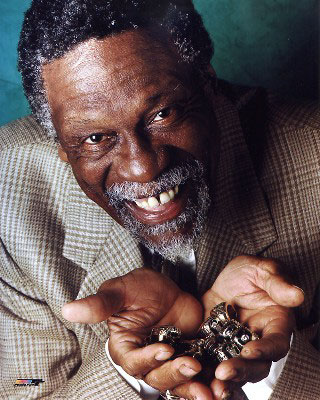
Seventeen titles. Keep smiling, Mr. Russell.

AAFQ036~Bill-Russell-Photofile-Posters

Labels:

6.14.2008

Paul Pierce Is The Motherfucking Truth

So said Shaquille O'Neal.

(So say we all.)

Pierce's career to date has been this weird mixture of respect and neglect; he's quite possibly the most ignored of the acknowledged superstars over the past ten years. This is a potentially transformative moment for him; Bill Simmons has commented a number of times that a victory in these Finals probably puts Pierce in the top 75 all time (more on that idea later) and probably elevates him to a Hall of Fame lock, as opposed to the borderline career he's strung together to date. He's already managed to transform his legacy simply by virtue of hardiness and longevity: in the Waning Jordan era, there were a number of players who emerged clearly in his mold, big physical 2/3s (remember that, back in the day, Jordan was big for a 2) who presented themselves as all-court scoring threats. None of them were exactly like Jordan (the most explicitly Jordanesque style going is Championship Dwyane Wade, who I'm not comparing in terms of skill, but in aesthetics resembled the 80s Jordan whose game was entirely based around screaming to the basket) but they all had their own spin on his legacy of dominating performances from the wing. There were a number of clear also rans - Jerry Stackhouse, Michael Finley, et al. - but four obvious elites: Kobe Bryant, Vince Carter, Tracy McGrady, and Pierce. Bryant was the troubled wunderkind, then and now the most clearly talented. I'm sidestepping the Bryant/Jordan comparisons, but in terms of offensive skill, Bryant's game is - and has been - more complete than any single era of Jordan's. 80s Jordan didn't have Kobe's jump shot, Second Threepeat Jordan didn't have his explosiveness to the hoop. Bryant's trouble - all of these guys' trouble, perhaps - is in his well documented attitude, the inability to channel Jordanesque fury and competitiveness and contempt for his lessers into a motivating personality rather than an alienating one. Vince Carter was the most physically gifted, unstoppable in his driving attack, but completely unsuited, psychologically, to the exploitation of his own gross talents, and his retreat into a dodgily motivated, injury prone, wincing also-ran has destroyed the legacy of a once promising career. McGrady is maybe the most overtly tragic, if for obscure reasons. The most compelling of these guys, for my money, when he was on, the late Ralph Wiley once wrote a wonderfully weird column in which McGrady was, via extended metaphor, turned into the Kwisatz Haderach from Dune, and he was right: McGrady was a master of the Wierding Way, understanding possibilities before they unfolded, and mystically putting himself in just the right spot to exploit the defense. McGrady's best moments came when his lazy eyes were half closed, ripping you for 35 points seemingly in his sleep, seemingly without effort, all lanky grace. McGrady's fall from this height is harder to understand than Carter's - injury prone as well (except with legitimately troubleesome back injuries, not tweaked groin after tweaked groin), but clearly troubled, depressed, gloomily talking about quitting basketball, unable to win in the playoffs.

In 2001 or 2003, Pierce probably would've been ranked the least of these four superstars. Today I think he's clearly the second, after Kobe but ahead of Carter and McGrady, brighter stars who are flaming out. Pierce's style is the least glamorous, the least commonly photogenic, but all the more captivating for me because of it: I wrote previously that one FreeDarko commenter called his game "slovenly", but another more charitably captured the same essence by name-checking Legend of Drunken Master. His game is herky jerky, stutter steps, speed changing, surprisingly earthbound for an NBA superstar. Undoubtedly this is one part of Pierce's physical durability (the other part being his previously mentioned toughness); he's not so dependent on elevation and explosiveness, more dependent on a deceptively methodical way of lurching towards the basket, trying to setup either (a) his low-elevation fadaway, or (b) a wat to get his man into an advantageous position, trapped on Pierce's hip, where he can then bully his way to the hoop or use the leverage for one of his incessant spin-moves. I dig the more accessible, human-esque, method of Pierce's game, the exploitation of more everyday qualities (his relative bulk and strength) to compensate for a lack of more overaweing gifts. If I find McGrady at his best to be magically transcendent, Pierce is the negative image of that, a relatively mundane approach to the game elevated to its highest iteration. By comparison, Vince Carter at his best was pure physical power and ability, and Kobe at his frequent best is a completely intelligible mastery of every aspect of the game; both are impressive but neither is as personally inspiring to me as McGrady's best or Pierce's.

(Aside: for reasons passing understanding, as a young boy during the beginning of the Celtics' fallow years, I rooted for the Knicks. I cannot rationally explain this, but I've decided to retcon it as a preternatural appreciation, beyond the ken of my immaturity, for Patrick Ewing's stoically workmanlike game, just endless tonnage of effort and sweat poured forth in service of basic fundamentals and a turnaround jumper. College Ewing was a fearsome freak, but Pro Ewing was just a man putting on his hardhat and going to work with the ever diminishing collection of tools he had available. No wonder Hakeem Olajuwon destroyed him [and all comers]. I probably recognize something similar between Pierce's game and Ewing's.)

Plus there's Pierce's personality (sorry for the alliteration): moody, a little arrogant, self-described as bipolar in what was presented as a joke but probably wasn't. There's something petulant about his bad side, the side that feels disrespected or unloved, but I'm drawn in recognition to, if not the specifics, the general outline of his moodiness. He can be a hard guy to like, as a fan, and - like Rasheed Wallace, like Allen Iverson - I find that attractive. Not to mention that his darker attitudes set the stage for his chest-pounding elations in hard-fought victory.

This post is long enough now, so I'll return another time to the idea of one more victory - meaning an NBA championship - magically pushing Pierce into another historical category.

Labels:

6.12.2008

Stereotypes

I just drunk dialed my DAD. To discuss a sporting event. This is, almost certainly, the clearest evidence to date that I am an American with a Y chromosome.

GO CELTICS.

Labels: ,

6.09.2008

What I Saw

Two games that I was excited by but walked away feeling like the Celtics got lucky wins. The fourth quarter of Game 2 was the Lakers' best stretch of basketball so far in the series, and they made a 24-point deficit evaporate like ... something wet evaporating someplace dry and hot.

There's been a lot of whining about the free-throw disparity in Game 2, and I fully admit that, especially in the first half, the Celtics were the recipients of some bogus calls. The idea that the game was fixed in any purposeful way is horseshit, though, as can easily be seen by some of the incredibly egregious calls that the Lakers got in the second half: Vladimir Radmanovic taking four or five steps on a breakaway dunk, Lamar Odom saving a possession by bouncing the ball off of P.J. Brown's face when Brown was already on the ground and halfway out of bounds. The Lakers have had the benefit of egregious officiating in previous series, and I'm sure some bogus calls will go their way in L.A. The other thing is that the "points in the paint" stat gets shown up as misleading, because even though the Lakers did well by that traditional mark of aggressiveness, it's only a proxy measurement, and three-foot jump shots and an array of hook shots != aggressive. The Celtics went to the basket harder, period.

Also, on some other occasion I'll need to write about why I really really like watching Paul Pierce when he's on. Someone over at FreeDarko has described his game as "slovenly," which is creative and sort of on point if you're going to be as ungenerous as possible; this year, as in past years, the playoffs go a long way to reminding me why I actually kind of hate that site and don't know why I keep reading it. And it has nothing to do with the fact that they threaten to become yet another bastion of Boston haterdom, which is the sort of thing I know I shouldn't even talk about because it's like feeding the bully the attention he wants, but it's really not funny. Boston has been incredibly lucky with its sports teams in this decade, any worthwhile fan of the city's teams acknowledges that with equal parts grace and glee tempered by the scars from how bad the city's teams were in the 90s (and how bad the Patriots were for their entire existence, and the whole Red Sox thing). Everyone else is an asshole, Just Like Everywhere Else. (NB: I wouldn't go to the Staples Center to watch the telecast of Game 2 in a Celtics jersey, but Stay Classy, Los Angeles!) Rather than saying more pointlessness in that vein, anyone who thinks Pierce is some sort of a drama queen or intentionally faked his "injury" is insane. The guy went down, heard a weird noise, felt pain in his knee, and was afraid to put weight on it, which he was already doing by the time he arrived at the locker room. I presume he got carried out (instead of one-leg-limping) because his teammates were feeling overprotective. He is guilty of the standard athlete's genuflection to the Almighty in thanking God for sending him an angel to make sure everything was ok - and, all right, I kind of wouldn't be surprised if Pierce was hamming it up a bit *there* - but the guy was afraid and overreacted, minutes later realized that his knee hurt but he could play, and he came bouncing back. He neither invited nor created Willis Reed comparisons (which would be completely inappropriate anyway), and if you think he's the sort of guy who would fake an injury just to get attention and glory, why would he do it in the middle of Game 1, when his team was playing well and the stakes weren't, at the moment, particularly high? And, really, I shouldn't read comments on sports blogs because they are the work of the Devil's dullwitted brother in law, but all the comments like "Pierce went down crying because of all the sand in his vagina" are pretty (offensive, but additionally) silly when directed towards a guy who started all 82 games of the 2000-2001 season, which began less than two months after he had LUNG SURGERY to SAVE HIS LIFE AND REPAIR DAMAGE after being STABBED IN THE FACE AND NECK AND BACK ELEVEN TIMES. (He's also played on after getting a tooth knocked out mid-game, but the stabbing is usually a good trump card.)

Well, there's enough of the defensiveness. I think the Lakers learned a lot about what can be effective against Boston in the fourth quarter last night, and they're going home for three straight games (BULLSHIT), but the primary reasons they're down 0-2 should be as much cause for concern to them as Boston should be concerned that they could have won both these games easily but didn't: their frontline gives away a ton to Boston in terms of bulk and aggression, they haven't figured out a way to get Kobe his points in an efficient manner*, and they haven't devised a scheme that can slow down both Pierce and Kevin Garnett, both of whom are lesser talents than Kobe but even more unguardable in this particular series** despite not pushing to capitalize on that.

* The theory is that a player like Kobe is getting his 24-30 points, no matter what, but you're better off when he scores 30 points on 30 shots than when he scores 24 points on 14 shots. (Then there are the nights when he scores 40 points on 20 shots, but.)

** Kobe is the best two way player in the league and still in my opinion a hair better than LeBron, but the Celtics scheme has been able to handle him even though he's primarily being guarded by Ray Allen, which is not the matchup most people anticipated going into the series (I, and others, presumed the Cs would tag team him with Pierce and Posey); on the other hand, Kobe is always attacking, always looking, always making an aggressive decision. KG is massively disinclined to trade on his physical prowess for more than five minutes at a time, and settles for his (very pretty and quite effective) 18 foot jump shot far too often; even when it's falling, it's the kind of passive concession he shouldn't make. because nobody on the Lakers has the strength OR the agility to keep him from powering his way to the basket. Gasol comes closest, but he's best as a weakside defender coming over to block shots, not remotely suited to the challenge of slowing down a force like Garnett. Pierce, similarly, is just an impossible physical matchup for the Lakers, because in this series he classically falls into a niche: nobody fast enough is strong enough, and nobody strong enough is fast enough. He's not greased lightning by any means, not nearly as agile as Kobe, but his array of stutters and speed changes is more than enough to embarrass the Lakers' bigger defenders, and Kobe - the most logical matchup, and one I saw more of as the series has progressed - simply isn't big enough. They're about the same height, but PIerce is listed at 25 pounds heavier and whatever the truth of the listings it's obvious from looking at them that he's simply heavier and, in the way the matters for basketball, stronger. That his mini-rivalry with LeBron has seen some of his best work is the more impressive because LeBron's much better suited to slowing down Pierce's "big butt and free throws" style of dominance; Kobe's pretty much helpless trying to stop a Paul Pierce postup by himself.

Labels:

6.03.2008

The Busy-ness

So I'm trying not to let blogging become like all my other hobbies and avocations, where I spend more time thinking about what I'd do if I had the time than I spend actually doing. But I've been exceedingly busy of late - or at the least exceedingly occupied. My company has now passed through the transitional period and has officially taken over control of its part of the contract, so there's busy-ness there. On the first day, in the call center, nobody's phones or computers worked at 8:30 in the morning, so we kind of started out way behind the eight ball. As I cheerily said later in the day, though, "the screwups today were entirely the fault of GACWTP's IT department, so we're not to blame. We didn't even have the ability to screw up!" Today was better but there's still a lot of craziness as people are finally able to figure out what works, what doesn't, what the real deal might be on certain topics, and who didn't do enough preparation (which seems to be entirely unrelated to the six weeks of transitional meetings leading up to this point).

Also, due to the transition, my dad's around, which means I'm staying out even later - out the door at 7:30 in the morning, home around 11:30 at night - because I want to spend time with him. Also, if I hang around after hours, I get two tangible benefits aside from, eventually, an hour or so of alone time with my father: a free meal and the ability to hang out with my dad, his business partner, and sometimes my immediate boss. In these sessions (aside from good dining) the metaphorical ties get loosened and I'm privy to stuff that's usually a lot more interesting and often a lot more educational than what I actually did during the work day. I couldcome home when I'm officially done with my work, but aside from wanting to spend time with my dad I do enjoy listening to and occasionally taking part in these conversations, despite the fact that I get home and wish I had more time available. (I should note that afterhours "educational" is meant in a broader sense; I'm learning [a lot] during the day about the parameters and management of the relevant program, but it's the afterhours unwinding between my dad and his partner where I learn about the specific personalities, the quirks of their business, being a supervisor/manager, and various other glimpses into human nature. Plus gossip.)

At dinner today I offered my generic observation of a particular individual that tried to contextualize a specific problem my dad and his partner had: i.e., his current behavior is part of an observed pattern that he can't, for whatever reason, publicly admit to anything less than perfect calm and control and ideal functionality. Whatever the issues with his employees or his system are behind closed doors, he can't bring them out into the open, and as a result obfuscates or just plain lies to avoid admitting that he might have a problem. I also compared it to another associate of theirs with the pithy nod that everyone has their personal flaw which needs to be managed; the other person's, discussed the previous night, is the myopic pursuit of making sure everyone knows he's very smart and incredibly knowledgable (which he is), the pursuit of which has rubbed a lot of people the wrong way and led a few to wonder if he's a bigot (which he's not). My dad was immediately interested as to what I thought his flaw was, and at dinner I demurred.

Afterwards I pointed out that: (a) I still have much less exposure to him in a professional/business/managerial context than I have to his partner; (b) that I love him; (c) that I admire him and both consciously and unconcsiously he's a powerful model for me, and I'd therefore have difficulty feeling like I could pick out a "flaw" in this sense because I'd be less likely to view it as a flaw, since it's probably also a big part of my personality. I'm intensely self critical, but most of my self criticism is counterproductive and bullshit, and it avoids the truly salient aspects of my personality. A legitimate flaw is that (like many) I compensate for extreme insecurities by layering them with a confidence that borders on arrogance, but this same confidence/arrogance is going to keep me from perceiving elemental personality traits as flaws. Objectively, for example, I'm extremely confident in my intelligence, and more to the immediate point, my perceptiveness, intuition, ability to mentally cut to the core of an issue or a process, and get there faster and better than the people around me. Sometimes I'm right and sometimes I'm probably wrong and ostensibly that overconfidence could become a problem, except I'm too confident to truly doubt my own self-perceptions. I'm running in circles right now, but that's the nature of self-analysis, I suppose, especially a self-analysis as involuted and repetitive and, frankly, hateful as I've been subjecting myself to for the past ten years. Anyway, to break out of the circularity, I also pointed out that some of the things I perceive as flaws in myself are things I criticize myself for because I think, compared to the example of my father, I fall considerably short.

For example, I become extremely contemptuous of people and their behaviors extremely quickly. Not any people, and not for just any reason, but there are particular personality traits that cut right to one of the things that most bothers me about other people, and my reaction to those I (rapidly) judge as petty, small-minded, vindictive, etc., is to build up a towering edifice of disdain that borders (depending on the nature and history of the petty vindictiveness) extremely close to hatred. By comparison, my dad projects the impression that he's pretty much above it all and it's water off his back; he points out that I'm 25 and, when he was my age, he got caught up in a lot of other people's pettiness as well, and even today he can still get amped up about some small person's bullshit, but he certainly handles it a lot better than I do. I assume this is all related to my self-nominated status as the official Grudge Holder in the family. It's, between the two of us, an attested fact that at some point I basically decided that (we're skimming over a lot of deep water here) it wasn't right for my mother (and, by extension, my father) to have forgiven her mother, my grandmother, for having been a pretty horrible person, and I was therefore going to pick up the slack by disliking her for everything my mother had moved past.

[Redacted due to extreme and irrational paranoia.]

So, you know, that's probably a personality flaw.

I was hoping to write an impressionistic preview of the NBA Finals before they actually started and contaminated the integrity of my thoughts, but I've only got one more night to do it in.

Labels: , , ,

5.30.2008

It's Been A While

1959: Celtics, 4-0
1962: Celtics, 4-1
1963: Celtics, 4-2
1965: Celtics, 4-1
1966: Celtics, 4-3
1968: Celtics, 4-2
1969: Celtics, 4-3
1984: Celtics, 4-3
1985: Lakers, 4-2
1987: Lakers, 4-2
2008: ???

Unhappily, my prediction is for the Lakers to win the series 4-2, but I'd love to be wrong and I'm going to try and enjoy the ride.

[UPDATE: I WAS VERY WRONG AND I AM VERY HAPPY. I DID NOT BELIEVE BUT I SHOULD HAVE. UBUNTU! Ahem.]

In the absence of serious analysis I'll point out that the Celtics have the most titles of anyone in the league, with 16, and the Lakers are right behind them with 14, that the 1959-1966 victories actually represent a run of eight consecutive Celtics titles, which is unequalled in the history of American professional sport, that former Celtics coach/patriarch Red Auerbach and current Lakers coach Phil Jackson are tied for the most championships as a coach, with nine apiece, that the Lakers have only missed the playoffs five times and despite not having the most titles have the most finals appearances, the most total wins, and the best historical winning percentage of any NBA franchise. It should also be noted that, like cowards, they intentionally lost the Western Conference Finals in 1986 so that they wouldn't have to suffer the indignity of losing to the arguably the single best team in Celtics history.

Labels:

5.24.2008

Inclinations and Hesitations

As I begin writing this post the Boston Celtics and Detroit Pistons should be tipping off for Game Three of their Eastern Conference Finals series. As per my vow in a prior post, I haven't watched any of the games so far nor will I do so unless the Celtics win a road game, and thanks to the Pistons' victory in Game Two the Cs have to win at least one road game in this series if they want to advance to the NBA Finals. In any case, the series features two of the more intriguing NBA personalities of the last decade, two players who've caught my attention since I'm always on the lookout for that strange animal, the incredibly successful underachiever.

Rasheed Wallace has long been one of my favorite players in the league, but he's also one of the most disappointing - as disappointing as the most talented and important player on a championship team can be, by the unfair standards to which we hold our athletic heroes. Most suited to the 4-spot, able to log extended minutes at the 3 or the 5, Sheed has all the skills necessary to be one of the greatest bigs of all time, especially one of the greatest non-center bigs. He's not close, a borderline Hall of Famer at best. There's nobody in the league who's better at man defense on an opposing big (when the overrated Ben Wallace was his teammate and getting consideration as the Defensive Player of the Year, it was usually Sheed's job to guard the superior big man on the other team, letting Ben sag off of his man and play free agent help defense). He's also a skilled help defender and a highly intelligent one; stories from the year that Sheed joined the Pistons mid-season (and went on to win the title) have him vocally anchoring the defense by calling out the proper rotations and identifying the other team's plays. On the other end he has effective range out to the three point line to go with a strong post-game - not fabulous, but good enough because it features one unstoppable weapon, the Rasheed Wallace fadeaway turnaround jumper. The release point on the ball is somewhere around nine feet in the air falling away from you, and when it flies true it's one of (in my opinion) the prettiest shots in basketball, as well as being essentially unguardable. There's no athletic or skill-based reason why Rasheed shouldn't put up 25 points and 12 rebounds every night.

And yet - his career stats are 15 and 7, and this season he tossed up 12.7 and 6.6. Fundamentally, Rasheed Wallace shies away from being the focal point. He's happy being the most talented cog in a machine that doesn't rely on him to flex his talents. He floats out on the three point line, away from the heat of the action, and goes through long periods where he seems disengaged from the game (on offense, at least). He's capable of taking over the game and asserting himself as the most gifted and skilled player on his team (often on the floor) whenever he wants, but he rarely wants it. According to a Jemele Hill in a recent podcast with Bill Simmons, this is essentially what Wallace is like in his off-court life as well: capable of being engaging and charming but disinclined to be the center of attention, which is how Hill explains his well documented moodiness in the face of stories about his various charities, what a great teammate he is, and so forth. Wallace has every skill, but his personality won't let him dominate.

The other great underachiever (or so we think) in this series is Kevin Garnett, widely acclaimed as one of the great players of the modern era and generally presumed to be a first ballot Hall of Famer. Garnett is, physically, even more gifted - with length, speed, explosiveness - than Wallace, and has the same apparent intelligence in his game. And unlike Wallace, Garnett is always trying as hard as he can. He's an unselfish player, and there are times when he shrinks from the ball (which we'll come to), but he's giving maximal effort all the time.

And yet - he's not nearly as good as he should be, and I'll insist this to the grave. With his physical abilities and knowledge of the game he should (also) be the greatest 4 of all time (and can also spend extended minutes at the 3 or the 5), but I don't think he's nearly maximalized his skillset in the way that Wallace has. Garnett is, in my opinion, a superior help defender (his fiery intensity and physical explosiveness are key advantages over Wallace in this regard) but a couple of shades off Wallace as a man defender. The clear deficiency is that he doesn't nearly have the complement of skills Sheed has on the offensive end, despite being a better ballhandler, just as long, and much quicker. His range isn't as strong as Wallace's, but Garnett is deadly out to 18 feet. It's in the post game that he lacks; whereas Wallace uses a rich arsenal of moves and goes to the fadeaway as his trump card, Garnett has a limited set of moves and uses his turnaround as a bailout weapon. When Garnett should dropstep and juke his way into a layup, he surrenders positions and fades from the basket. And he used to work for Kevin McHale, who had the greatest set of post moves in basketball history. Something is weird there.

(Actually, my pet theory is that the fledgling and poorly managed Minnesota Timberwolves didn't know what to do with him and wrecked him by abusing his versatility. Garnett was capable of doing so many things for that team and they absolutely called on him to do every single one of them: be the best post defender, be the lead on-the-ball defender in Flip Saunders' zone, be the primary scoring option around the basket, be the best jump shooter, be the guy who runs the offense...he was never given the opportunity to focus his skillset and develop it in a particular direction; he could have been the evolutionary Kevin McHale or the evolutionary Scottie Pippen, and he kind of came out as two-thirds one and one-third the other, except not clearly better than either [in my opinion; I imagine many would disagree].)

The more common knock on Garnett is that he shies away from The Moment and doesn't have the desire (or the reproductive glands) to take the big shot, or take over in crunch time and score on five straight posessions. This article by Simmons generously suggests that part of the reason is that Garnett has never really had the opportunity to learn how to handle himself in the moments of greatest pressure. Playing on those crappy Minnesota teams, he didn't have the opportunity to make season-defining plays because the Timberwolves just weren't going to be in those situations anyway. Tim Duncan won a title in his second year, and rookie Kobe was airballing huge shots in the playoffs, a key part of the learning curve to make him one of the great clutch players of all time. Garnett, Simmons points out elsewhere, also plays all-out all the time, whereas most NBA players have learned that the grind of an 82 game season plus playoffs is too tiring and they must necessarily conserve their energy until the games (or quarters) when it really matters. Rasheed Wallace playing to the peak of his abilities might be a better player than Kevin Garnett, but it's hard to say because Wallace only plays at his peak for two or three minute stretches; Garnett seems to fall short because he has nowhere to elevate to. We see the best of Garnett for 38 minutes or so a night, every night.

(Yes, I think there's such a thing as clutch. And, to be honest, I don't think it's a rising to the occasion nearly as much as it is the mental fortitude to not shrink from the occasion.)

There is something Wallace-ish, though, in that I feel like Garnett is disinclined to take the winning shot; he wants to not take the losing shot more than he wants to take the winning one. Part of his maniacal effort is wrapped up (like Wallace's apparent distaste for the spotlight) in a somewhat idealistic manifestation of basketball as a Team game (where Garnett derived this I don't know, but Wallace learned it from Dean Smith at UNC). Garnett is aggressively looking for the open man, just as he aggressively looks for the offensive board, and like his unflagging effort this stays constant from the first minute to the last. This is why if the Celtics win a title with this team I bet the Finals MVP will be (will have to be) Paul Pierce, who isn't nearly as talented but, when he flips the "go to the basket" switch, has the confidence and attitude to take matters into his own hands.

Just because it's floated into my head, there's some vague similarity here to George Benson. People can dispute whether George Benson is the greatest jazz guitarist of all time (he's not nearly my favorite, but I think he probably is the best) but he absolutely should be. By modern standards, his technical chops are frightening, but by the standards of the time he hit the scene Benson was untouchable, his phrasing and time are impeccable and (rarely for a jazz guitarist) he swings as hard as the greatest horn players, his harmonic imagination is probably the least part of his playing but still strong, and his melodic improvisations are accessible (when they're not blazing by so quickly that all the ear registers is a blur). If he's not the greatest jazz guitarist, it's a technical disqualification for having such a limited career (sort of how Bill Walton should have been one of the greatest centers of all time but needs to drop several spots down the list because injuries kept his career from bearing out the breadth of his talent). Benson turned, fairly early, to singing (actually, he was a singer before he focused on the guitar) and drifted into very lucrative and popular smooth jazz/r&b, and has been disinclined to play jazz on record (he still shows up as a guest on other people's bandstands) ever since. His jazz abilities are still important to him, because Benson has talked about sharing the stage with McCoy Tyner and freaking out because he'd let his jazz chops get so rusty, and ever since he's made a point of practicing and playing enough straight jazz to be able to dominate anywhere, anytime. But he doesn't make the records, and doesn't appear to want to. I don't begrudge him his aesthetic choices over the years - if he likes the music he makes then he likes it, and he should keep doing it - and if he's focused on the smooth stuff to make a bunch of money, I respect that without question, but: he's got lots of money now! And it's not as though he needs to exclusively do one thing or the other; there's no reason he can't record an album of jazz standards and then turnaround and tour on "Breezin'", and we know he still cares about jazz because of the aforementioned chops-maintenance, not to mention his eagerness to get on stage with current jazz greats to begin with...I don't get it. He has all the ability in the world, but he seems to have no interest in putting it out there for our enjoyment. I don't want to say that it's selfish, because the music is his to do with what he wants, but I find it perplexing to say the least.

Huh. A quick check online shows Boston up 18 at the half.

Labels: ,

5.18.2008

Doc Rivers, I Will Sell You A Clue

It's a commonplace of people reflecting on the nature of territorial sports fandom (i.e., rooting continually for the same team, rather than FreeDarkoesque "liberated fandom") that the pain of losing is greater than the joy of winning. Additionally, the greater the expectations, the harder the comedown; if you never expected to make it to the title game, losing isn't as painful. Surely that's a lesson reinforced for fans of Boston sports in the wake of the Superbowl this year; of course I'm happy the Pats had a great season until their last game, and I wouldn't trade those first 18 games for a middling season of fulfilled but low expectations. But the loss still hurt the more for all the buildup that went into it.

The Celtics' season, though pretty damn impressive, wasn't on the level of the Pats' run at an undefeated year, but those 66 wins look pretty hollow. This has been a weird playoffs anyway, what with the widespread dominance of the home team in any given game, but the Celtics in particular seem so pathetic in their split-personality, winning handily at home and looking like a lottery team on the road. It's bizarre how discombobulated they become outside the Garden, and watching Kevin Garnett fulfill every low expectation I ever had of him as well as watching Pierce retreat into his worst impulses is pretty depressing. And Good Lord is Doc Rivers a bad coach. Really bad. Like, the people who think coaching doesn't really matter in basketball because all you need to do is fire up the players and manage the rotations and call timeouts have to recognize that he's a bad coach because he...can't seem to fire up the players in any effective way, and he can't manage the game and he CANNOT manage his rotation. I'm not watching another Celtics game until/unless they win one on the road; I'm just tired of it right now. I have an intellectual curiosity in the potential Spurs/Lakers matchup, but my basketball malaise has corrupted enthusiasm, and I wouldn't watch it; I would watch Hornets/Lakers, and (Celtics aside) I'd watch either the Hornets or the Lakers take on the Pistons.

Oh, fuck it: I'll watch a Spurs/Detroit finals too, because I'm always up to see Tim Duncan vs. Rasheed Wallace.

Labels:

5.13.2008

Memo to The Boston Celtics:

WIN A DAMN ROAD GAME.

For serious.

To be fair, due to scheduling and the minor obstacle of not having my own personal television set, I'm not seeing enough of these games to have a developed and intelligent opinion; for that I'm reliant on the pieces that I do watch being augmented by the collective wisdom of these here interwebs. But my gut and my pre-existing prejudices tell me that

(1) Doc Rivers really isn't a good coach. It might not be fair to lay this on him, but the guy can't manage his rotation and can't effectively micromanage specific in-game situations when they arise and beg for occasional micromanaging.

(2) Kevin Garnett is what he is and what he is not is a crunch-time go-to guy, whether crunch time be "the last two minutes" or "near-must-win Game 4 on the road".

It must be said that I'm a longtime Garnett skeptic; he's one of the most talented guys in the league, but I don't think he's remotely as good as he could or should be despite his also clearly being one of the best guys in the league. That he's disappointing me in a way I could've predicted six months ago - I'm not sure whether that reflects more on him or me. (Conversely, Objectivity notes that I'm in the tank for Paul Pierce. He's my favorite player on this team and while I'm not blind to his several flaws I'm more forgiving of them. I thought I'd write a bit more about why and what I like about Pierce and my mild irrationality when it comes to his career, but it'll have to wait for some other time.)

I did like, from the AP/espn.com recap, this: "When Garnett dropped his first jumper, former Celtics player and current broadcaster Cedric 'Cornbread' Maxwell removed his headphones, rose out of his seat and screamed, 'Get down in the box,' toward the floor below." Also, the recap describes a moment where Paul Pierce intentionally fouled LeBron James to stop him from dunking and their momentum carried them into the stands and onto LeBron's mother. Now, I should've snagged this last night when I could, but the original recap said something along the lines of: "Gloria James tried to pull [or hold, or something] Pierce while her son yelled at her to sit back down," whereas that's been scrubbed for: "The players' momentum carried them into a crowded front row, where Gloria James told Pierce to leave her baby alone.
'I told her to sit down, in some language I shouldn't have used,' James said. 'Thank God today wasn't Mother's Day. All I could think about is her. ... I know my mother. It's fine, we're good.'"

Look, I know LeBron is the best player in this series, and in my estimation it's not particularly close. And the Cavs had one of the best defenses in the league, and they have some guys who can make some shots, and the Detroit Pistons are actually the only team to win a road game so far in the second round. But the Celtics had THE best defense in the league, one of the best defenses of the post-ABA merger era, are the only team left in the playoffs that hasn't won a road game at all despite being the best road team in the regular season, have four of the five best players in the series not named LeBron, and UGH. At the beginning of the season I thought this team would need time to gel and learn together and predicted that they'd make to to about the second round and no further, but at the time I didn't think they were going to win 66 games, either; a second round exit at this point would be a serious disappointment, and I can't psych myself into thinking otherwise. The series isn't over, but I don't like what's going on AT ALL.

Sigh.

Labels: