10.02.2009

Cause I Know All None Of You Are Dying To Read My Thoughts

Trying to get right to the point and glide past my longer than normally long absence from blogging:

What I find distressing about all I've read of the pundit-driven* commentary against Roman Polanski's potential extradition is that those few voices that aren't primarily focused on the difficult task of being as morally contemptible as possible (I AM LOOKING AT YOU ANNE APPELBAUM) are gesturing in the direction of a reasonable argument but completely missing the seriousness (and thereby failing to make their point) of what their comment implies.

This is the argument, more or less, that it's been a long time, he's an old man, he hasn't repeated his crime, Samantha Geimer has said she doesn't want him subject to legal action, and there's accordingly no purpose served by bothering to prosecute him. (Might as well note that while it's true that so far as we know, he hasn't raped - in the violent coercive sense of his victim's testimony - anyone else, it's not true that he hasn't committed what in the United States would have been and is statutory rape - the crime he pled to - because he carried on a relationship with a fifteen year old Nastassja Kinski, which may have been consensual on its face but under the precepts of American law could not by legal definition have been consensual.) There are two interesting prongs of legal-philosophical argument here that are, to put it charitably, underdeveloped, and perhaps in conflict.

Taking first the victim's wishes, the fact of the matter is that under American law this doesn't mean a damn thing. In practice we are of course reminded of many cases where at the urging of the victim in a crime like, say, domestic abuse, the state declines to file charges (but in part this is because the victim herself would be an uncooperative witness), and the pleadings of a victim's family have certainly swayed decisions (prosecutorial and judicial) about sentencing. These are instances, though, where our criminal justice system is for better or worse (in my opinion, just to get the cards out, worse) bending away from its stated purpose both in philosophical underpinning and statutory fact. The criminal system doesn't work on behalf of, or for the benefit of, the victim (that's what the civil court system is for). My bullshit half-knowledgeable half-conjectural take on this fact is that it stems, at root, in early Germanic/Anglo-Saxon law, and the weregild concept. That society had a long history of violent retribution leading to endless bloody cycles of revenge which were ultimately detrimental to the health of the society as a collective, so blood revenge was replaced by the progressive (for then!) and repugnant (for now!) concept of the blood-price, or weregild (literally the man-money, or more properly man-payment, man-debt). Your station in society determined your worth; in essence, there was a kind of inverse price on your head at all times, which was the amount your potential killer would owe your family if he in fact killed you. This is in some sense still the system we have in the modern civil proceedings of wrongful death suits, but without the creepy actuarial tables detailing the relative worth of men, women, slaves, etc. It's also, in the criminal legal context, a first step in realizing that allowing the victims to drive punitive action instead of the state was harmful to the state (I mean, a murdered slave might be atoned for with gold, but in practice the family of a murdered man didn't usually want the weregild, they wanted to murder the killer and his family, which is probably also still true for many/most people today). By the time we get to the present, we have a long established Anglo-American legal system which prosecutes criminals not on behalf of the victim but explicitly on behalf of the state, and which does not, in its official capacity, recognize the desires or needs (such as they are) of a victim('s family), because the state is concerned with the offense against society at large and against the state's own authority, which would be equally offended by allowing the victims to pursue common revenge.

In practice, our legal rhetoric is still heavily veined with pleas about getting justice for the victims and their families, but this is contrary to the letter and spirit of our legal system, a common example of the common phenomenon whereby human instinct strains against the civilizing bounds of human intellectual theory. And of course I've been writing about circumstances where the victim desires to see her assailant punished, when the case in front of us is a case where she desires, more or less, to not see that. This is just simple consistency, though; you can't have a fair legal system which accommodates a victim's request for lenience but disregards her request for vengeance. In our system as currently assembled, Samantha Geimer's wishes simply aren't supposed to matter from the state's perspective. There are two ways in which you could argue that they should matter: the less ambitious one is further from the folk-concept of justice under consideration, but can be integrated into the OTHER prong of arguing that Polanski should be let alone; the more ambitious implies a complete reordering of our legal system's precepts which hopefully would not lead us back to the days of blood feuds but which would prize the victim's sense of justice over the state's authority, or at least try and place them into more equal balance. I don't think you can go very far in this direction without leading to the kind of personalization of retribution which modern society would find deeply unnerving and which would also severely degrade the integrity of the state: the foundation of our criminal system is the principle that the state has a monopoly on the just and authorized use of violence (in a broadly construed sense of the word, which incorporates incarceration, asset seizure, etc.), and to hand our legal system over to the desires of victims would be to make state-authorized violence into an instrument of the individual citizen and ultimately corrupt the whole concept.

The other way to go is perhaps less intuitive but more interesting and maybe more feasible. Here we retain the primacy of the state's self-concern for its monopoly on violence, but compromise or reorder the details of how it executes the protection of that right. Right now the system is set up in principle to be, well, defensive of the principle. People break the law and they are punished. What could happen is to reimagine the criminal justice system as one which philosophically and statutorily promotes the kind of compromises prosecutors reach in the everyday application of the statute to real cases; the recognition that there are mitigating circumstances not explicitly provided for in the law and the somewhat crass (to an idealist) recognition that some cases are not worth trying because of the fiscal cost to the state or the possibility of an unwelcome jury verdict, hence plea bargains where the accused stipulates his guilt regarding a lesser crime in exchange for lenient sentencing. This is a pragmatic approach to the judicial system, but inconsistently so (is it really worth going after all those harmless pot smokers? - of course not, but we do it so often anyway). An overall pragmatic overhaul of our legal structure would require rewriting and reinterpreting the penal code and its associated sentencing rules, but would also necessarily empower prosecutors and justices to balance their estimation of how important it is to punish a particular instance of a crime against the overall rule. This would make Kant's head explode (not in and of itself a bad thing!); it would also make relevant the victim's wishes, which would be a good thing - borderline instances of statutory rape which are in fact legitimate "Romeo and Juliet" cases that happen to fall directly outside the arbitrary bright lines of the law would be let go, e.g. Samantha Geimer's desire for Polanski to be left alone doesn't stem from that place, though - it stems from the understandable but self-interested desire to be left alone and allowed to live an anonymous life without reading her name in the paper always connected with a traumatic violation. The agents of the state could weigh her interests against the potential threat Polanski poses to society at large, decide that he poses no such threat, and let be. But to be able to do that inside of a just and coherent legal system would require not simply looking at the somewhat exceptional circumstances of this case and making such a judgment, but would require recreating the state's interpretation of its own self-interest in pragmatic rather than idealistic terms. (I think this would be a bad thing on balance, because it would ultimately enhance the different enforcement of the law in different jurisdictions, such that in one locale a man who avenged his family's death [always back to the blood feud and the blood price!] would be let go and in another he would be guilty of murder; you can't be pragmatic and have hard-and-fast guideline at the same time. But it wouldn't be the kind of catastrophic method of arranging the legal system that I believe prioritizing the needs and desires of the victim would be.)

But needless to say, nobody's saying any of this about Polanski; they're just gesturing at the idea that he ought to be left alone because ... well, because. Of course, even in a pragmatic system the state still needs to be vigilant about protecting the integrity of its authority, and in this case Polanski is once again rightly doomed; he's not merely a criminal for the initial rape but a criminal for being a fugitive from justice. He's committed a crime that comes closer than any other to literally violating the state's authority, because he willfully evaded punishment, and a system that allows people to regularly do that is not a system with longevity. Of course, we could just this once make an exception because Polanski is so old and his crime was so long ago, but...

Oh, but in a pragmatic legal system the axe swings the other way. Letting Polanski go breeds cynicism that the law does not apply to the wealthy and famous (whether or not that's why he's hypothetically let go), which ultimately corrodes the state's authority. Making an example of him (justly or not) promotes the impression that the state applies the law equally to all, no matter their station, which strengthens the state's authority. Pragmatically, it's worth it to be less than normally lenient in certain circumstances in order to prove that no one is allowed to evade justice forever. So you've got that to ponder.

Or you could just say that Polanski is a fugitive who justly needs to face his crimes in the legal system that initially set out to try him, because as it turns out our theoretically inflexible, practically flexible (for good and bad) system is actually pretty good when weighed against the alternatives set out above (do you really want to live in a system that incentivizes the state to make an example of people?) and that being inflexible about its principles is generally the right way to go. ESPECIALLY WHEN THE GUY IN QUESTION IS A FUCKING CHILD RAPIST.

Ahem.

* The other anti-extradition commentary is what I'd call Hollywood-driven, in which all right-thinking people swallow a little uncomfortably as their favorite SoCal creative types seem to reveal themselves as, well, the sort of people I described in the prior paragraph. This isn't really so surprising, though. If a good friend of mine were accused of a crime like Polanski's, I'm not sure how I'd react, and if a good friend of mine were in the position I believe Polanski is in - guilty (of more than he pled to), a long-time fugitive from justice, very old and far removed from the time of his crime - I can't promise that I wouldn't say something unfortunate myself (or at least keep my mouth shut and not say what I probably should). Now, not everybody in Hollywood is a friend of Polanski's, of course. But he's widely (and, for his work, deservedly) admired to a considerable degree, and not at the kind of remove that I admire Chinatown and Rosemary's Baby, but with the special intensity reserved for the heroes of your own craft, profession, and love. Plus not everyone in Hollywood is personally associated with Polanski, but I'd be surprised if, taking the set of "people I've heard of in Hollywood" you could get more than three or four degrees of separation from someone who was professionally or personally friendly with Polanski. So basically they're acting like ignorant members of the same social circle, which is unfortunate but totally predictable in any given social circle; these just happen to be famous people.

Labels: , ,

4.12.2009

Fucking Eostre

EVERYTHING is closed on Easter. Shit. I guess we're not quite a godless nation yet. I'll have to get to work on that.

Eostre (or Eostra) herself may be a fabrication of the Venerable Bede, but umpteen cultures had spring festivals of rejuvenation (hello, May Day! let's dance around the spring pole and then fuck ourselves silly!) because that's what you do at the end of a long winter so bad that you're obliged to have a midwinter festival in the middle of it where everybody lights candles and celebrates the promise and hope of a spring to come lest everybody just kill themselves. These things are all part of a cycle. So naturally Christians had to get in on that springtime festival action because the major signposts of European religious experience are predictably similar across cultures and if you didn't provide a Christian method of celebrating those natural cycles you'd have people dancing around the maypole and fucking themselves silly in the spring and sacrificing bulls to Mithras in the winter and whatever it is they were wont to do depending on where they were from and what stories their grandmammies told them.

Funnily enough, though I'm not cogent enough to try and resurrect the amateur religious studies scholar of my early adolescence, I recall that actually it's believed that the early traditions of Jesus' birth place it in the spring, which suggests that if it hadn't been moved to midwinter in the first place Easter - well, the resurrection celebration in the springtime - wouldn't have been necessary for papering-over-purposes (unless the same early tradition also puts the crucifixion in the spring, which would make sense what with the rebirthing and all). I'd like to re-look into all of this someday.

Labels:

4.11.2009

Yeah I Got Links

In general I'm the sort of person who is simultaneously flabbergasted by women who remain in abusive relationships but also who thinks endlessly interrogating them as to why they don't/didn't leave (sooner) is unlikely to be productive or helpful to the woman abused, because I don't think rationality plays into it very much, and I also believe that as the abuse goes on for longer periods of time, psychological conditioning subverts what other people would consider to be normal reasonable behavior and response to that kind of treatment.

Anyway, I found this, from the estimable Hilzoy, to be an excellent consideration of a difficult topic. (So did, apparently, everyone else in the blogosphere.)

In less serious territory, I'm going to humbly suggest that you check out - I will provide the links at the end - the most recent week of Penny Arcade, the online comic that's ostensibly "about" gaming. Despite being roughly a decade out of date with their supposed subject matter (they deviate a *lot*, and the jokes are almost always gettable even if you're not a gamer, I think), I usually love this strip, because I have an affinity for their sense of humor and I also enjoy the writing style of Tycho, the writing-alter-ego of the comic's creative duo. However, one of the most interesting things about Penny Arcade is the evolution of the art, provided by Gabe. The first strip, from (wow) over ten years ago, looks like this. (It also isn't really funny.) A few years later it looked like this. (I'm not selling you on the funniness of the strip, I know; it's gotten better writing-wise as well. I picked this one because I stumbled across it accidentally and it conveniently introduced the Cardboard Tube, which will be relevant later.) Which eventually evolved into this, which is more or less what it looks like today. Except for when they take advantage of Gabe's vastly improved artistic skills to deviate from their normal format and stretch their legs and do things like:

This, and

This. That's from the middle of one of the adventures of the Cardboard Tube Samurai, which is a silly joke they've used to present some surprisingly lovely art and elliptical storytelling. Which brings us to:

(And, yeah, I'm aware that I'm lavishing many more words on a webcomic than I am on domestic abuse.)

The most recent three-part tale of the Carboard Tube Samurai, which is like the one I linked above completely wordless but offers up an unexpected punch at the end. As Tycho said in the accompanying blog post, it's apparently about fatherhood. Shit.

Part One
Part Two
Part Three

So.

Labels: , ,

4.05.2009

Closer Than We Remember

One of the women I work with - about the same age as my boss, which is to say old enough to have been a teenager during Jim Crow - told me that she has two signs she acquired (I'm not sure where) in her house, one in the living room and one in the kitchen, which say "Colored Only". She says people, including her own kids, always ask her why she has those signs; I didn't need to ask (apparently her mind and mine are more in sync than I would've guessed) but she told me: "I won't forget. We can't forget." Given the unfathomable wickedness to which black people in America were subjected in living memory of millions of people alive today, I can't comprehend how fatuous some (white) people (and often by people I mean "fuckwits who are more or less in the media") are when they say things like "slavery ended almost 150 years ago". Yeah, but the Tuskegee experiment only ended 37 years ago.

Random fact to lighten the mood: Laurence Fishburne starred both in the 1997 HBO film Miss Evers' Boys (about the Tuskegee experiments) and the 1995 HBO film The Tuskegee Airmen (about the Tuskegee airmen).

Labels: ,

3.31.2009

If By Blind You Mean I'm Going To Look When Your Back Is Turned

This is interesting, but mostly because I always assumed that the colleges I applied to, most (if not all - I can't remember) of them claiming to be "need blind" were in fact just lying to us and in fact were quite cognizant of how student finances were shaking out. The idea that Chicago at no point, ever, in the process of deciding to accept me, was even aware that my family could afford to not have financial aid, just didn't - and doesn't - seem plausible to me.

More serious thoughts on education and class potentially forthcoming but you'd do well not to hold your breath, if you like that whole "breathing" thing.

Labels: ,

3.25.2009

Thing #71 I Don't Understand About Our Gender Politics

There's a lot more that I could (and someday perhaps will) say on this topic, but in brief: by the standards of the definition of "manliness" implicit in the idea of the fucking Combos people rating the "manliness" of various cities by metrics that apparently involve NASCAR, hunting, particular attitudes about appropriate attire and grooming, and whatever else you want to lump into the standard definition of nonelite American machismo:

I'm going to keep using colons:

How on earth is it remotely manly for a man to be concerned with what other men think about the level of his manliness? And how on earth is it remotely manly for a man to be concerned with judging the manliness of other men?

This is the sort of thing that I completely understand in one sense (our gender politics make no sense and appear primarily designed to make us anxious by dint of trying to live up to unresolvable contradictions, so it's par for the course) and completely don't understand in another, more immediately relevant sense. If some dude actually questioned my manliness (NB: I think this is highly unlikely for a variety of reasons) because of my drink order or my pink tie or my interest in some forms of art and sport vs. other forms of art and sport, my response would be: "Why the fuck do you care? Why are you spending your attention and energy worrying about strange men?"

I mean, really? Worrying about the guyness level of other guys? What, precisely, is it that you're trying to tell me, again?

Labels:

3.17.2009

Sláinte Mhaith, As A Matter Of Fact.

Not that I think it should actually do anything to change the cultural meaning of the day, but I always enjoy pointing out that St. Patrick was actually Romano-British (from the area around Carlisle), captured as a teenager and enslaved by Irish raiders.

That said, I must as ever offer up my kudos to Irish Americans, who've done a really astounding and admirable job of overcoming the intensely bigoted attitudes against which they struggled for the better part of a hundred years in trying to make their way in this country. On the one hand, the overwhelming cultural similarity to the English (and English-descended Americans) should have made this a smooth and simple process, but on the other hand, that fact that the English (and English-descended Americans) hated the Irish more than anybody else did kind of overwhelmed the mutual love of beer for a few decades.

The Italians, of course, have done pretty well in getting accepted by the American mainstream themselves, but lots of Italian things are marked ITALIAN in a way that's more decidedly foreign - dusky, scented with olive oil - than those things marked Irish. Italians had a language barrier to overcome, sure, but on the other hand they were bringing much better food to the dinner table. I think the superior integration of the Irish into the American mainstream demonstrates the advantage of having drunken vaguely Catholic parades which are fueled by beer and images of four leaf clover, instead of drunken vaguely Catholic parades which are fueled by wine and images of the Virgin Mary, weeping.

So even though I tend to ignore the day as much as possible, I say to you: Sláinte.

Of great note: for the first time since I was maybe fourteen, nobody called me out for not wearing green. There's always somebody, and usually multiple people, who will be wherever I am during the day and who will also chastise me for not being sufficiently verdant. On absolutely no evidence, I'm going to use this data to generate a new stereotype: Black people don't give a shit about St. Patrick's Day.

Labels: ,

1.24.2009

What You Think You Know...You Don't Know

One of my college roommates was a huge fan of Alias and in turn he made me into a huge fan of Alias, and the title of this post was one of our favorite lines. This is not a post about Alias.

Now that The Wire is gone from TV, it's pretty commonplace to say that Battlestar Galactica is the most politically relevant show going. Even when The Wire was on, there were many who would say that, and I'd be one of them.* This is not a post especially about the ways in which Battlestar is politically relevant, but rather about how I think it treats of one universally important idea.

*(The Wire's political concerns were as immediately relevant to the 90s as they were to the 00s, and the series drew heavily from David Simon's reporting on the police beat c. twenty years ago. Baltimore on The Wire was at least as much the Baltimore of the late 80s and early 90s as it was the Baltimore of today and also an Every City standing in for Cleveland, Pittsburgh, Newark, Gary, St. Louis, etc. The Wire's political social relevance exists on a much longer timescale than the Bush administration, and really covers everything from the 60s into an unknown future; it's not, thematically, a show that's grounded in the time it was made. Battlestar's political/social questions are going to be worth consideration at any historical moment, but they particularly resonate with the last seven years; there are basically no Americans who are worried about the ethical status of torture or the proper way to think about violent resistance movements who were equally concerned about those topics ten years ago.)

We are, essentially, fundamentally ignorant, of the world around us and of the people we interact with and, maybe most damningly, of ourselves, and this ignorance binds us into blindly held ideological stances we can't see our way out of. One of my perpetual bete noirs is "the idiot plot" - classically, a story which is only made possible by the characters behaving like idiots. This is extremely common on sitcoms; the other day I happened across a Friends rerun in which 90% of the plot was generated by the consequences of Chandler not wanting to admit to Joey that he wrecked one of their recliners, and of course this only makes things worse, or if you will, hilarity ensues. If you think about the sitcom as a genre, you'll realize how much of what we see onscreen relies on one character not sharing information with somebody else for no good and understandable human reason. What bothers me more is when similar things happen in dramas, but what I find incredibly frustrating as a viewer is when a character is simply ignorant for no good reason, and the plot relies on the consequences of his ignorance. This is maybe a failing of mine as a viewer: I find the experience of watching something like this so violently frustrating on a personal level that it disrupts my enjoyment unless that ignorance is elevated to a thematic level.

In the last two years especially Battlestar has absolutely expanded on and expounded on the consequences of ignorance - wholly understandably and justifiable ignorance, no less - both of self and of other. Tonight's episode of the show was entirely about people being ignorant (well, and one example of Adama being very clever, but).

If you step back a few episodes, to the last episode before the long hiatus, the humans and the cylons are engaged in what was, frankly, a ridiculous standoff. D'Anna looked the most ridiculous because she had the most reason, since she'd been out of action for at least six months of in-show continuity-time. She instantly took command of the situation despite being the least caught up of anybody on the status quo. Her justification for the ridiculous standoff was that "The humans will never forgive us for what we did to the twelve colonies." This is actually perfectly logical, and maybe accurate, but the level of her self-absorption is so extreme (and realistic) that it doesn't occur to her that this is actually reasonable of the humans - why should they forgive an attempted (and almost successful) genocide? She also says, "we attempted cooperation on New Caprica, and it failed" - in what frakked up universe can she believe that New Caprica was a cooperation? It was an occupation, by force, and D'Anna's blinders almost led to further catastrophe and possibly the completion of that genocide. She can see that she can't trust humans, but she can't see the human position or understand that she could actually be wrong. She's trapped by her ignorance, and it makes her worse. She has to know that by spacing one hostage every fifteen minutes until the "Final Five Minus One" are released into her custody she's doing something abominable, because she has to know that the humans don't have any control over what the F5-1 do, since she has to know that the don't know who the hell they are. She's pretending to negotiate while actually trying to goad the F5-1 into revealing themselves in the way most convenient to her, all without actually being able to project how the F5-1 might feel about the situation - this capable, intelligent woman is actually surprised that Saul Frakking Tigh would expose himself to the people he loves rather than give in to her demands?

And (applicable both to that episode and to this one) the humans. Good lord. Tory, who I think had the least reasonable response to finding out that she was a cylon, said the smartest thing when she asked Roslin to consider that if she didn't know Tory was a cylon, she ought to wonder what other things she'd been wrong about. This is a question everybody should ask themselves on this show. The funny thing about the last two years especially, when (I think to the show's detriment) the "secret"/"mystery" aspects were hyped beyond their real importance to the overall story, is that the audience is in a state of hungering to know what's really going on and being pained by its ignorance, but we know VASTLY more than the characters do about the world they inhabit, and we can synthesize the new information MUCH better than they can. The human race has in a very short time period (I think the show covers about three years) received a number of completely staggering revelations:

(1) That there are humanoid cylons, the provenance of which remain unknown
(2) That some of these cylons can be programmed as sleeper agents who do not know that they are cylons and are absolutely invested in their fictional biographies and in their very real human relationships
(3) That cylons have completely valid emotional lives
(4) That individual cylons can choose to side with the humans and be trustworthy
(5) That there are models of cylon which the cylons know exist but do not recognize
(6) That these last cylons turn out to be people they've been friends with for years
(7) That the cylons have internal disputes so severe that they resulted in a shaky alliance in which one group helped the humans to a staggering military victory with profound consequences for the development of the cylon race.

And yet with very few exceptions on the part of the people closest to these events (and often not even them), none of the above matters because once the cylons attempted genocide, no new information can be allowed to complicate human hatred and mistrust of cylons. If you don't watch the show - and nobody I know reading this watches the show, I believe - then I'm surprised if you made it this far because a lot of this probably looks impenetrable without a thirty minute primer. But trust me when I say this is tragic, tragic shit going down, and the apparent direction of at least the next few episodes, where it looks like the human fleet is going to erupt into civil war over the issue of whether, essentially people who have risked their lives to fight alongside the humans can actually be trusted and actually, if we're talking about Gaeta, and really most of the humans in the fleet, whether they can even be worth a modicum of shared sapient decency...The commonplace joke about the racist is that he'll say "Black people can't be trusted," and when you ask him about Bob from work, he'll say "Oh, Bob's different, he's a great guy." The tragedy is that all too often, as right now on Battlestar, Gaeta finds out that Tigh from work is a cylon, and this doesn't complicate his thoughts on cylons, it just makes him hate Tigh, who really had no fucking say in the matter and has done nothing but risk his life for the sake of humanity since finding out the truth, let alone his years of honorable service before.

But what goes around come around, right? Because Gaeta sits down with Starbuck and reminds he that she sat on a secret tribunal which nearly executed him for collaborating with the cylons because, essentially, they were being ignorant fools. This was a horrible thing and wrong, and Starbuck to her understandable discredit, can't really hear him on this. Because he feels the need to point out the irony that as it turned out, that tribunal was full of cylons and people who were married to cylons (even though exactly nobody knew it at the time). But does he consider his own ignorance now, does he respect the things he doesn't know? Of course not, he can't, because he's too full of hate at the way the universe has treated him, and all he has is bitterness, so he can't learn from his own mistreatment; he must seek out a way to visit it on others.

I'm fond of saying things like: I'm humbled by the universe, I'm humbled by everything I don't know, by the scope of existence and how far it is from my grasp, etc. I find it, for one thing, a valuable corrective influence on my native intellectual confidence. But I also think it's truly valuable shit to believe those things. The weight of our ignorance should bend our backs from time to time as a reminder to be humble in our doings and our judgments of each other. But - and the thing to remember is that every piece of text I produce which makes it this long is ultimately about my own dissatisfaction with the nature of humanity, because given enough space and time I'll always become a misanthrope - we never do. We're never humbled by our own ignorance, only emboldened by it. Battlestar has an immediate cultural relevance but a universal resonance, because there are going to be many times in our history when we should be open enough to resonate with the horror of two peoples gearing up to destroy each other because they're nothing more than ignorant fools and blind.

Labels: ,

10.23.2008

Step Away From Your Son, Ma'am

Embedded in this - review? exploration? exegesis? - of a NYTimes "Modern Love" column, which is indeed mighty creepy, comes this little gem: "a degree of narcissism masquerading as self-awareness". It so happens that I'm perpetually afraid of that description applying to myself, which probably means that I'm already caught in the self-sustaining loop. Trying to blog doesn't exactly help alleviate the concern.

I don't make a habit of reading "Modern Love" columns, but I do make a habit of reading the aghast comments other bloggers have on them, and occasionally go to the source to drink in the bizarreness myself. Some people seem to think the author of this column is doing the whole thing in an ironic voice, parodying the Jocasta impulse, but I didn't get a sense of that kind of multi-layered self-awareness from my first read through (admittedly a skim) and I really, really have no inclination to reread it and consider multiple interpretations of the narrative voice.

One thing I find perpetually bizarre is the number of people who appear willing to write sticky things about their children and refer to their children and themselves by what are all too often their legal names. A grown woman might feel embarrassed if her mother or father had published accounts of her adorable childhood exploits, but that's not so bad, really. A more in depth, but sensitively imagined and carefully written exploration of a child's life, or a child's relationship with her parents, might be more emotionally difficult for the adult twenty years later, but - and maybe this is just the frozen New England emotional mileu of my childhood (but usually not my family) talking - there are some things you really shouldn't say when your kid's name is attached. Taken at face value, the essay in question is at best bizarre and not the sort of thing I'd want to even know about as a grown man.

The specifics mean nothing to me personally; my parents, I think, probably weren't threatened and driven to psychosis over childhood crushes in either direction even though there was one* of particularly long standing. But I'd say that I responded with some strength to the essay's general thrust because I do take the stuff in the previous paragraph seriously, in that recording the warped attitudes you have toward your child is likely to contribute to the child's own warping. A parent's love is frightening, and I've quite honestly come to feel that expressing that love to the greatest possible extent is not good for the kid. I believe that my dad loves me more than anything in the world, but he's very good at letting me know (frozen New England emotionality was the setting of my childhood, but inside my house we were pretty, ah, expressive) without letting it dominate our interactions to the extent that it could (or at least could have when younger). My mother was not, emotionally, a well person, and while I don't think she had any pathology resembling the one the author of the "Modern Love" essay evinces however ironically or un-, she did express her love for me to the fullest extent possible. The central dilemma of my two abortive stints in therapy was that 75% of my depressive issues can be summed up under the heading "I hate myself," but neither therapist could help me remotely uncover the reasons why. I've since come to a partial hypothesis. My mother's love for me, and her constant, intense, multivalent expressions of it, were warping. She was not bipolar in her depression, in the diagnostic sense, but the mood swings were pretty severe and doubtless exacerbated the intensity of her affection. My mother's love was probably the most important and inescapable fact of my life for its first twelve or so years, and it was probably the most important and inescapable fact of hers, other than perhaps her depression, from the time I was born until her death. This was not healthy for her and in turn it was not healthy for me, and I think this goes back much further than the first adolescent manifestations of my depression. My mother's love (I keep saying those words!) was too much. It was like drinking from a firehose. It was the brightest light I have ever known and it burned me as much as it nurtured me.

* My first crush on someone my own age**, more or less, was on a blond girl from preschool whose name I have on several occasions attempted to remember. My second crush on someone my own age lasted from kindergarten until she went to a different school, in third grade if I recall, and I was in love, or whatever that means to a seven year old. I just googled her name and I think I may have found her, and am about to write an email to confirm or deny. If I'm right, she's a graduate student in a scientific discipline at a prominent university in the northeastern US, and she looks very much like the woman that girl might have grown up to be (or at least one possible such woman), although the picture on her homepage, alas, fails to stir up within me that old magic feeling. I've long felt that my old loves don't wither, they just change (good!) or otherwise lie dormant (bad!) but perhaps if I reach far enough back into the past everything really will fade. I feel old but I'm still young, and I have time to find out, for better or worse.

** My first two crushes period were on (I think I've got them right chronologically) my dad's goddaughter's aunt (the only person not family who ever took care of me as a kid, and she was a longterm houseguest of my grandparents' and honorary family anyway) and my aunt (not by blood). Somewhere in there we also need to throw in Dick Van Dyke Show-era Mary Tyler Moore, although contrary to what you might assume I don't care for capri pants.

Labels: ,

8.13.2008

Confluence

At Lawyers, Guns and Money (I go back and forth on whether or not to italicize website names, which I would prefer to do but is apparently not the evolved standard) Scott Lemieux has a post up concerning Anthony Kennedy's opinion in Carhart II. The money quote:

While we find no reliable data to measure the phenomenon, it seems unexceptionable to conclude that some women come to regret their choice to abort the infant life they once created and sustained. Severe depression and loss of esteem can follow.

Except, that, per the APA, it is exceptionable to conclude this. Unless you allow the word "some" to do a great deal of mealy-mouthed work (of course "some" women experience depression and loss of esteem after an abortion; "some" women also experience depression and loss of esteem after successfully giving birth, or at least that's what Brooke Shields would have you believe) this is actually a baseless claim. The APA's studies suggest that post-abortion depressive symptoms are about statistically on par with the occurence of the same symptoms among women who proceed with unplanned pregnancies, which is to say that getting pregnant when you weren't trying to is sometimes really shitty whatever you choose to do.

I say it's "baseless" but of course Justice Kennedy's "base" is in his intuition; he writes that it's "unexceptionable" because it seems evident to him and I'll bet it also seemed evident to most people he asked or would have asked if he did take an informal opinion poll. Hell, I would've guessed that there was some significant proportion of women who suffered depressive episodes post-abortion, although I like to think I would've made the logical leap to unplanned pregnancies in general. It's the sort of statement that unless you empirically know it to be false, or have differing intuitions, just "intuitively" seems reasonable.

And I say "confluence" in the post title because two minutes before I read the LGM post above I read this thread (which is actually about the best advice posters received from professional musicians) where one person relates studying with a mathematician who told him, "You rely a lot on intuition. That's good, because it sharpens your insights. Unfortunately, intuitions are usually wrong." The mathematician, of course is right.

My favorite example is the Monty Hall problem, which you can read about in some depth here, or to get an engaging story about the most famous public explication of the problem and insight from Mr. Hall himself, here. Now, as a mathematician in the second link suggests, the human brain seems particularly ill-wired to sort out issues of probability (I wonder if this is why 99.99% of reporters don't understand statistical margins of error). But even if this is an extreme example, not only of the failure of intuition but also the capacity of people convinced of their correctness to be insufferably arrogant and gracelessly self-righteous, the general point really does stand; human intuition usually isn't worth much.

Well, it's worth something because, for one thing, if you're interested in the functioning methods of human cognition it's probably interesting to think about why common intuition is wrong in one instance or another. And, of course, intuition is sometimes right, brilliantly so, transformatively so, although I'd (intuitively!) suggest that most of the great intuitive leaps of human achievement have resulted from the intuitive moment of someone who had spent a significant amount of their time thinking about related problems and not from someone who idly thought about a subject for a few minutes before coming to a radical insight. I'd also (intuitively!) suggest that commonly held intuitions are more likely to be borne out the softer the subject matter; ergo, it's more likely that an APA study would vindicate Justice Kennedy's intuition about the psychological effects of abortion than that someone's intuition about probability games would turn out to be accurate. And yet we're still wrong all the time. One facet of the human condition which has gathered a great deal of philosophical literature about itself (and with which literature I'm not very familiar) is the tricky problem of self knowledge. Sidestepping self knowledge for its own sake, all we have to go on when attempting to intuit human reactions and emotions in others, or in populations, is our lifetime of interpersonal experience, which is created by imperfectly and often incorrectly interpreting a statistically insignificant sample of other people's behavior, and the cautious application of our own self knowledge to others. And yet we frequently don't know ourselves at all! (Actually, I think I know myself pretty damn well, but then I've spent a lot of time thinking about myself, which in the end probably hasn't been good for me.)

Somewhere I had a point, but it's long lost. I just thought the confluence of reading those two snippets so close to each other would be an opportunity to ramble briefly on a subject that interests me. Two related addenda:

(1) I wish I knew more about, or would take the time to learn more about, the relatively new subfield dubbed "experimental philosophy." I could be completely wrong but my impression is that experimental philosophy is largely concerned with actually asking people their opinions of philosophical questions and incorporating the "folk wisdom" of an average collective response into philosophical work. If I've characterized it accurately, and even if my characterization is accurate it's probably insufficiently nuanced to be fair, you can guess that I'm going to take a dim view, unless the purpose of seeking out the "folk wisdom" is to talk about human perception of philosophical issues rather than the issues themselves. To give an example, I mean the difference between (a) describing human intuitions about ethical obligations and (b) describing ethical obligations, or even (b-1) describing the reasons for human intuitions about ethical obligations.

(2) Link-within-a-link! In the Monday Bullets from about six weeks ago basketball blogger extraordinaire Henry Abbott notes that:

It's the job of an NBA GM to take all the available data, interpret it, and make tough personnel decisions. But some of the available data these days is extremely intense. I suspect some of the best research is really not properly understood by the people at the top on some teams. And today I learn that same thing happens in the U.S. Supreme Court.

In general I think the issue/problem of judges and justices basing their decisions and opinions on data which they don't understand is interesting especially because I can't intuit a good solution. Outside of the Supreme Court, probably the most recognized jurist out there in the US is Richard Posner; at the least he's the most recognized jurist within academic circles regardless of discipline, because Posner is an academic and something of a polymath. Actually, despite the highly respected quality of his jurisprudence, his academic recognizability is undoubtedly due as much to his eager and broad pursuit of various intellectual avocations as it is to anything else. The problem is that as polymaths go he's not actually that impressive; at the least, he's not a very good literary critic because he's not actually a particularly sensitive or insightful reader. He may be better than the average adult American, but based on what I've read of his in the field he wouldn't rate as an actual English professor. All of which, tied together with Kennedy's cheerfully confident errors above, point to what is perhaps my ultimate point: lawyers aren't all that smart, as a class, and even though judges are presumably selected from among the smarter lawyers, "the smarter lawyers" is saying very little in the scope of human intellectual achievement.

Labels: , , ,

7.17.2008

Perhaps Not Entirely Advisable

Nothing came of it, since the "stranger" in question was me, and we were in an elevator in an office building, but:

Might I suggest that if you're in a public space with people you don't know standing around, it's probably not a good idea to make fun of the Army? Particularly in a way that mocks their collective intelligence? Especially if you're not military or ex-military yourself and can't play off any unpleasant escalations with the whole "Hey, man, I'm in the Navy/Marines/Air Force, you know, professional rivalry, all in good fun, ha ha," thing. I had no ability to glean the conversational context, but this guy - who, by the way he said it, clearly wasn't military - said to a companion something like "The Army isn't very bright, are they?" In addition to being more or less wrong - as an institution you might think the Army has done some stupid things, but they're undeniably very good at the job they're supposed to handle, and that requires having a lot of intelligent people around. And, really, bad idea. You don't know who's Army or not and who might be incline to get in your face or not. I mean, I don't look like I'm ex-military, which is good because I'm not, but a friend's dad was a Ranger (or was he a Green Beret?) in Vietnam, and I wouldn't have at all guessed it to look at him. Anyway.

Labels: ,

7.16.2008

And While I'm Out On The Internet

This is a better and more interesting article than you'd think from briefly considering the concept: "Hey, MMA is like gay porn!" I'd say the final twist on page three is kind of stupid and offputting but I don't actually have any knowledge of or insight into what gay porn is like. (Really!)

Labels: ,

7.08.2008

I'm Really Not

Go watch the whole thing, folks, and let the truth wash over you like a wave.

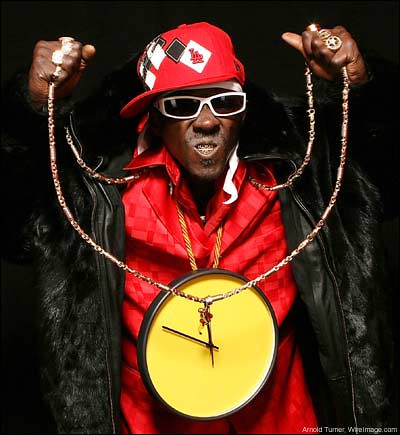
And please understand: I might like some of you, but I'm not blogging here because I want to make friends. I'm not here to make friends, I'm here to be with Flav.

flavor

Labels: , ,

7.07.2008

Music Is Free! (When It's Five Hundred Years Old!)

Hallelujah.

The re-opening of the Internet Music Score Library Project (IMSLP) isn't just important for my own selfish needs, but it's a necessary (if a small or limited audience) victory in the intellectual property struggles which I generally leave to my betters. (Or, specifically, one better in particular.) I'm not going to hash out the basis of the position on IP and copyright as filtered through my worldview, but briefly: the IMSLP was shut down under threat of lawsuit from certain (primarily European, if I recall) music publishers because some users had uploaded works which were still under copyright. Here I'm going to take a moment and say: Bad Users! Very Bad! What you were doing legally amounted to encouraging theft, doing so in a public place, and most importantly to me, wound up Ruining It For Everyone Else. The purpose of the IMSLP is to archive editions of music which are no longer under copyright.

Essentially, nobody owns the rights to publish editions of, say, Haydn's string quartets, which means that everyone is free to do so (and many publishers do offer such editions). If the IMSLP were scanning the Dover editions and presenting them as copyright free, that would be Wrong; what the IMSLP is about is putting up old editions which are themselves no longer in copyright. The open letter linked above heartily defends this position, just after a few paragraphs on how the IMSLP and publishers can work together to mutual benefit: "However, permit me to make one point clear here in no uncertain terms. IMSLP will continue to oppose organizations who attempt to limit and restrict the already much-shrunken public domain." The only people who benefit from keeping ostensibly public domain works like those of Bach or Haydn or Schumann or (I presume) Wagner out of the hands of the public unless forced to pay for them are the publishers offering their own editions. (Again, the ostensible purpose of the threatened suits which forced the site's closure regarded works which were under copyright, but I'm fairly certain that from the publishing industry's standpoint [or its most conservative standpoint] this is the greater concern.)

The ancillary point to the reopening of the IMSLP and the letter's invitation to music publishers to consider new models for distributing and promoting their products is that the current system for publishing the works of contemporary composers is broken. If I were interested, as I was some months ago, in perusing a score by a young and acclaimed composer like, say, Thomas Ades, some research would indicate that he has a deal as a house composer for the publisher Faber Music. Here are a listing of his scores which are for sale (many more are only available for rental), and please note that prices are in Pounds sterling, currently worth just less than $2. The cheapest non-libretto work here, is the Arcadiana string quartet, which would cost something like $20 before shipping and taxes. I know that Ades and his publishers would like to derive some income from the sale of his scores, but I bought pretty much the complete string quartets of Haydn online for about $80 total. And Haydn wrote a LOT of quartets. The score to arguably his most famous instrumental piece, the symphonic work Asyla, would be more like $60. Is it any wonder, then, that I could only find one score of his at my local library, or that I couldn't find (with, granted, a very brief search) any of his scores available on Amazon? This isn't a system that works very well insofar as serving the needs of a small but interested public is concerned, and the health of the score-publishing industry as well as notated music in general is dependent on, and should be solicitous of, said small but interested public.

Labels: , ,

7.01.2008

My John The Conqueror Root

No one's actually raised it with me, but I hubristically imagine that some of my readership might've been perplexed by the reference to "[white man's definition!] mojo."

This comes from conversation with another of my distinguished readers, Mr. ELH, wherein we observed that the mainstream use of the word mojo, and its use by white people in particular, has mojo meaning, roughly, "groove". So if you're not listening closely to the lyrics when Muddy Waters sings "Got My Mojo Working," you might think he's saying "I've got a lot of sex appeal and it is going on tonight."

But actually, in its initial use in blues music and African American culture, "mojo" isn't your groove, it's a supernatural charm that bestows groove - or its supernatural facsimile - upon you. It's not a force, it's a thing, not "I have mojo" but "I have a mojo," like you have a four leaf clover or a rabbit's paw. And actually in "Got My Mojo Working" the narrator's got his mojo working but it's not working on the girl he wants it to, so he's planning to go down to Louisiana to get a stronger one. In his version of "(I'm You) Hoochie Coochie Man" Muddy Waters memorably sings that:

I got a black cat hand, I got a mojo too
I got a John the Conqueror root, I'm gonna mess with you


Just so's you know.

Labels: , ,

6.24.2008

Restatement

Wow, that basketball post from yesterday was a mess. I changed directions about three times there. Maybe it's because I almost fell asleep on the bus home from work, so I was actually more alert later on, when I wrote about coy vampires. Anyway, I was trying to communicate, in the end, a few different things, which I'll do much more briefly this time around:

(1) You should read The Last Shot. Everyone should read it. It's a fantastic book, and if you're not interested in basketball just pretend it's about something else you're not interested in but willing to read a compelling and well written book about. It's reporting on events that happened, now, almost twenty years ago, but like its logical companion piece Hoop Dreams (aka the only three hour documentary I watched twice in one day because I was so blown away by it), all that's changed is that rap is more integrated into the mainstream and hairstyles are different. Since the NBA instituted its deplorable age limit, the situation is exactly the same. Except that people are getting paid a lot more now, and the sneaker-sponsored AAU summer league teams are possibly more influential now (though the sneaker market itself is shrinking; I don't know yet what this portends).

(2) I don't know why I went on about Marbury - not someone I spend much time thinking about, NBA-wise - except that, especially as viewed by reading The Last Shot and The Jump at the same time, he is a fascinating figure. I suppose I was trying to complicate the kneejerk reaction towards a particular kind of athlete by saying that his context and upbringing account for a lot of what makes him difficult to like today; if he didn't have those negative qualities, he might well have gotten lost before making it as an NBA player, instead of getting lost after making millions of dollars. Plus I accidentally stumbled into something else: in The Last Shot, one heartbreaking refrain is that parents and educators alike continually wonder if there's something specially wrong with their neighborhood: why, when Lincoln High has been a dominant force in the Public School Athletic League for years, had it never sent an athlete to a Division 1 program? Why do they all struggle to make the 700 on their SATs? The average background for an NBA All-Star is probably something like "poor and disadvantaged but not hopeless." Coney Island at the time of The Last Shot was hopeless. The extra hurdles and damages incurred for a talented athlete to survive Coney Island vs. a rough neighborhood in Oakland in the same time period may account for a lot of the difference between Stephon Marbury and Gary Payton.

(3) One of the main reasons why I was spurred to try and write that post is because I was trying to articulate why, beyond my pure love of the game, I find basketball so engrossing: more than any other sport, the matrix of social issues that surround pro basketball is to my way of thinking indicative and relevant to a lot of things going on socially in America at large. (Or, alternatively, the social issues relevant to basketball are the ones I'm interested in.) The whole system of basketball education, development, and recruitment for - as ultimate goal - the pro game is broken, corrupt, exploitative, and, as I said in the prior post, fetid, rotten, ill. But that's not just of interest to basketball; the System here is an extension, and expression, of the Larger System affecting America overall, and by understanding the exceptional specifics of this instance we find ourselves having larger discussions about race, class, education, social justice, and, to get broad and sentimental, what we want from our public figures and what we want for our children.

Labels: , ,

6.23.2008

Who Did You Think He Would Be?

(I know my small readership doesn't give a shit about basketball. The Finals are over! Your hometown team won! What's left to say? Well, I have like 2.5 basketball posts left in me, at least until the Olympics start, if I decide to write about the Olympics. Hopefully whatever I come up with basketball-wise here and in the near future will be a little more general interest.)

I somewhat accidentally started re-reading The Last Shot, by Darcy Frey (a freelance journalist who also wrote the article which inspired the movie Pushing Tin) the other day, and am unspurprisingly engrossed in it again. It's easily the best book I've ever read about basketball - though there are some other avowed classics I should check out, at least one out of print - and for human interest and literary quality absolutely crushes The Jump, its logical prose companion piece. The Jump is about Sebastian Telfair, of Coney Island and Lincoln High School, and follows him during his senior year of high school (class of '04) as he navigates the college recruitment process while simultaneously weighing the option to jump to the NBA, which he does. Telfair goes late in the lottery and the book closes on a high note that's probably well earned: Telfair has done extremely well for himself and, I hope, for his family, even though he's been an unmitigated disappointment thus far as a professional basketball player. My criticism of The Jump - which I read a few years ago and might be remembering unfairly - is that it treated the overwhelmingly rank and fetid bullshit people like Telfair need to go through for the one in a million shot at escaping Coney Island as a series of hurdles an aspiring kid could conquer, rather than the manifestations of a broken system that stifles and chokes everyone but the one player in a thousand who gets a shot at pro ball.

The other criticism is that Telfair isn't the most interesting guy in the book; his cousin is. His cousin was also in The Last Shot, which follows three seniors and one freshman on the Lincoln High basketball team during the 1991-1992 academic year. All of them have, in varying degrees, the basketball skills to at least earn a scholarship to a four year institution and maybe go pro. Without spoiling the book's heartbreaking afterward, this is what happened to the three seniors: one dropped out of junior college and as of 2004 is scraping by but actively pursuing his non-basketball related passions; one suffered a horrible car accident in the middle of his college career and is now physically and mentally disabled, working as a plumber and maintenance man; one is dead, a possible suicide. And the freshman? He's the most interesting character in The Jump, maybe the most interesting character in The Last Shot, Sebastian Telfair's cousin: Stephon Marbury. Multiple NBA All-Star, 20 points and 8 assists per game for his career (possibly still only the second man in league history with those marks, but I'm not going to check), over $100 million in gross lifetime earnings from basketball, let alone his endorsements.

Marbury is a shadow at the edges of The Jump, the cousin who made it, the model to follow, and yet a bitter and inscrutable man seemingly jealous of his cousin's impending success, also tagged with the label of someone who hasn't done enough to help those he left behind in Coney Island. Marbury's the closest thing to an enigma in The Last Shot as well; the preternaturally talented freshman who walks onto a team of extremely talented seniors and is, instantly, on their level if not better. He is, perhaps unintentionally, constantly marked and written as The Other in the book: he gets treated differently by the coaches, the other players kid on the square by saying things like, "Here comes Stephon, future of the neighborhood," and he himself is at fourteen astoundingly arrogant and aloof. On the other hand, people have known about his basketball ability since he was SIX YEARS OLD. What you need to know about Stephon Marbury is that he is the fourth and last Marbury brother who played basketball at Lincoln High and was considered a future pro, but he's the only one that made it (the others weren't able to either go pro or get a degree). The final hope of a storied family, into which all the weight of his brothers' failures has been poured, by his parents, his family, his neighborhood. What you need to know about Stephon Marbury is that a school custodian stopped him in the halls and told him, "Don't fuck up like your brothers." Marbury's father refuses to cooperate with Frey unless he gets paid. Burned by the supposed failures of three sons, he watches the development of his last hope with ferocity and a small-minded solipsism that, Frey eventually concedes, may be the most rational response to the world with which he's been presented. Marbury pére accuses Frey of buying the kids off in the same way college coaches are constantly slipping favors and cash and promises of more to come under the table, and in the moment of accusation he sounds like a fool and a pathetic man - "At the Seven-Eleven in Gettysburg: I saw you buying them slushies!...And now I suppose you want me to think you did it because you're just a nice guy. Oh, come on!"

Oh, come on indeed, Mr. Marbury. And yet: "having spent several months with Stephon, I am beginning to wonder how he and his father are supposed to act. The entire basketball establishment has been trying to buy Stephon for years." The Marbury response is to assume that they're being used and shamelessly demand that they get their in turn. If you want to make money off of me, you'll give me mine first. If I'm going to be used and exploited and then dropped when convenient like all these other kids, then I will have no shame in demanding my cut of the pie. And who can blame them, really?

This post has taken a more Marbury-centric turn than I intended, so I'm going to stay true to that. Originally I was going to focus more on college recruiting, but a single passage suffices to encapsulate the rotten heart of all this. Rollie Massimino, then the coach at Villanova, makes his pitch to one of Lincoln High's seniors by stressing the importance of family, the close relationships he has with his players, their mutual trust, etc. ad nauseam. Lincoln's coach, daringly, cuts through the bullshit for a minute: "But all you coaches are looking to move."

When a player signs a letter of intent to attend a certain school, the college's conference requires him to honor that commitment, whether or not the coach who recruited him stays around to honor his commitments. Now that many top coaches are compensated in the high six-figures...they regularly migrate from school to school, shopping for the best deal, unrestricted by the best rules that bind the players.

Massimino's response is to laugh and then seriously note that, when he was younger, he could've promised the player a forty year relationship if he signed with Villanova. Now, in his older years, Massimino can only offer a twenty year guarantee. "Ten years from now, you'll call me to talk things over...Because if you don't ... I'll kick your ass!" Frey observes that the player seems a little unimpressed by the appeal to loyalty, which is a good thing because "it is also a fact that were [he] to join the Villanova family next year, Massimino would be dispensing his help, guidance, and love three thousand miles away, to the players at the University of Las Vegas."

(Sidebar: this matters, not just because of the mendacity and double standards essential to the recruitment process and the treatment of coaches vs. players, but because a different coach with a different attitude may not provide the right opportunity for a player to grow and hopefully [for the talented few] sell themselves as NBA prospects. If you're a 6'8" bruiser and the coach who signs you promises to continue his school's proud tradition of pounding the ball in to the big man, you should be freaking out when he leaves and is replaced by someone known for a run and gun, guard heavy offense.)

This is the barest slice of what gets exposed about the filth involved in basketball development in The Last Shot. So imagine what it takes to rise above all that, to persevere and emerge not just from such a broken system but from the most broken feeder of that system, the basketball-obsessive wastelands of Brooklyn. (Notable that New York is always acclaimed the Basketball Capital of the World, that the city is in particular famed for its point guards, and yet over the past thirty years the Next Great Point Guards from NYC - Rod Strickland, Kenny Anderson, Stephon Marbury, Sebastian Telfair - have all been disappointments at the pro level. Chicago has produced a richer crop of guards in the last thirty years, but the undisputed [I should hope] two best point guards produced in the USA in the last twenty years grew up hooping in Oakland. It's worth noting as well, for the larger point I'm barely articulating in this post, that an off-hand tally in my head has very few of the most successful NBA players coming from the absolute blight of a place that Coney Island c.1990 was; the kids coming from the worst of the worst neighborhoods wind up as role players and troubled All Stars more than they do outright phenomena.)

And now think about Stephon Marbury - "Starbury" - an All Star talent with All Star numbers relentlessly decried as selfish, a loser, a team cancer, someone whose teams have always improved in the year after he left them, someone whose gaudy numbers are hollow. Consider that he's donated heavily to charities. That he's perceptive enough - and concerned enough - about the damaging structural role the sneaker companies play in the filthy machine that he started his own line of bargain priced shoes to try and change the paradigm: put a name bristling with street cred (and Marbury still has that - at this point in his embattled pro career, the only things he may have left are his street cred and his millions) on a $15 sneaker and maybe fewer kids will get beat down or even killed for a pair of Nikes (and maybe the shoe companies will stop being such a force in the recruiting and development process). Consider his character as hazily outlined in The Jump, resentful of his cousin's shining moment in the sun, closed off and isolated from his old neighborhood, from his extended family, possibly from everyone. Trustful of few if any. Always arrogant - how else could he make it out? Always shameless - how else could he make it out? Stephon Marbury made it to the promised land, and possibly for the very reasons he was able to get there he's been unable to truly find a place in it. Surely he's found it wanting. His millions have brought him the ability to walk away from his past, but not much else (other than, you know, all the other things that millions can buy.) Don't feel sorry for Stephon: he's obscenely rich and has become so for playing a game, and he's kind of an unlikeable personality. But when he's held up, as he so often is, to be the poster boy for the spoiled, arrogant, entitled, selfish athlete, remember what was necessary for him and others like him to reach the plateau they've achieved, what personalities they needed to develop to break through their dismal origins. His three most talented classmates wound up broke, disabled, and dead; his three brothers were labeled failures in their own neighborhood. He's a multimillionare because he was more talented and because he was stronger. What kind of strength does a fourteen year old need to batter through all that?

Who did you think he would be when he was grown?

Labels: , ,

6.19.2008

Everything Happens To Me

I was typing up something about a guy at work, which inspired the post title, but then I realized that in text form, to people who haven't met him, it'd be utterly boring, so I scrapped it, but kept the post title because I like it despite not at all remembering how the song goes.

I'm currently reading Shamanism: Archaic Techniques of Ecstasy, by Mircea Eliade, which is/was a classic text on the subject in the comp religion/mythology field, published almost sixty years ago now in the original French. I gather from Wendy Doniger's forward that the book has fallen into some questionable repute (for one thing, Eliade was more a historian than an anthropologist, and the book is entirely composed of secondary sources, which is something I admit to not knowing when I bought it, but there weren't a lot of lay-scholarly books on shamanism competing with it for shelf space), but while offering some criticisms of her own she defends it as a valuable perspective on the topic and a useful starting place for inquiring minds (like mine, I guess; Doniger is herself not without her contentious critics). Anyway, I'm slogging through it with some interest although I feel like the first three chapters are actually the same chapter over and over.

The reason I bring it up is because of this passage, describing an Inuit shaman named Aua:

Aua summons his two helping spirits with a monotonous song:

Joy, joy,
Joy, joy!
I see a little shore spirit,
A little aua,
I myself am also aua,
The shore spirit's namesake,
Joy, joy!

He repeats this song until he bursts into tears; then he feels a boundless joy.


When I read that I went, roughly, "bu-whua?" He repeats the song until he cries? Why would the song make him cry? I actually get why he would feel a boundless joy after crying because I have, at times, felt something similar, and I guess that was my point of entry here. The thing to bear in mind, I suppose, is that despite modern context making the book's subtitle sound really porny, "archaic techniques of ecstasy," of the ecstatic, is Eliade's take on what constitutes shamanism per se and sets it apart from more generalized mysticism, medicine man, magic type mythology and ritual. The shaman's ability to achieve an ecstatic, transcendent state. So it would make sense that Aua is more capable of moving himself to great emotion than the average person today - or maybe what's elided in Eliade's summary of someone else's field notes is that (speculating) "repeats this song" glosses over something more like "repeats this song ceaselessly for five hours," which would probably be enough to put anyone into a very heightened and delicate emotional state. Of course, "anyone" simply wouldn't do that, would give up after ten or thirty or eighty minutes.

So: a given that the shaman is more willing and by nature of his skills more able than the average person to access extreme emotional conditions - and to do what is necessary to get there. But I also wondered, not for the first time (here we approach the point) whether other cultures and, in other times, our culture (or, if you like, our culture's recent ancestors) were simply more emotive. One common reaction to artistic works from different cultural moments, even relatively recent ones, is to find them somewhat maudlin. Maybe that's a semi-universal (and reciprocal?) response, the inaccessibility of one set of cultural assumptions and experiences to another, so that we're fooling ourselves if we think we can slip seamlessly into the skin of an original audience member. Or maybe our culture is just locked down and colder, emotionally, than the ones which have come before it. In Season Two of Carnivàle, in the episode where Jonesy's leg is healed, he whoops and hollers and does a bunch of abortive little quasi-Irish jigs, kind of dances in a half circle. It's an endearing and kind of loopy expression of elation, but on the episode's commentary track Daniel Knaupf (the show creater) says approvingly that it's a "very 1930s" expression of happiness. My first thought was to say "how the fuck would he know?" and my second was to concede that it's a very 1930s movie expression of same. But maybe it's really authentic: maybe similar scenes in films from that era are descriptive and journalistic rather than more expressionistic and heightened. Maybe merely seventy years ago we danced jigs of joy and wouldn't have found it so strange that a First Nations shaman from Canada made himself weep by singing a little ditty about his shore spirit.

Labels: , , ,

6.15.2008

Of Course I Haven't Actually Read The Book

This here, what I'm doing? It's like slow motion blogging. I write about things three or four days after I think about them.

Anyway, this is more a musing than a thought out post, inspired by another brush with the ideas of Jonathan Haidt, who's garnered some notoriety for his argument that human psychology has five categories of moral evaluation: "harm reduction, reciprocity and fairness, purity, respect for authority, and in-group loyalty." (Quoted from, and refreshed in my memory by, this post. Haidt's own project is self-described as focusing "on the moral foundations of politics, and on ways to transcend the “culture wars” by using recent discoveries in moral psychology to foster more civil forms of politics." Within the world of the liberal blogosphere he's garnered more specific attention for arguing that, roughly speaking, upper-middle and upper class educated westerners tend to articulate their moral framework entirely around the first two concepts, harm reduction and reciprocity and fairness, and further extending the point by claiming that liberal politics essentially springs from that sociological foundation and thereby struggles to connect with people outside that group, whose moral worlds (he claims) are more quitably distributed amongst all five categories.

OK.

First of all, it's unfair for me to get into evaluating this position without actually having, you know, done the reading. I'm sure that Haidt's work is actually deserving of careful engagement of the sort that I'm not currently about to embark upon. On the other hand, what I've outlined above is about the level of detail and precision with which his ideas have memetically filtered into (one particular extended) online conversation, so I don't think it's completely invalid to engage with them on this level. (My hazy and unfair justification being that it's not like the most influential and important discussions about, say, Marxism have ever had much to do with a nuanced understanding of Marx. That's bullshit but I'm tired. Also, no one reads this anyway [except You, Loyal Reader!] so it's not like I'm actually doing some concrete disservice, just thinking "out loud".)

Second of all, if there's something I'm not it's a cultural anthropologist (or a ballet dancer, or...), but my understanding is that there is a (potential) validity to Haidt's core observation. Since I'm not a professional, I'm very worried about balancing a respect for the strong differences between my inherent assumptions and those of another culture's, on one hand, and on the other being careful not to engage in the kind of laissez faire cultural relativism-as-excuse-for-offensive-thought-and-behavior type bullshit that has, e.g., US public officials saying things like: "Look, Arab culture is very different from ours. When we kill a family member, they're not satisfied by our apology, or even the offer of a cash settlement; the Arab mentality requires more for justice, and they want some sort of emotional reckoning as well. It's a completely alien culture." That said, it tracks with my ignorant nuggets of half-information to stipulate that, for example, traditional Chinese cultures might place a much greater emphasis on "authority" than they do on what I'd consider "fairness". And a casual consideration of the history of western cultural mores over the last thousand or so years also tracks an apparent devolution in the importance of authority (of God, of the King, of the State) vs. other moral considerations.

Where I struggle is with the application of these intuitions to the particulars of the current political landscape. Liberal politicians may make appeals to the moral button of "in group loyalty" less often than conservative politicians, but in practice it's absolutely a powerful mechanism behind the alignment both of casual voters and of more politically engaged and committed individuals; witness, re: the latter, the kind of snarling mutual contempt between "unrepentant" Nader 2000 voters and the rest of the actively political Democratic establishment (including, let's be honest, me in that second category), and re: the former consider the pile of data indicating that, from election to election, casual voters (and not-so-casual voters) will endlessly re-articulate what's important to them in a personality or a platform so that their stated ideals better line up with the current candidate of the political party for which they've voted for the better part of their adult lives. (Modern liberal politics in the US was also built in large part on the backs of the unions, which movement was certainly expressive of one kind of in-group loyalty as a moral virtue, but a lot's changed in the last eighty years.)

But how much do conservative politicians really actively reach for the "purity" or "in-group loyalty" triggers? In the Haidt-as-read-by-bloggers context, what he's talking about here is (to phrase it neutrally) that conservatives do a much better job of reaching out to a self-consciously "unsophisticated" (which is of course its own sort of elitism, but that's another post) population of a particular ethnic and religious identity (Northern European and Protestant, for the most part), which has for the most part set aside its own potential in-group distinctions (Irish v. English v. German v. Swedish, Lutheran v. Episcopalian v. Presbytarian) in favor of conceiving of itself as, in some way, the bedrock of Americanness. Now, I think this group is wrong to the extent that they think of themselves that way (another post, again), but it's almost not their fault; after all, they're constantly being told that they're the norm from which the rest of us deviate in our Americanness. But what interests me here is that appeals to this population's sense of mutually defined purity and loyalty are almost always expressed via the dog whistle. Look, the ugly flipside to what I tried to express above in non-valuative turns is that conservative rhetoric frequently tries to agitate and activate this population by reaching for the presumed belief that the further you deviate from White Straight Christianity (and, all right, let's throw Hard Working in there along with some other platitudes) the less American you are, which is why self-identified Democrats in West Virginia were talking about how they didn't feel confident that Barack Obama was American enough for their vote. (Just to put it out of the way: I'm not accusing a whole gigantic mass of people of racism or any other negative-ism, merely observing that politicans try to reach them as a group by appealing to intutions which, brought out into the light, aren't very savory. Maybe they're not actually reaching anybody this way anyway!) But my actual point here is to drag that last parenthetical out into the light of my paragraph's main body: these appeals are all coded and soft-spoken. When somebody gets strident they're talking about "Being American" without really examining what buttons they're pushing, because nobody's comfortable stripping away the assumptions people wrap into "Americanness," but other than that there are very very few explicitly racist (or other -ist) appeals to voters floating around, when weighed against the country's ongoing racial tensions. And why is that? Because it's not acceptable. (There are exceptions, which fluctuate over time; right now it's acceptable to be pretty vociferously anti-Muslim in American discourse, which is why attacks meant to suggest Obama's Muslimness are [a] presumed by their makers to have effectiveness, and [b] considerably less coded than attacks meant to highlight his blackness.) Those people who are out and out cognizant racists know they're not supposed to talk that way in general company, and the many many more of us who have intrinsically and subconsciously racist persuasions (of all sorts, and I'm not excluding otherwise good people or otherwise liberal people, including for the sake of fairness myself, from this group) actually just believe that it's wrong to makeor be receptive to that sort of transparently racist appeal. (I've been talking about race as my example, but a somewhat smaller segment of the population feels just the same way about religious plurality or what have you.) Appeals to "purity" often involve making "whiteness" and "Americanness" identical, but never explicitly, because you'd break the spell, disable the rhetoric, and turn your audience against you, if for no other reason than the preservation of their own self-regard as Good People who Don't Think That Way.

Now obviously I'm writing from a particular position whereby I claim that I can see into the codes and dogwhistles and divine subliminal racist intent, and lots of people would say "Shut the fuck up you overreaching liberal apologist, you hate America so much that you'll read evil subtext into the most innocuous call to patriotism," and there's not a lot I can say about that. I'm confident that a measured and objective analysis of the way the rhetoric of "purity" or "group loyalty" (I'm lumping these two Haidt-distinct concepts together because they're the conveniently most objectionable and questionable to me; I'm not going to talk about the moral value of authority here, but American poilitics has a very complicated relationship, I'd say, with the idea of authority) would bear me out that followed down the logical line to it's underpinnings these arguments are appealing to something racist or heteronormative or religionist. (And since people don't like using the word racist, I'll even get all milquetoast and say "racialist" if you want.) This is, again, part and parcel of a larger and different discussion about the role racial tension plays in American society and who's willing to own up to it and who isn't. ANYWAY.

The upshot of the understood unacceptability of bald appeals to (religious/ethnic) purity and loyalty wraps back to what Lizardbreath at Unfogged says in the post linked above: these are moral concepts that don't stand up to modern American society. Sure there are subsets which hold them dear, but the reality of American society is that it's far too heterogenous to support a commonly understood conception of purity or in-group loyalty that can hold moral weight, unless you try to stretch them so broad that the group in question is the most generous definition of "American". There is no defensible concept of what a pure American is, unless you resort to the literal legalisms, and valuing loyalty to the US as your group is so vague and taken for granted as to be not worth mentioning. To the extent that I have loyalties in this sense, they're to the United States (although I frequently root for the Puerto Ricans and Portuguese during the Olympics) - unless you want to weaken the whole notion of loyalty so that it means little more than respect, I'm not "loyal" to my ethnic heritage (I'd have to think the moral scales were seriously out of joint to, e.g., support Portugal in a war vs. the US). I think it's sad when people disown or reject their heritage out of hand, but I conceive of my obligations to my ancestors as acknowledgment and measured pride - my real loyalty, if not to the US, is to myself, and my conception of myself consists of much more than my genetic background. Even if everyone did value loyalty to their ethnic heritage as a moral good - "Don't trust people who aren't Polish-American, Kristof" - that's not something you can build a greater society around. I knew two guys who shared a dorm room in college, one a devout Muslim and the other some sort of quasi-Pentacostalist: they were good friends and quite happy to remain so while completely convinced each that the other was bound for hellfire. They were sort of tongue-in-cheek, but not really. Now, that's heartwarming in a ghoulish sort of way, but you can't write that into the morality of a society. You can't get up on a podium and say "My fellow Americans, it's important that we all agree some of us are going to hell, but it doesn't really matter which group!" This is the lie of the broad-based Christian coalition (and, more recently among intelligentsia, appeals to the Judeo-Christian tradition): their "goals" are currently far enough from achievement that they can be vague. If Pat Roberts had everything he ever dreamed of, though, it wouldn't be long before the Baptists and the Methodists would start regarding each other with the same suspicions that their most zealous adherents currently reserve for Muslims and atheists. A politics which morally values the exclusion of outsiders only works when pretty much everyone is the same. (There's also loyalty to the family in-group, but again I think it's too banal, in a country of 300 million people, to turn the moral good of family loyalty into an articulated political position, although perhaps this is one place where liberals unthinkingly concede too much ground to conservatives.)

This is all sort of one of the successes of liberalism - the triumphant recognition of a heterogenous society - but I am willing to concede that there's still a homogneous urge to be scratched. I just don't see what you can do about it except try to articulate why we need to set those feelings aside; perhaps somebody much more creative than I could articulate a concept of moral purity that would be broadly acceptable and philosophically sound and compatible with left-liberalism, but I don't see it happening. These are impulses no longer relevant to the great work of a society like this, even if we can find place for them in our more immediate lives. (And even then.) It's natural that as human society expanded we woudl try to continue rewriting our most basic intuitions into society even as it grew larger and larger, but at some point you need to try and stop -

One theory (which I like) of the Uncanny Valley is that it's a deeply coded evolutionary instinct (broadly akin to the instinctive revulsion most humans [most mamals?] have toward snakes) for self-preservation, and if so the instinct undoubtedly well predates the rise primates: something that looks almost like [my kind], but is somehow clearly not [my kind] is not to be trusted and possibly dangerous. The preservation of and need for and loyalty to the group is everything, evolutionarily, but that's just not where humans are anymore. One of the great things about the overstuffed human mind is that we've puffed ourselves and our societies so far past the point of evolutionary imperative, but one of the troublesome things about the human mind is that we still carry around so much luggage from before we really began using our minds to do such great things.

INSTANT UPDATE: I was skimming this post-posting and immediately thought: "Democratic Primary, you idiot!" but I think that almost proves my point: I can't imagine a political race in this country, today, being more overstuffed with overtly racist and sexist rhetoric (and, look, I'm not interested in who said what sinful thing: if you step out to no more than two proxy-levels away from the candidates, they had surrogates saying distasteful things) and it was universally and objectively understood to be an ugly race that in its more extreme moments was considered to be threatening the future viability of the Democratic party itself. The small group of voters who feel that by Clinton's defeat they've been somehow disenfranchised has given itself over completely to political loyalty as moral imperative (and I'm confident that had things gone the other way there'd be an analogous group), but the rest of us rightly understand that these people are BATSHIT CRAZY. Like, making unrepentant Nader 2000 voters look like well-adjusted political rationalists. This was a far more explicitly charged-with-combustible-group-identification-issues campaign than any I can remember in my brief political consciousness and it's widely regarded as near disastrous. We (most of us) just don't have much tolerance for seeing this shit dragged out into the sunlight, which is one reason why people don't like it when someone like me reaches into the coded messages trying to do just that.

Labels: ,

6.14.2008

Seriously, I Don't

Like people, that is.

To wit.

Sigh.

Labels: