9.12.2009

"I'm Thinking About What I Want And What I Need": Life, Season Two

Not much to say; not as good as Season One, but the high points, oh the high points. This show should have been bigger. This post is mostly to preserve the dialogue at the end of the penultimate episode, which rockets us into the finale.

"Charlie - what are you thinking?"
"I'm thinking about what I want and what I need."
"What do you want?"
"I want a peaceful soul."
"And what do you need?"
"I need a bigger gun."

Damian Lewis' delivery of those lines, as Charlie, should be bottled and sold. (Adam Arkin is pretty awesome too, btw.) Alone on the page they're walking the line between cheesy and badass, but Lewis nails the tone just right, because while Charlie Crews is a badass, he's (as mentioned previously) a Steve McQueen badass, which means he doesn't talk like someone who learned to be a badass by watching badasses in movies. "I want a peaceful soul" he says, with painful longing, and then "I need a bigger gun," he says, in the same serious but informative tone he uses at work, describing the tool he'll use to save a loved one.

That's the little engine at the heart of Crews, and Life: for all the explicit and implicit reference to Crews' discovery and adoption of Zen philosophy in jail, he's not Zen. Perhaps no one can actually be Zen, but Crews is very, very far from being Zen. But he's trying so damn hard, because he thinks Zen is the path to what we wants - a peaceful soul. He wants peace to quiet the beast inside him, the beast that got him through twelve years of wrongful imprisonment (as an ex-cop in Pelican Bay, no less), the beast that erupts when the people he cares about - too few, he realized in an earlier episode - are endangered, the beast that needs to know not merely who really killed his friends, but why he of all people was framed for it, and by whom. Crews never seems certain whether his quest for the truth of why he had twelve years taken away is a quest for peace, that the knowledge and understanding can soothe his deep wounds, or if it's a quest for vengeance, to let the beast do what it wants and savage the people who savaged him. Crews undoubtedly fears that it's both, that succumbing to violence - not very Zen, he would say, but it'll do until Zen comes along, he says in the finale - will bring him to peace. That's the path he tries to avoid, he tries to use Zen to shield himself from, but in the end he can't quite manage it.

He's not quite ready for the peaceful soul, but at the end of the season - and, sadly, the series - he seems closer to it.
He doesn't ultimately get the bigger gun, but he didn't ultimately need it.

"Do you wanna know how I got through twelve years of prison?" he asks an enemy.
"Your Zen?" his enemy laughs.
"Like that," Crews explains after breaking the other man's windpipe.

He wants a peaceful soul.

Labels:

8.14.2009

"I Know You": Life

You did not watch the primetime NBC drama Life.

You should (have) watch(ed) the primetime NBC drama Life. I have only seen the first season; it is on DVD. Soon the second and final season will be on DVD. Like, in two weeks.

Particulars:

I appear to be drawn to shows that build to something strong (and for all I know don't stay there) and as long as there's a spark of something I enjoyed to begin with I'll wait a long time (relatively speaking) to let it get there. Lots of people apparently didn't like the way Life started, and it does bear down very heavily to ladle on the quirkiness flavor, but by the end of the first season, having established who these people are and what this world is, they don't need to lean so heavily on the idea that protagonist Charlie Crews is a Weird Guy, Ignorant of Technology and Prone To Eating Fruit and Speaking in Zen-ish Koans; a show with a better start, or a show on a network that was more willing to let its creators breathe (I don't know, so I'm not pointing fingers) might have eased off much faster on shoving some of the basic premises at us. But I watch these things for emotional resonance and moments of art and scenes that delight me, and I'm quite often willing to let a lot of frustrating material accumulate if I get the sense that it's laying the necessary pipe which will lead me to those things I crave. I liked the early episodes of Life, but I understand why people were annoyed. The last four episodes of the first season, though, are stunners.

Firstly: great protagonist, great performance. Damian Lewis plays Detective Charlie Crews, who was wrongfully imprisoned for 12 years; exonerated thanks to DNA evidence, he sues the City of Los Angeles and gains as settlement an undisclosed sum of money (a lot of it) and reinstatement into the police department as a homicide detective. His ex-partner remarks that he was a normal cop before jail; working towards his twenty and his pension. After jail he is not a normal cop. He maintained sanity by reading Buddhist philosophy and fantasizing about revenge on the people he believes must have framed him, and is driven by these two often conflicting influences. Damian Lewis looks, as someone remarks on the DVD, a lot like Steve McQueen and a lot like Stan Laurel, and at the proper moments he manages to absorb the spirit of both into his performance. I can't say anything about this performance because it's so controlled and contained and cool, and I can't say enough about it because it's so good.

Also fantastic guest actors and supporting players waltzing through; lots of Deadwood alums building up to Titus Welliver fucking owning in the last episode, a surprising brief turn from Jessy Schram (Veronica Mars) that's just strong as anything, nice moments for the First Lady of San Francisco, a sprinkling of Adam Arkin, some sweet scenes with Christina Hendricks (and Adam Arkin), and just lots of actorly goodness. Plus, maybe my favorite recurring actor moment on the series is Sarah Shahi looking at unusual things before we get to see them. Some reviews knock her performance as weak; she's not the best actress at the world (but then who is?) but she's quite good, I think, and she's got her own energy which is the kind of thing you have to respect, and while let's be honest it helps that she's beautiful there's something very particular about the way she gawks at something unusual. I could watch a loop of every moment where Sara Shahi approaches a crime scene, curious and a little surprised. She does a lot of eyebrow acting without it seeming, well, like heavy eyebrow acting. Different energy, but not wholly unlike Mary-Louise Parker in the way a lot gets expressed with posture and by moving the head.

And that leads us to the images; by the end of the season each episode gets at least one memorable, unique, startling and beautiful tableau. Those aestheticized crime scenes feed into the rest of the tone of the show; the CSI's have done their take on beautiful crime scenes for almost a decade now but they're always dark and often prurient. Life shoots for the unusual but not the grotesque, and that's part of the way the show is shot - it could just as well be called Light. This is a relentlessly sunny detective show, not by way of cheerful tone but by way of literal and manufactured sunlight. Charlie Crews spent too long in a dark cell, and now he loves the sun, is drawn to it, and the show follows him into brilliant color. He's always standing by windows, looking up at the sky, positioning himself so he can feel the sun's warmth and bathe in it.

...

"If she shot him through the door, why is there blood on her hands?"
"That's not blood, it's meat sauce."
"Why is there meat sauce on her hands?"
" ... I really don't know."

Labels:

7.26.2009

You Should Do The Things I Tell You

For example: You should watch Spaced. It's available on Hulu right now. It's very good. Very funny, for a few fleeting moments kind of stirring emotionally - the tiny sweet center if you will - really very funny, and you can watch the entirety of the show in about six hours.

Also, Nick Frost, whom I always found entertaining but not as good as Simon Pegg in their movies together, murders every scene he's in. It's phenomenal, phenomenal work.

Plus at one point Simon Pegg says a prayer to Buffy Summers. Also the female lead and co-creator/co-writer was awesome in a very different role, with a very different tone, in two of the best episodes of the revamped Doctor Who. So good people all around.

Labels:

6.09.2009

Your Childhood And Mine, On Jimmy Fallon

This would've been more awesome with a less awkward host.

Also, since the show doesn't apparently have the rights to re-air the promo clip of Raising the Bar that they played on the live broadcast, there's a weird meta effect on top of the actual meta on display here; there's an awkward cut, and indeed it feels as though we, the Online Viewer, have been placed in a Time Out.

Labels: ,

5.09.2009

Just Saying

More to come soon, I promise. (Yeah, right!)

Just musing after staying up way too late last night watching dodgy movies on TNT:

(1) The film AEon Flux is not a good film.
(2) The film AEon Flux has almost nothing to do with the source material MTV cartoon, to a degree that serves as another brick in my "why bother with adaptations" argumentative wall.
(3) I get why both fans and the creator of AEon Flux the cartoon were hugely upset by the film. Since I don't really care about AEon Flux the cartoon, I don't really care about their upset-ness, except inasmuch as it bolsters (2) above.
(4) Nonetheless, AEon Flux the film was both visually and conceptually pretty interesting. Were the visual and conceptual notions put to best artistic use? No, but there was a lot of interesting stuff there. The central plot questions of the movie - which as far as I know are entirely unrelated to the cartoon - could've been put to excellent use in a much better film, which is sort of the point of this article, as much as I might quibble with its specifics.

***

There's another point floating around somewhere in my head about Joss Whedon's Dollhouse, which I'm relatively certain I like much more than the majority of the 152 people who have been watching it every Friday night. I think the show is still struggling to find its legs from time to time - no shame in that - which will be unfortunate if it's cancelled (which is more likely than not), but most of the criticisms I've seen people direct towards the show (out of those who are willing to sit down and engage with it in a fair/serious manner) seem sort of beside the point. Not beside the point to whether or not they should like the show - you like what you like and find important what you find important - but beside the point to the goals of the show. I agree that it's difficult to care about the characters, especially the dolls, but I think that's in part by design, because it folds so precisely into Whedon's point; these are individuals - at this point, really, bodies - who have been more or less literally dehumanized; one of the show's conceits is that the procedure is not (cannot be?) 100% effective, so some essential spark remains, at least in the cases of Echo and Alpha, but the spark is elusive and near-ineffable. (Unless Whedon's found God in the last few years I doubt he's literally endorsing Paul Ballard's platitudes about the human soul in religious terms, but the logic of the story so far indicate that Ballard is correct [for once!] about the impossibility of truly erasing the dolls' baseline personality, whatever that means in religious/metaphysical/pseudo-metaphysical/neurological terms.) I'm interested in Echo and Sierra and Victor and Alpha and SPOILER SPOILER SPOILER Whiskey, but I'm not invested in them the way I was in Buffy and Willow and Giles. But that's part of the point. The annoying professor guy at the end of the "Man on the Street" episode who points out that if the technology really existed it would be both used and abused and ultimately spell the end of humanity...he's right, and the show in part makes the point by having its central characters be true ciphers with no dependable or consistent personality from week to week. Obviously, Whedon is interested in working with identity, and since that's a relatively new theme for his television work I don't really know what he thinks about it or where it's going to go (whereas I can pretty much guess that in a Whedon work about family, the family you create will be more important and dependable than the family into which you were born, because that's One of His Things), but so far I think he's going about it in a logical sense.

None of that helps someone who feels the need to relate or invest in a character, of course, and I'm not immune to that sensibility; the easiest way to summarize why I've spent the last few years rolling my eyes at House whenever I happen to watch it is because I think 95% of the time the writers "get" House wrong. That's a ridiculous thing to say, of course, because I didn't create the character and they did, and what I really mean to say is that there's a version of Gregory House I find interesting and compelling, and the guy who's given a wide berth to be a monumental asshole in ways both petty and profound to everyone around him, and indulged (by in-show logic) because he always gets medical results, and indulged (by the writers and I think the fans) because he always gets medical results and because he's also a depressed person whom the show will evoke sympathy for...that isn't the guy whom I find interesting and compelling. That Greg House, the one who stars in 20 out of the 22-24 episodes in a given season, is an asshole who doesn't deserve the indulgences he gets and who I can't stand watching for more than ten minutes at a time because both he and the way he's treated by his "friends" and colleagues are unbearable to me. (My other main issue with the show is that it's demonstrated the ability to create phenomenally good and creative episodes of television, almost always by deviating from its own incredibly well-worn tropes. If there was some sort of feed I could sign up for that would alert me when an episode of House is going to break from the traditional patient-of-the-week structure, I'd watch all of those episodes.)

Anyway, so I get why people don't think Dollhouse works, but sometimes I think they're watching the show with the wrong eyes. Also I, personally, appreciate the lengths to which Dollhouse is willing to be nasty; in series past, Whedon has never shied from going for the emotional gutpunch, but the degree to which Dollhouse wants to make you feel uncomfortable, emotionally and intellectually, is I think new for him. Ballard's affair, Echo's return to Patton Oswalt's character at the end of "Man on the Street," a lot of the Alpha stuff, a lot of the Topher stuff, Victor in the chair with Dominic's personality, SPOILER SPOILER SPOILER Whiskey ... this is just meaner than prior Whedon, and I have to say that I like it.

Labels: ,

4.11.2009

NOOZLES OH MY FUCKING GOD NOOZLES

NOOZLES

For the last several years I intermittently have tried to remember the name of an animated show I greatly enjoyed as a child. It had something to do with koalas and Australia and children and Uluru/Ayers Rock functioning as a place of great mystical power.

Today the mystery is solved. Today I put the search string "children's animated 'ayers rock'" into Google and I was brought to happiness and joy here, which lead me again to here. (Apparently it aired back to back with another koala-themed show, because the programs were created in Japan which was had recently gone, as seems unsurprisingly likely for the Japanese, absolutely fucking nuts for koalas. It seems quite possible that I have also in part conflated elements of these two programs if they did indeed air consecutively on Nickelodeon.)

NOOZLES

It has to be this; there can only have been one children's program in the late 80s/early 90s that centered on koalas AND ALSO had the mystical properties of Uluru/Ayers Rock as a recurring plot point, right? RIGHT?

And so we come to Youtube. Here. It is important now to observe that absolutely nothing appears to be as I remembered it. The show I remember was much cooler. But it must be this.

It must be, right?

(Noozles?)

Labels: ,

3.21.2009

Does Anybody Remember Shelly Godfrey?

EDITED TO ADD: According to Tricia Helfer, Shelly Godfrey will be somehow explained in the forthcoming TV movie "we're really done, now, except for Caprica, entitled The Plan (as in, "the Cylons have a"). So I appear to be incorrect that Godfrey - who seemed to me like an obvious tip of the hat that there was a supernatural in the Battlestar universe - was what I thought she was. Still, though, people shouldn't be surprised by the mystical elements of the finale. WE NOW RESUME THE ORIGINAL POST WHERE IT BEGAN:

Without actually spoiling anything re: the Battlestar Galactica finale (not that anybody reading this watches it), which I thought was primarily brilliant with a few missteps, people who are surprised that God comes along and, well, Gods Godself out of a machine, can't have been watching the show I was watching. There's a higher power in the Battlestar universe, despite its impenetrable an ineffable nature, and it's been obvious that this is the case since well nigh the beginning of the show. Or what did you think collective lucid hallucinations and Shelly Godfrey and fulfilled prophecies and Kara Thrace returning from the frakking dead was about, anyway?

Also, I was thinking about writing a post about Dollhouse and how everybody online seems to think it's a massive disappointment (superbrief summary of the unwritten post: dude, go watch the first few episodes of Buffy and get back to me), but I'll hold off and simply observe that last night's episode was, as Whedon advertised, a stratospheric leap forward. It was awesome.

Labels:

3.15.2009

Lynchathon II: Twin Peaks

One casualty of my schizoid attitude towards blogging (I must write things here/I hate the things I write here/No one cares what I write here/I feel an obligation to try and fail to entertain the people who read the things I write here) is that I didn't blog about Twin Peaks back when (or just after) I actually watched it, which at this point is over a month ago. As I worked through the series I had all sorts of thoughts and reactions, but I guess I'll just (!) confine myself to some bullet points.

BULLET --> I highly recommend that anyone reading this check out the first season of the show. If you dig it, move on to the second season. At whatever point you start feeling like maybe you should get off the train because it seems like derailing is imminent, trust your instincts and get off, because actually the derailing happened before you noticed it. I'd be glad to fill anybody in on what happens after you save your time and patience by taking the remainder of Season 2 off your Netflix queue. That's sort of like the advice my friend Phil gave me when he saw me reading the first volume of the Dune series back in college: "Stop with this one. Trust me, don't go forward. I'll tell you whatever you want to know, but for your own sake, don't pick up the next books." I ignored his recommendations, and people, I was Wrong.

BULLET --> Of course, David Lynch directed the unutterably bad adaptation of Dune.

BULLET --> Special Agent Dale Cooper is one of the greatest characters in the history of filmed media. From his introduction (somewhere between ten and twenty minutes into the pilot) he grabbed me, and I have a hard time imagining anyone wouldn't find him charming. He's actually the best explanation for the fact that

BULLET --> Season 1 of Twin Peaks was ridiculously popular. Watching the show almost twenty years later, the idea that a massive viewing audience tuned in for something that weird just blows my mind. My friend Fay suggests that it's because TV was super shitty back then, so very weird but good shows had a better shot at mass success. I also imagine there was a lot of misunderstanding the show in the same way people misread Blue Velvet and make it all about "darkness in the heart of small town America." But I think a lot of it had to do with Dale Cooper, addressing the mysterious Diane by dictaphone, and exulting about "these magnificent trees".

BULLET --> Dale Cooper is played by Kyle McLachlan, who also played Paul Atreides in Dune (ugh) and Jeffrey Beaumont in Blue Velvet (yay). And actually, Cooper is sort of very like what would happen if Jeffrey Beaumont grew up and became an FBI agent; there's a kind of wide-eyed gumption that the characters share, a fascination for the world and an endearingly sincere, Hardy Boys kind of approach to life and mystery. Cooper seems like what would happen if Jeffrey matured, saw the world, and came to terms with the things he learned about himself in Blue Velvet.

BULLET --> Cooper also reminds me a lot of my aforementioned Phil, completing the little nexus here of mental associations. This is the first time, hopefully the last, and certainly the best possible situation in which I might observe a character in a David Lynch work and think "Hey, I know somebody sort of like that." I mean this in the best possible way, but Phil also has an enthusiastically Hardy Boysish side.

BULLET --> In the things I've read about Lynch, the Hardy Boysishness (and I wish I had a better way to describe it) seems like an undersold element of his aesthetic. David Foster Wallace gestured towards it in his behind the scenes look at the filming of Lost Highway when he observed that it's hard to know whether or not to take Lynch seriously when he says, apparently unironically, things like "Golly" and "Terrif." I presume it's (almost?) entirely sincere, because that kind of American Boy of the Fifties thing is such a big part of Lynch's work. Smiling men who love coffee and give each other thumbses up (which, because it's Lynch, go on a little too long to be truly comfortable), grown up American boys who read adventure comics and never leave home without a pocketknife and dreamed of finding an old Indian arrowhead in the backyard. Consider that (miniscule spoiler) two malevolent spirits at the heart of the Twin Peaks story turn out to be named MIKE and BOB and BOB, in particular, is a greasy middle-aged guy in a denim jacket, the sort of guy who looks like he might brain you with a tire iron behind the gas station and take your money, or leer at children when they make too much noise in the general store. He's creepy in a completely unassuming Americana kind of way, and it's not because Lynch is indicting or exposing the whole gestalt of that aesthetic, it's because he's telling a story he wants to tell (which involves good and evil and mysterious spiritual forces, or in the case of Blue Velvet, about adolescence and corruption) and he's put it into a setting he enjoys or finds interesting (the rural northwest), not because the setting inspires some dissective urge in him, but because he likes it. Again, Lynch's idea of exposing how bad a place can be is Eraserhead, which is among other things about how he hated living in Philadelphia.

BULLET --> The devolution of the show's quality over the second season is pretty sad, both in the filming and the writing. Lynch's idiosyncratic filmic gestures are always motivated by something which caught his painterly eye - even late in the series, you can find meaninglessly meaningful cuts like one that stays with me in particular, where in one instant we're close up on a character's frightening grin and in the next frame we're looking dead on at the side of a pie that's been cut into. The crust and top frame the huckleberry (or whatever) inside like lips frame teeth. It has no story importance, but you walk away for the first time thinking "Wow, it never before occurred to me that from a certain angle, a pie with a few slices missing looks like a smile." In place of that, though, as the series goes on, the camera starts lingering on objects of no especial visual interest, like it's just killing time and trying to seem portentous via the properties of a slow zoom. Look at the black telephone, audience, look at it! It's not ringing! This script was SHORT SO LOOK AT THE PHONE. Also the characters start getting served more and more poorly. By the end of the series, the Indian sheriff's deputy Hawk is talking about the stories of his People and quoting cheesy parables; at the beginning of the series he said something that sounded like a hoary proverb about love, and then instantly clarified: "That's a poem I wrote for my girlfriend: [Girlfriend's Name], Ph.D, Brandeis."

BULLET --> A surprising portion of the cast doesn't actually seem to be any good at acting.

BULLET --> A surprising portion of the cast is sufficiently awesome enough at acting that I can't figure out why they aren't in more things.

BULLET --> I don't even know what to say about the movie, Twin Peaks: Fire Walk With Me, other than to note that now I understand why it got booed at Cannes.

BULLET --> If people who make a film actually haven't really thought about what they need to do to make the film work, it's going to be apparent pretty quickly; a film is only so long, you know. If people making a continuing dramatic TV show haven't really thought about what they need to do to make the show work, it can take a whole bunch of episodes before that becomes apparent. I'm not interested in dissecting the contributions and failings of Lynch vs. Mark Frost vs. the involvement of the network in the implosion of Twin Peaks, but these were not people who knew what they were doing. These were not people who thought about how to tell a compelling dramatic story over the course of 30+ hours, nor about how dramatic TV might require different rhythms and techniques than dramatic film, nor about how to engage and satisfy the ongoing requirements of an audience that comes to you with open hearts and willing eyes once a week. I'm not a huge fan of J.J. Abrams these days, and he royally frakked up Alias, but he said of the pilot to that show [paraphrasing]: "I knew I'd eventually want to start taking the show in an overt science fiction direction, but I hadn't worked out the details of it yet, so I made sure to seed some unexplained science fiction-y looking stuff in the pilot episode so that when we returned to the more out-there concepts two months later, the viewers wouldn't be asking where the hell it all came from." That's a guy who's thought more about how to approach making a TV show than the Twin Peaks team did. David Foster Wallace wrote that he thought people became dissatisfied with the show (among other reasons) because (mild spoilers) our moral sensibilities require that Laura Palmer's scuzzy life had to be connected to her death. Maybe, but more to the point it felt like a lot of time had been wasted; it's one thing to say (and accept) that the murder investigation is a MacGuffin because what we're really watching is Dale Cooper interacting with a mysterious set of compelling characters, but it's quite another to say that the murder investigation is a red herring because what really happened to Laura Palmer had nothing to do with what we saw and loved in the first season but is in fact vitally important because the series turns out to be concerned with elemental forces of good and evil (which to be fair is something alluded to about midway through the first season, but doesn't come clearly to the fore until much later).

BULLET --> Goodnight, Diane.

Labels: ,

3.14.2009

Bad Money (Stewart/Cramer/Medrawt Part II)

Rereading the post from last night, I already spotted a few things I wish I'd phrased differently, and multiple instances ("self-immolate himself") that are artifacts of the kind of sloppy writing you get when you're falling asleep.

Only the most bizarre pastiche of a dream survives into my waking hours with any clarity, but I can report that I actually did have a dream that somehow dealt with the stock market last night.

Also, last night I completely forgot, but this morning remembered, that at the very least I know of two people - espn.com writer Bill Simmons and his friend, "Cousin Sal" from Jimmy Kimmel's late night show - have in fact bet with each other on what the line is going to be for NFL games over the course of a particular season. It's clear, though, that they considered this a sort of ridiculous and esoteric activity. And again it's possible because the bet is an assessment of what an identifiable and rational actor - Vegas - is going to do in response to the activity of the betting market, whereas there is no rational and identifiable actor setting stock prices in response to the activity of the investing market.

***

To the limited extent that I have any sort of economic consciousness, it was born in my 11th grade US History AP class. Over the course of the year I developed what I thought was an understanding, albeit a primitive one, of how the economy developed and how our economy works. I found it all very frightening. There was - is - a central unreality to the economic system that I found conceptually disturbing. Our monetary system functions, I gathered, because of a collective agreement that it does and that we won't think very hard about it.

Now, I'm not a goldbug. (Even the gold standard has serious problems in the "reality" category, and certainly returning to it would be disastrous.) What I really find unsettling when I think too hard about it is the concept of money at all. Yes, I'm finding myself unsettled by over two thousand years of human social development and yes, I know that life as we know it would be impossible without a monetary system. You simply could not seamlessly swap a barter economy into modern society, and many currently viable modes of life - including ones I'm quite fond of - would become unsustainable. So, you know, I'm a fan of the monetary system, it just makes me sort of queasy.

But I'm smart enough to know that I'm not always going to be right (see what I did there?), and I'm especially distrustful of intuition (not just mine, everyone's) when it comes to all sorts of things, so I just assumed that I was wrong to feel the way I did. Intellectually I made my peace with the collective hallucination of "money" and moved on, presuming that what I had was a blind spot, a naive intuition, and that the confidence of intelligent and knowledgeable people in this arena was evidence that they were, on this topic, more sophisticated than I was. In a way, I was really presuming that I didn't truly understand the monetary system, I only thought I did, but there was something I was inherently unable to grasp because if I could have grasped it I would feel comfortable with it.

This is not a story of how I learned to stop trusting the dollar in my pocket. It still makes me queasy when I think about it and I still think that my queasyness about the dollar in my pocket is useless, because I'm much happier living in a world where I can spend that dollar on anything I want instead of a world in which buying a book turns into a Zelda game: I get paid in potatoes, the bookstore owner doesn't want potatoes, he wants cabbage, so I go to the cabbage salesman, but he doesn't want cabbage, he wants rice, so I go to the rice guy, but he doesn't want...you get it. (Instant thought: in a sophisticated barter economy designed to work in something like the modern economic system, banks would have to be the size of warehouses, because they'd need to be warehouses. Not just to hold people's savings - not sure if that concept could translate - but because you'd need a centralized place of exchange to make life manageable, somewhere you could go and say, "Hey, my client paid me in bolts of cloth, can you turn this into ham hocks? Thanks.")

At this same time I sort of learned abstractly how the stock market works, which was an interesting historical moment to do it because I was in 11th grade during the last, enormous, wild lurch of the dot-com bubble before it burst. I think I'm in the middle of a 5-10 year window of kids who were born recently enough that the internet is completely natural but early enough that it's not inevitable, which meant that I'd wander into my parents' bedroom while they watched MSNBC, listen for five minutes to all the internet stock hype, and then inform my parents that those people were crazy. Yes, ladies and gents, I was bearish on investing at seventeen. Because if you explained what was going on to a naive seventeen year old it made No Fucking Sense, especially since I was able to tell my parents interesting facts like: "Uhm, none of these companies is actually making money, and most of them are going to burn through their venture capital and shut their doors before they can start generating income." This turned out to be correct, of course, which meant that while I distrusted my intuitions about money, I became overconfident about my intuitions re: the stock market, namely that it was doubling down on everything I thought was scary about the monetary system. Still, with age comes humility (thankfully) and through college I softened my antagonism towards the stock market until I was almost as credulous towards it as I am towards the idea that the dollar in my pocket has intrinsic value.

Credulous not towards the bubbles, whether they be internet or housing or tulip - but towards the market itself. That doesn't mean that I personally was a big fan of individual stock speculation; as a risk averse guy it just seemed insane to me to believe that an individual who had no connections to the financial industry and a straight job that took up eight hours a day could hope to "beat the market," a phrase that masks the reality of what the market is. You can outperform the market average in the short term, but in the long term almost nobody will because they're not in any possible way separated from the market. The market is us, talking about the market and trying to beat it.

So already I still had a disdain for people like Cramer who peddle stock picks as though offering up investment advice to people like, well, me - or future versions of me who've acquired some more liquid capital to play around with. But here we're wrapping back around to the Stewart/Cramer interview and one of the essential points Stewart makes that Cramer simply can't respond to:

The idea that there are "two markets". The first is "one that has been sold to us as long-term. Put your money in 401Ks, put your money in pensions, and just leave it there, don't worry about it, it's all doing fine." The second market, the "real" market according to Stewart's rhetoric, is "occurring in the back room, where giant piles of money are going in and out, and people are trading them, and it's transactional, and it's fast, but it's dangerous...and it hurts that long term market."

I think Stewart oversimplifies this; the long term market, where people sock away money for their retirement - because what else can they do to plan for their retirement? - is as he describes, and its safety is the sort of thing into which I talked myself; just entrust your cash to a mutual fund and you'll be fine in the long run. The "real" market is more than he describes, though; the "real" market includes all the people day trading in the front parlor as well as the back room, and what they do brings incredible structural instability to the market, but is well understood in its mechanisms if poorly understood in its outcomes (i.e., nobody significantly outperforms the market in the long run except Berkshire Hathaway, and they do it by behaving quite differently than everybody else). What happens in the back rooms is the stuff that no layman can really explain or understand, and is the stuff that led to the ridiculously overleveraged positions which laid the groundwork for this crash. Stuff like AIG buying shitty insurance policies isn't getting directly tracked by the up-and-down ticks of the S&P, but turned out to be hugely important to the global economy (which is one reason why, referring back to last night, confusing the DJIA's shorthand for the status of the economy itself is such a laughable mistake). There are, however, powerful points of intersection between the backroom "shenanigans," as Cramer continually calls them in this interview, and the second-to-second trading decisions made out on the floor, as when in yet another damning video segment Cramer describes how to damage Apple stock because it would benefit a hedge fund to do so.

The backroom deals have a destabilizing effect which is reinforced by the normal fluctuations of the market as both individual investors and major fund managers try to locate painfully brief inequities between the current and anticipated value of a position and get there first to sell it days or even just hours into the future. This is the kind of madness that Stewart gestures towards when Cramer defends CNBC by pointing out that they're filling 17 hours a day with live TV and Stewart replies, "Maybe you could cut down on that." Cramer also defends himself by pointing out that he never claimed to make 100% perfect picks, and that he tries "to make as many good calls as [he] can," which is when Stewart introduces the rhetoric of the real market and the unreal market. I actually thought Stewart was clearer in tying day trading to the more egregious decisions made by major financial institutions a week earlier, when discussing with Joe Nocera how "creating a false urgency every day of profit and loss in microseconds, and that amplification is actually what's hyperinflating bubbles and hyperinflating recessions."

The caution that any halfway reputable public figure - including Cramer - issues about trying to compete with the big brokerage firms in day-to-day profit and loss decisions is completely and utterly belied by the fact that CNBC nonetheless devotes so much of its 17 hours a day not merely to the idea of picking stocks but to slavishly following the ups and downs of the stock market (or its shorthand indicators), period. This is what Cramer can't or won't get, what CNBC can't or won't get, what the various pundits who have criticized Stewart for being unfair or mean-spirited in his one-week attack on CNBC don't get; he's not criticizing them for recommending bad stock picks, he's criticizing them (a) for focusing so much on the idea of stock picks, and (b) for doing so at the expense of trying to do in depth reporting and commentary on how the market really functions. Cramer is chastened, but he doesn't even offer a defense of the short term market - maybe because Stewart in this instance presented it purely in terms of the unsavory conduct of Bear Stearns et al., which Cramer is going to find indefensible, and not putting it the way he put it to Joe Nocera. Defenses of the short term market are possible - people make them in blog arguments about this topic all the time - but the pundits who are actually out there defending CNBC haven't done so that I can see because it's apparently beyond their ken that such a thing should need defending. Of course they have to fill 17 hours of live TV a day, and of course it has to be about hourly market fluctuations (and puff pieces on successful financiers) because that's totally normal and reasonable and what else could there be, anyway? Why can't Cramer provide an answer when Stewart asks him to whom CNBC is supposed to be beholden, or what its purpose in offering "reporting" is? That Cramer, eating crow, seems open to suggestions about what kind of content he should be offering on his show is flabbergasting (if it's not purely disingenuous) because it seems like he's saying he's never previously given sustained thought to the question of what a financial news network should be doing with its time.

Meanwhile the thing that I'd convinced myself wasn't true turns out to be true, and here I do think Stewart articulates the point both clearly and powerfully: "It feels like we capitalized your adventure [with our pensions and 401ks]." The long term market isn't safe (my dad's 401k is worth about 55% of what it was a year ago), because of the short term market, because of the inside baseball bullshit the brokerage houses do, which is simply the logical extension of what everyone who trades does by buying and selling multiple times a day, which is why, I think, the people at CNBC never imagined that the business practices of Lehman or Bear needed to be subjected to scrutiny in the first place. For one, those guys know what they're doing, for two, what they're doing is in the same spirit as what we talk about doing every day - maximizing income by playing the market for short term profit, and even though we caution individuals about thinking they can come out ahead that way, it's just so fucking fun, and lucrative, and because it's taken for granted everybody will tell you that the market is just perception but no one behaves as though they grok, in their deepest bellies, that the market is Just Perception, and that having a frighteningly volatile Just Perception game in the same financial and cognitive space as the Safe Long Term Investment game is going to wind up being a really bad fucking idea.

Which is why when people like Stewart, or me, turn to the people who are supposed to keep us informed about the financial markets, and we say "Why didn't you protect us?" they have no answer, just defiance (everyone on CNBC except Jim Cramer, apparently) and potentially genuine contrition (Jim Cramer). But being sorry is worthless unless you understand what you did wrong, and I don't think anybody in the middle of this clusterfuck is ever going to understand that, truly and deeply, because humans are too handicapped by the narratives in which we find ourselves.

And by the way, if every bank failed tomorrow, it looks like the FDIC actually doesn't have the money to pay us all the money FDIC ostensibly insures, because FDIC hasn't collected its insurance premiums (thanks, US Senate!) in a decade, because banks don't fail.

As my longest arguments generally do, this is falling apart and I'm not going to be able to put it together unless I rewrite it, which I'm not going to do, but I'm glad we wound our way back to one of my predictably pessimistic and misanthropic hobbyhorses, and I'm sorry if you waded your way through my undrunken ranting.

Labels: ,

Mad Money (Stewart/Cramer/Medrawt Part I)

This is going to be long.

I'm sure the people who read this blog are aware of Jon Stewart's attack on CNBC, and how it came to a climax on Thursday when Jim Cramer (unlike Rick Santelli, who originally provoked Stewart's comic ire and then reneged on his acceptance of an invite to appear) had the gonadal fortitude to actually show up and take his lumps. I'd been warned by various of the blog outlets I frequent that the video was pretty awkward and uncomfortable (when I watch The Daily Show I do so online a day or two after the airing), since Cramer basically goes out and gets embarrassed, so I was worried that I'd have difficulty watching given my inherent discomfort with watching other peoples' embarrassment. Not so - I found it gripping and not uncomfortable (from the viewer's perspective, at least), though definitely at times awkward. The whole interview was too long to run on-air, but Comedy Central provides the unedited (fucks and bullshits and all!) thing here (first part of three).

What does come off as maybe painfully awkward to people are the moments when Cramer finds himself strung up by the video clips Stewart airs. (The clips were clearly never imagined by Cramer to become publicly available; I don't know their provenance, so I'm not sure whether or not they're the same clips mentioned in this very long and only slightly deranged article about Cramer. I had heard on prior occasions about some ostensibly private clips of Cramer speaking at a function or being interviewed in which, according to some people, he essentially gave out enough rope for the SEC to hang him if they cared to, but I can't speak to the legal issues or the details of any of these video clips.) He knows they make him look bad, he offers defenses which are upended by the next section of the video, and clearly vitally wishes that there had not been a camera running that day. I do wonder whether the deployment of these clips, which Stewart effectively used to make a number of his points, actually hampered the ability to which Cramer was able to be an open and honest interlocutor:

I don't know how much actual apologizing for error Cramer does on Mad Money, but he's obviously willing to go on The Daily Show, take his lumps, and say: "Look, I was wrong," even "Look, I failed," since that's exactly what he does in this interview, however much or little it personally rankled him to do so. What he's (understandably) not willing to do is say "Look, I was bad." Stewart uses the video to undermine the more mealy-mouthed responses Cramer provides, but they also put Cramer in a position where he can't really talk honestly about what's on screen because the optics are so horrible - he has to evade the reality of what he's on camera as having said, which also means that Cramer isn't as psychologically/rhetorically free to dissect and impeach the practices he describes in the video. If Stewart had made use of video clips involving other people articulating basically the same points (although maybe Cramer is right in one of the clips when he says that no one else would be willing to go on the record with some of the details he's providing about how fund managers can manipulate financial analysts and thereby the market), then Cramer might have felt freer to provide a "safe" explanation of what he observed and even what he did as a fund manager in the 80s and 90s, an explanation that criticized and exposed those practices without precisely setting his own self on fire. I have no inherent sympathy for Cramer, but it's a lot to expect a man to willingly self-immolate himself on national television. Also, the clips of Cramer (and only of Cramer) work against Stewart's (accurate) observation that he initially had no interest in focusing specifically on Cramer, but rather was throwing pie at CNBC as a whole. Of course, while Cramer is willing to boo Santarelli's infamous "loser" rant, there's probably a limit to how much he's willing or able to throw a coworker under the bus; my understanding is that he left the world of fund management in excellent financial circumstances and Mad Money is really a lucrative "retirement," but he probably would really really like to get his contract renewed, and there's limits to how much a personality can go after another personality on the same network.

(Although maybe not: check out this montage of Shep Smith openly shitting on Glenn Beck.)

ANYWAY

The upshot is that Cramer is willing to offer apologies for incorrectness and inadequacy both on his part and CNBC's overall, and he's willing to express a lot of anger (though it's a very sad-eyed anger) at the people who created the circumstances for this financial collapse. What he can't really do, because he lacks the awareness, capacity, inclination, or courage, is engage more substantively with Stewart's critiques of both the market and the network that purports to cover it better than anyone else. He can't or won't answer what is in many ways Stewart's most basic question: what is CNBC's audience? To whom are they responsible? Stewart raises this question on I believe two separate occasions, and both times Cramer doesn't answer. The kernel that so angered Stewart and whomever else on The Daily Show staff in Santarelli's rant against financial assistance for the average homeowner was that CNBC promotes itself as a network than can help the average viewer like me or you navigate these tricky waters of the financial markets, and dispensed a lot of bullshit advice while telling us to trust them because they were the experts, when in fact if the network's coverage served anyone in the end, it was the people who fucked us. This is par for the course with my running (if not previously voiced on this blog) fury at major media outlets for having approximately 0.5% awareness of how they are intimately and inescapably wrapped up in every story they tell by the fact of choosing to tell it, and wide-eyed speculation about what will or won't be an "important" story is insulting coming from the people who make that decision by voicing their speculations in the first place.

This is doubly ironic in the world of the financial media, because what CNBC is doing by reporting in this un-self-reflective manner on the health of the stock market and its constituent companies is (a) exactly what the political media does while also (b) acting as a force multiplier on the vicissitudes of the market. Everyone will tell you that "playing the stock market" is a form of gambling, but it's really a very special form of gambling, really meta-gambling. Allow me a tendentious and over-explained analogy:

Let's say that I want to bet on a basketball game that was played tonight, the Chicago Bulls at the Philadelphia 76ers. The most unsophisticated way to do this is to simply pick the winner - I would've picked the 76ers (and been correct in doing so). That's not how real sports gambling works, though; the people with whom you will place your bets are going to offer you a "line" - I don't know the ins and outs of how this works, but in the US at least lines are more or less standardized by Vegas. The line for tonight's game was probably something like "76ers by three" or "76ers by five", and this is called the "spread". The actual bet is that the 76ers will win the game by at least the amount specified. I would've bet on the 76ers to cover the spread in either case, and I would've won if the spread was three points but lost if the spread was five points, since the 76ers as it happens won by exactly three points.

Now, there's a bit of an art to setting the line; what Vegas wants to do is pick a line such that the amount of money bet on the 76ers to cover the spread is as close as possible to the amount of money bet on the Bulls to either win or lose by no more than x points; they take into account both what they actually think is going to happen and what they think the people who are going to bet on the game think is going to happen - if Chicago fans are known to bet vociferously on their team even when it's not very good, that'll affect the line. In practice, for at least some events up until a certain point in time (or maybe even as the event is ongoing) the line is actually mobile (again, I don't know the ins and outs of this because I don't actually gamble on sports); if heavy money is coming in betting on the 76ers to cover the spread, the sports books will continue to shift the line to make that a more and more unfavorable bet so that they can get equal money on both sides of the ledger. We're getting somewhere sort of like betting on the stock market, but not quite yet, because:

In this instance, the Vegas books actually act as an arbiter of where the line is. They respond to the activity of the people placing bets, but there is a sense in which they provide a semi-externalized authority that determines what is and is not a reasonable opinion to have about the outcome of a particular game. The stock market is only the bettors, collectively setting and resetting the prices of every stock continually throughout the trading day. Setting aside quibbles about ethics and SEC regulations, if I had enough friends and we each had $30 million of money with which to play on a given day, we could radically change the prices of stocks by coordinating our efforts, just for shits and giggles. So when you step into the stock market you're stepping into a constantly fluctuating environment the fluctuations of which are entirely determined by, well, you. My bet to buy Bear Stearns (or whatever) is not in any direct way a bet on Bear Stearns, it's a bet on whether other people are going to bet on Bear Stearns. To return to the tendentious and overextended sports analogy, betting on stocks isn't betting on a line, it's betting on what the line is going to be, placing a bet a week beforehand that at the time of tipoff, the Vegas sports books would be offering 76ers +3. It's gambling on how other people are going to gamble, except since we're all in the same pool, they're gambling on how I'm going to gamble on their gambling. It's meta-gambling.

WHICH IS WHY when CNBC opens its collective yap to talk about "what the market is going to do" they're either stupid or disingenuous if they don't think their discussion of what the market is going to do has a direct and not insignificant effect on what the market is actually going to, because the whole thing is based on what the collective perception of the collective perception is, and if you've got a major media outlet discussing what the collective perception is, that's going to be heavily factored into the actual collective perception (of the collective perception).

Or as Jon Stewart put it a few days ago, mocking pundits' use of the Dow Jones Industrial Average - the Big Mac Index of stock market assessments - as evidence of Obama's job performance:

"I know what you're thinking - isn't the Dow Jones Industrial Average just a short-twitch numerical representation of a bunch of guesses about other people's assumptions about the financial well-being of an arbitrarily chosen group of thirty out of tens of thousands of possible companies?" ("No! You're wrong! It is a real time, cause and effect, precision barometer of how the president is doing.")

This post isn't done, so more will follow after I've slept the sleep of the bitter.

Labels: ,

2.16.2009

It's On Your Face

Fox's new show Lie to Me, starring Tim Roth, should be fluffily entertaining and satisfying, but it pretty much isn't; it's kind of dull. However, I'm just babbling out loud and surely not the first person to snarkily observe that the show depends on the ability of its main characters to spot miniscule facial movements that are involuntary even in people who are presumably practiced liars who are prepared for the fact that they're going to lie, to the extent that the main characters can also call out when people are faking emotions they're not feeling, like sorrow or surprise. The show isn't un-nuanced about the realities of this - I saw an episode where at first they think somebody's lying, but then they realize that she's using Botox - and I presume that at some point they're going to engage with somebody who's both a practiced and a knowledgeable liar, somebody who knows the tells Tim Roth's character looks for (or is really, really innately good at it). But the show also depends on the ability of a large number of guest actors every episode to accurately sell all these emotions that they're not actually experiencing.

There's any number of directions to take that essential paradox, either to complicate or to resolve it, but in brief I think it's a nifty illustration of one of my hobbyhorses: how what's actually real and what seems to be realistic have a complicated and fractious relationship in a fictional context (if not outside of one as well).

Labels: ,

1.24.2009

Put Me In, Coach

This is interesting.

I don't know if it'll be a positive or a negative or most likely a neutral factor for a Cowboys organization that's not exactly healthy at the moment, but compared to most reality TV shows out there it seems like it could be compelling TV without being embarrassing either to the viewer or the contestant. I also appreciate that despite the pitchline of using "football neophytes" they're actually, it seems, going to focus on guys who played college ball but for some reason or other didn't make it to the NFL, so there's some shot that the winner, having secured a slot in training camp, but actually be able to hope that he could possibly make the cut for the season roster (unlikely, though).

However, I do wonder at the selection of positions for the contestants. There'll be six wide receivers and six defensive backs (the guys who are more or less responsible for defending wide receivers). The offense/defense thing makes sense, and wide receiver/d-back is one of the more glamorous positions out there; an extremely casual fan like myself can certainly name more receivers than offensive linemen. But of various positions on the football field, wide receiver seems like one of the least likely ones at which you could find a body of guys with NFL level ability who haven't already got a cup of coffee in the league. Everybody in the NFL is surprisingly agile for their size, but NFL wide receivers are freakishly quick considering that the prototype right now is probably about 6'4", 215 lbs. Plus they can jump really high. I would think you'd be much more likely to be successful if you were looking for, say, tight ends, who are about the same height (trending taller) but need to weigh something like 250 lbs. An NFL tight end needs to be faster than the average guy his height and weight, but not to the explosively quick degree a wide receiver does; after the sheer bulk requirement, it seems like one of the less demanding positions in terms of the physical restrictions needed to be competitive. There's just a lot more big guys who can hustle quick and hit hard than there are NFL-quality greyhounds.

Actually, I'd expect that there's also a lot of NFL-caliber quarterbacks floating around. Pro teams are notoriously bad at being able to project who will or won't be a successful quarterback, and rely on a lot of physical data that's marginally relevant at best. I'll bet there are a lot of guys who are good enough to be a backup QB in the NFL but aren't because they're 5'10" or had a shitty Wonderlic* score or something like that.

* I took the Wonderlic, which is some sort of weird intelligence assessment test, when I signed up with a temp agency after graduating from college. I don't know what my results were, but maybe I should consider that they never called me for work evidence that I don't look too impressive on a Wonderlic. It was a weird test, but my best understanding is that it tries to measure decision making and pattern recognition under considerable time constraints. That seems like a valuable skill for QBs to have but there are a bunch of great ones who've famously done poorly on the test, and frankly I think the intellectual aspect of being a QB is oversold. Football in general is a pretty heady game considering all the hitting that goes on, but just because the QB has the ball in his hands doesn't mean he's got the most intellectually challenging job. Basically he needs to see the open man and recognize if a defensive back is trying to bait him into making a pass. The guys who actually score highest on the Wonderlic are offensive and defensive linemen, which is funny given stereotypes about football players, since they're by far the biggest men on the field. The adage is that the closer to the line of scrimmage you play the smarter you need to be (at least smart in the ways the Wonderlic cares about) and it makes sense, because the o- and d-lines are always shifting and trying to fool each other into misrecognizing what's going to happen once the play starts. The ability to instantly perceive what's actually going on and put your considerable bulk in the best position to thwart it is what makes a great line, and a great o-line can make mediocre "skill" players look like Pro Bowlers (and a great d-line can make them look like chumps).

Labels: ,

What You Think You Know...You Don't Know

One of my college roommates was a huge fan of Alias and in turn he made me into a huge fan of Alias, and the title of this post was one of our favorite lines. This is not a post about Alias.

Now that The Wire is gone from TV, it's pretty commonplace to say that Battlestar Galactica is the most politically relevant show going. Even when The Wire was on, there were many who would say that, and I'd be one of them.* This is not a post especially about the ways in which Battlestar is politically relevant, but rather about how I think it treats of one universally important idea.

*(The Wire's political concerns were as immediately relevant to the 90s as they were to the 00s, and the series drew heavily from David Simon's reporting on the police beat c. twenty years ago. Baltimore on The Wire was at least as much the Baltimore of the late 80s and early 90s as it was the Baltimore of today and also an Every City standing in for Cleveland, Pittsburgh, Newark, Gary, St. Louis, etc. The Wire's political social relevance exists on a much longer timescale than the Bush administration, and really covers everything from the 60s into an unknown future; it's not, thematically, a show that's grounded in the time it was made. Battlestar's political/social questions are going to be worth consideration at any historical moment, but they particularly resonate with the last seven years; there are basically no Americans who are worried about the ethical status of torture or the proper way to think about violent resistance movements who were equally concerned about those topics ten years ago.)

We are, essentially, fundamentally ignorant, of the world around us and of the people we interact with and, maybe most damningly, of ourselves, and this ignorance binds us into blindly held ideological stances we can't see our way out of. One of my perpetual bete noirs is "the idiot plot" - classically, a story which is only made possible by the characters behaving like idiots. This is extremely common on sitcoms; the other day I happened across a Friends rerun in which 90% of the plot was generated by the consequences of Chandler not wanting to admit to Joey that he wrecked one of their recliners, and of course this only makes things worse, or if you will, hilarity ensues. If you think about the sitcom as a genre, you'll realize how much of what we see onscreen relies on one character not sharing information with somebody else for no good and understandable human reason. What bothers me more is when similar things happen in dramas, but what I find incredibly frustrating as a viewer is when a character is simply ignorant for no good reason, and the plot relies on the consequences of his ignorance. This is maybe a failing of mine as a viewer: I find the experience of watching something like this so violently frustrating on a personal level that it disrupts my enjoyment unless that ignorance is elevated to a thematic level.

In the last two years especially Battlestar has absolutely expanded on and expounded on the consequences of ignorance - wholly understandably and justifiable ignorance, no less - both of self and of other. Tonight's episode of the show was entirely about people being ignorant (well, and one example of Adama being very clever, but).

If you step back a few episodes, to the last episode before the long hiatus, the humans and the cylons are engaged in what was, frankly, a ridiculous standoff. D'Anna looked the most ridiculous because she had the most reason, since she'd been out of action for at least six months of in-show continuity-time. She instantly took command of the situation despite being the least caught up of anybody on the status quo. Her justification for the ridiculous standoff was that "The humans will never forgive us for what we did to the twelve colonies." This is actually perfectly logical, and maybe accurate, but the level of her self-absorption is so extreme (and realistic) that it doesn't occur to her that this is actually reasonable of the humans - why should they forgive an attempted (and almost successful) genocide? She also says, "we attempted cooperation on New Caprica, and it failed" - in what frakked up universe can she believe that New Caprica was a cooperation? It was an occupation, by force, and D'Anna's blinders almost led to further catastrophe and possibly the completion of that genocide. She can see that she can't trust humans, but she can't see the human position or understand that she could actually be wrong. She's trapped by her ignorance, and it makes her worse. She has to know that by spacing one hostage every fifteen minutes until the "Final Five Minus One" are released into her custody she's doing something abominable, because she has to know that the humans don't have any control over what the F5-1 do, since she has to know that the don't know who the hell they are. She's pretending to negotiate while actually trying to goad the F5-1 into revealing themselves in the way most convenient to her, all without actually being able to project how the F5-1 might feel about the situation - this capable, intelligent woman is actually surprised that Saul Frakking Tigh would expose himself to the people he loves rather than give in to her demands?

And (applicable both to that episode and to this one) the humans. Good lord. Tory, who I think had the least reasonable response to finding out that she was a cylon, said the smartest thing when she asked Roslin to consider that if she didn't know Tory was a cylon, she ought to wonder what other things she'd been wrong about. This is a question everybody should ask themselves on this show. The funny thing about the last two years especially, when (I think to the show's detriment) the "secret"/"mystery" aspects were hyped beyond their real importance to the overall story, is that the audience is in a state of hungering to know what's really going on and being pained by its ignorance, but we know VASTLY more than the characters do about the world they inhabit, and we can synthesize the new information MUCH better than they can. The human race has in a very short time period (I think the show covers about three years) received a number of completely staggering revelations:

(1) That there are humanoid cylons, the provenance of which remain unknown
(2) That some of these cylons can be programmed as sleeper agents who do not know that they are cylons and are absolutely invested in their fictional biographies and in their very real human relationships
(3) That cylons have completely valid emotional lives
(4) That individual cylons can choose to side with the humans and be trustworthy
(5) That there are models of cylon which the cylons know exist but do not recognize
(6) That these last cylons turn out to be people they've been friends with for years
(7) That the cylons have internal disputes so severe that they resulted in a shaky alliance in which one group helped the humans to a staggering military victory with profound consequences for the development of the cylon race.

And yet with very few exceptions on the part of the people closest to these events (and often not even them), none of the above matters because once the cylons attempted genocide, no new information can be allowed to complicate human hatred and mistrust of cylons. If you don't watch the show - and nobody I know reading this watches the show, I believe - then I'm surprised if you made it this far because a lot of this probably looks impenetrable without a thirty minute primer. But trust me when I say this is tragic, tragic shit going down, and the apparent direction of at least the next few episodes, where it looks like the human fleet is going to erupt into civil war over the issue of whether, essentially people who have risked their lives to fight alongside the humans can actually be trusted and actually, if we're talking about Gaeta, and really most of the humans in the fleet, whether they can even be worth a modicum of shared sapient decency...The commonplace joke about the racist is that he'll say "Black people can't be trusted," and when you ask him about Bob from work, he'll say "Oh, Bob's different, he's a great guy." The tragedy is that all too often, as right now on Battlestar, Gaeta finds out that Tigh from work is a cylon, and this doesn't complicate his thoughts on cylons, it just makes him hate Tigh, who really had no fucking say in the matter and has done nothing but risk his life for the sake of humanity since finding out the truth, let alone his years of honorable service before.

But what goes around come around, right? Because Gaeta sits down with Starbuck and reminds he that she sat on a secret tribunal which nearly executed him for collaborating with the cylons because, essentially, they were being ignorant fools. This was a horrible thing and wrong, and Starbuck to her understandable discredit, can't really hear him on this. Because he feels the need to point out the irony that as it turned out, that tribunal was full of cylons and people who were married to cylons (even though exactly nobody knew it at the time). But does he consider his own ignorance now, does he respect the things he doesn't know? Of course not, he can't, because he's too full of hate at the way the universe has treated him, and all he has is bitterness, so he can't learn from his own mistreatment; he must seek out a way to visit it on others.

I'm fond of saying things like: I'm humbled by the universe, I'm humbled by everything I don't know, by the scope of existence and how far it is from my grasp, etc. I find it, for one thing, a valuable corrective influence on my native intellectual confidence. But I also think it's truly valuable shit to believe those things. The weight of our ignorance should bend our backs from time to time as a reminder to be humble in our doings and our judgments of each other. But - and the thing to remember is that every piece of text I produce which makes it this long is ultimately about my own dissatisfaction with the nature of humanity, because given enough space and time I'll always become a misanthrope - we never do. We're never humbled by our own ignorance, only emboldened by it. Battlestar has an immediate cultural relevance but a universal resonance, because there are going to be many times in our history when we should be open enough to resonate with the horror of two peoples gearing up to destroy each other because they're nothing more than ignorant fools and blind.

Labels: ,

8.09.2008

Story Telling

When the mood strikes me to randomly watch a DVD I often turn to the first two seasons of Alias (the only seasons I own, or particularly want to). If you dig the schtick of the show, and I obviously do, it's really well made and goes down smooth. Usually, though, when I intend to watch an isolated episode I get sucked into watching an extended run of them, and that's happened this weekend. I noticed something this time, though, the first time it occurred to me consciously.

Alias tends to invert the traditional structure of a television episode. Continuing dramas have evolved through (and evolved into) a number of storytelling formats, but the main story of each episode has a similar dramatic arc which loosely or closely follows the canonical "three act" structure. "Act" doesn't mean a literal act in a play or a complete segment between commercial breaks; a TV show with four commercial breaks or a Shakespeare play has five discrete segments, and the storytelling is molded to invest each act with its own dramatic pulse. The "three act" structure is more of a storytelling principle wherein the dramatic issue is presented, escalated, and then resolved. The Star Wars movies are a good example of how this works, if you imagine each movie to represent one "act". The example has the convenience of illustrating how each "act" - in this case each movie - has its own independent dramatic structure that replicates the presentation/escalation/resolution arc on a smaller scale. This is necessary to provide some sense of resolution and closure to a particular installment; Empire ends with a lot of balls in the air (because by that point it was clear that Lucas would get to make a third film), but it's more tied up than if it was, say, the first part of a two-part television show and ended on a cliffhanger with the words "To Be Continued..."

A show on American network TV is constrained by the imposition of commercial breaks at regular intervals; each between-commercials segment is treated in TV parlance as an act, and many if not most shows attempt to mold all the acts but the last one into a modified miniature of the "three act" structure. A problem is presented and escalated, but we go to commercial before resolution as an incentive to keep you watching through the ad break; when we come back, the resolution of the previous act occurs and we start the cycle again, until the final act of the show wraps up the whole hour's worth of drama. The art of writing scripts that lend themselves to compelling "act outs" is one of the major skills required for television work.

So we've seen how drama, and especially TV shows, take the storytelling concept of the "three act" structure and continually replicate it, with necessary modifications, at every level of division. It's sort of like a fractal in that at each level of magnification it replicates the complexity and (in a Mandelbrot set, IIRC) the actual shape of the larger structure. Television shows that explicitly engage in seasonal arcs, like Buffy the Vampire Slayer or most seasons of The Sopranos, also map this structure over the length of their 22 or 13 episodes. On Buffy, the first third, more or less, of episodes set up the pieces in play for a given season, the middle escalates the dramatic action, and the final third, more or less (usually a little less) drive towards resolution. One of the arts of crafting a season-long story is having all this happen at a satisfying pace; there's a balancing act between on the one hand tying off the resolution too soon or too slowly so that the last few episodes drag, and on the other hand delaying so much resolution that the final hour is overstuffed and feels like its solutions came out of nowhere, abruptly.

ANYWAY. Alias eschews the season-by-season story structure (the single biggest paradigm shift in the show happens in the middle of Season Two) but as a continuous drama it clearly draws from the tradition of similarly-minded shows which meld aspects of the soap opera format (where continuous development of relationship-driven plotlines is paramount) and the anthology show format where each episode is a closed box. The Twilight Zone is the ultimate anthology show since it had no continuing characters other than the narrator, but for these purposes procedural-type shows like Dragnet or CSI can be considered as exemplars. On CSI, with the exception of a few recurring antagonists, the "A" story of each episode is a closed-off arc with a defined resolution, but the sub-plots unfold over multi-episode, sometimes season- or series-long arcs (Grissom's deafness, his relationship with Sara Sidle, etc.) The dominance of this form of storytelling goes back at least to The X-Files and probably also draws from Twin Peaks and various 80s cop shows, neither of which I'm familiar with.

Such with Alias: each episode deals with independent missions, but they weave in and out of longer story arcs - Sidney's relationship with and understanding of her father and her mother, the mysteries around Rambaldi, her relationship with Vaughn, etc. Alias was, however, a somewhat notoriously cliffhanger-driven show, which brings me to the point which instigated this post. Imagine a continuing episodic drama's "A" stories as a sine wave, with the crests as the points of heightened drama and the valleys as their resolutions. In most shows, the episode breaks are aligned with the valleys. Alias' method of generating its incessant cliffhangers (seriously, I've just watched episodes two through eleven of Season One in the last few days, and I think there've been three episodes that didn't end with some variant of "How's Sydney going to escape this dangerous situation?") shifts the episode breaks to happen over the crests of the sine wave. Another way to look at it is that the entire show is structured as though its individual episodes were acts of one episode, the week between episodes were a commercial break, and therefore dramatic resolution were disrupted and delayed until we're back from commercial/back next week. The standard Alias episode runs resolution/presentation/escalation. This works pretty well on DVD, but I can understand part of why the show struggled to establish a solid fan base and why network executives eventually mandated more isolated episodes. The cliffhangers were there on the assumption by the showrunners that they'd drive up viewership, but by continually denying a resolution coterminus with an episode's conclusion, the show frustrates (and undoubtedly alienates) the natural dramatic experience we've all been conditioned to expect and enjoy.

In other words, you've got to really enjoy the show's schtick to deal with the weird inverted way it built its episodes.

I wonder, incidentally, where the breaks were in, say, the serialized publications of Dickens' novels. Did he just write until he reached his page count for a given installation and stop wherever necessary, or did he craft each installment to have its own dramatic arc?

Labels: ,

7.08.2008

I'm Really Not

Go watch the whole thing, folks, and let the truth wash over you like a wave.

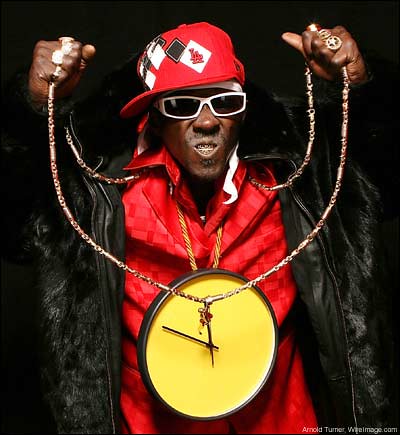
And please understand: I might like some of you, but I'm not blogging here because I want to make friends. I'm not here to make friends, I'm here to be with Flav.

flavor

Labels: , ,

6.23.2008

Why So Coy?

Okay I lied a little. I decided to watch a brace of shitty vampire movies (the Underworld series, soon to have a third installment) and then followed it up with a pretty good BBC serial called Ultraviolet. This isn't really a review of either one, just a jumping off point for a musing. Maybe gearing up for Buffy.

Both Underworld and Ultraviolet attempt to take a relatively science-informed perspective on the whole vampire schtick, and have the obvious starting point of viewing the vampiric condition as, basically, a virus. Underworld is a little more pretentious with its faux-scientific aspirations and actually tries to just offer a hand-wavy explanation for the virus: a plague swept through a fifth century Hungarian village and killed everybody except one Alexander Corvinus, who, we're supposed to gather, had some genetic mutation that by chance allowed him to survive the plague by mutating it, with the result that he was immortal. So far so good, for what it's worth, and the whole plot of the first movie especially is involved with the fantasy-logic of evolving strains; one of Corvinus' sons wound up being the first vampire and the other the first werewolf. Except that the reason why is that one of them was bitten by a bat and one by a wolf. So this crazy plague-virus-mutation *also* had the ability to, uh, incorporate DNA characteristics transmitted through another animal's saliva. And those characteristics which humans find evocative, rather than the ones which are actually germane. A little dodgier ground. What makes it hilarious is the self-seriousness of the first movie's commentary, where Len Wiseman (the director and co-creator) and Kevin Grevioux (co-creator and the big black dude with the crazy deep voice who plays a werewolf) talk about their desire to make it all plausible within the movie's world. They're not fooling themselves that they're dealing with actual science, but they're gesturing very broadly at the idea that, given their first principles, they've tried to work out something plausible and rigorous, which is an admirable notion that reaches its climax when Wiseman explains that in these movies vampires DO reflect in mirrors because he couldn't come up with a reasonable explanation for why they wouldn't. At which point I burst out laughing because, for fuck's sake, What is the reasonable in-movie scientific explanation for being allergic to ultraviolet light?!?!?! Because the vampire ancestor was bitten by a BAT?! So "prefers the night-time" is glossed as "will burst into flame when exposed to the sun?" JEEEEZ, guys.

(NB1: The "vampires reflect" thing is actually put to very clever and subtle story use in the first film, so props for that.)
(NB 2: The association between vampires and bats is much younger than the idea of the vampire. The word "vampire" in Slavic languages traces back about a thousand years, but the various cultural manifestations of the idea [in Slavic and other cultures] are much older. The vampire bat, on the other hand, is indigenous to South America and wasn't encountered by white men until the 1600s; the bat was named for the beast, not the other way around. Also, vampire bats are a lot smaller than the bats you see in vampire-associated contexts these days. Fairness does compel me to note that bats were considered to have mystical properties in Europe, and so maybe there was some association predating the vampire bat after all. Probably not, though.)
(NB 3: The idea that vampires are allergic to sunlight is less than a hundred years old and seems to date to the film Nosferatu in 1927. In Stoker's Dracula, the titular character is weakened and less powerful in sunlight, but fully capable of walking around in the daytime. Incidentally, the no-reflection theme is considerably older [though not at all universal] and may date to the days when mirrors were backed with silver, which was considered a good all purpose material for fighting supernatural bad guys. Werewolves with silver allergies, by the way, is apparently a sufficiently rigorous scientific concept for the Underworld braintrust.)

This kind of myopic seriousness is indicative of Wiseman and Grevioux's contentions that they're just really big "genre" fans and wanted to make a completely unapologetic and uncompromising "genre" film. I hate the use of "genre" in this sense, where it's deployed as a descriptive noun to mean "stylistic or plot-based ghetto". What they really mean is "horror," except they don't because they admittedly made an action movie. So what they do mean is, in fact, "not-'literary'." What this results in is taking the world-building conceit superseriously, which is a valid way to go except for where the whole "mirrors vs. sunlight" and "being bitten by a bat" thing makes it ridiculous. I certainly wish that at times Buffy had been more careful with its own continuity and world-building, but Joss Whedon was always forthright about that not being his primary or secondary interest. Whedon is a gigantic "genre" fan as well, but his engagement with genre tropes is to play with deconstruction and collage of those elements. Buffy's raison d'etre, particularly in the first three seasons, was the extended articulation of the horror genre as a metaphor for everyday life: your school is a pit of Hell, if your mom won't let you go out tonight it will be the end of the world, sleeping with a boy will change him in very real and upsetting ways. This would be insufferable if the show didn't have a sense of humor and, really, a sense of camp about its own mechanisms; it couldn't be what it wanted and shoot for the straight-faced tone to which Underworld aspires.

(NB 4: Another mechanism of the whole "we're just big fans of 'genre'" thing is the way in which Underworld is sort of fan-service-y. Wiseman talks on that same commentary track about how, filming a particular shot of Kate Beckinsale walking from behind, he told her "I'm really sorry, but this is absolutely going to be in the trailer." And it was. [He doesn't mention, on the commentary, that during filming he and Beckinsale began a relationship {they're now married} and she ended a longstanding relationship with the father of her daughter, which gentleman was also a main character in the movie!] Vampires are sexy, post Anne Rice, and part of being "genre" for these guys is putting attractive women [and let's be honest, Beckinsale in skintight black leather is one of the things that kept me awake through these two flicks] in revealing costumes. On the other hand, there are no female werewolves in either movie, because presumably werewolves as conceived here aren't sexy. In the Buffyverse, werewolves [in their wolf form] aren't sexy either, but there are two female werewolves of some considerable appeal anyway, one played as a somewhat unlikeable femme fatale and one played as a sympathetic romantic interest. Not to mention, of course, Seth Green's turn as Oz. In Whedon's world, the emotional logic rules everything else, whereas in Underworld the allegiance really winds up being "what do we think is cool." Really really really hairy chicks is apparently not cool.)

Ultraviolet is much better. For one thing, it has Idris Elba (fans of The Wire take note!) and Jack Davenport (fans of the original BBC's Coupling take note!) among other players in a very strong cast. It's six episodes long, tells a compact dramatic arc, and works on its own terms much better than Underworld. The show is much less concerned with origins; the science works to the degree that humans have figured it out (yes, it's a blood virus, and you can do things like isolate the active ingredient in garlic and use it in a smoke bomb), but the whence and wherefore of vampires is left unexplained, unknowable. One character deduces that it was exposure as a young boy to vampires which drove another character into the priesthood - what but a vampire could be a clearer sign that there were supernatural powers in the world? By being less ambitious with the extent of explanations, Ultraviolet's science works better and the show overall is much more compelling. It does, however, share a title with a Milla Jovovich movie directed by Kurt Wimmer, and the Netflix envelopes for the show think they're holding the movie.

Fun fact: the Milla Jovovich Ultraviolet is ALSO sort of about vampires! I did not know this from the trailers to that movie! Like, no mention of vampirism, or indication of explicitly and uniquely vampiric qualities! It's like they didn't want us to know there were vampires in the movie. Which by the way, nobody says the word "vampire" in the show Ultraviolet. They call them "Code Fives" - i.e., "Code V" - or, for slang, "leeches", but usually "them". The show's creator has said he thought it'd be easier to sustain the tone he wanted if nobody used the word. Also: while people do use the word "werewolf" in the Underworld movies, the preferred term is "Lycan", as in "lycanthropy". And the reason is because Len Wiseman and Kevin Grevioux thought werewolves were a little cheesy and didn't think they could or their audience could take seriously the use of the word over and over. Hence lycans. GUYS: You developed a whole movie around the idea of a war between werewolves and vampires and then you thought that you were a little embarrassed by the fucking word werewolf?!?! This is what I was talking about before! It's a perfectly good word with perfectly respectable and scary Germanic roots. So anyway, I knew the movies had werewolves when I saw the trailers because I deduced it from the whole clever "lycans" thing, but otherwise I might not have known until I started reading the press. And finally: I haven't seen I Am Legend, and I'm not really interested. But: the early press, at least, for the movie gave no indication as to who or what the monsters were. At the time I assumed that they'd followed the book and made them vampires, but instead they made them, apparently, some sort of zombie-like thing, because they decided they'd rather re-make The Omega Man, itself a profoundly unfaithful adaptation of the source novel, one of the great works of 20th century horror. Some day someone will make a faithful adaptation that actually understands what the fucking point of the book is, but until then I'm left to wonder why only the first movie version - The Last Man on Earth, starring Vincent Price - bothered to use vampires instead of vaguely associated zombie creatures. Are undefined zombielike mutants so much more palatable than vampires?

(NB 5: This, from the wikipedia article on the Will SmithI Am Legend, fucking kills me everytime I read it: "The director [Francis Lawrence, who directed Constantine and a bunch of music videos] had watched The Pianist with a low volume so as to not disturb his newborn son, and realized that silence could be very effective cinema." This is priceless. An adult who aspires to be a film director took until the last few years to realize that silence could be effective as a dramatic tool? He didn't notice this from watching any actual movies that intentionally deployed long stretches of silence? This guy got to direct a fucking movie?)

People seem to be anxious about admitting their vampire and werewolf movies have vampires and werewolves in them. They seem to feel the need to disguise or apologize or alter them so as to not seem so - what, silly? If the idea is silly it's silly even when you call your werewolves lycans. The (late) WB network apparently always had a problem with the title Buffy the Vampire Slayer, and I can see why; like with Battlestar Galactica, in addition to struggling with the memory of a predecessor work bearing the same name, the title is a barrier to someone presuming he can take the thing seriously. But I do like Whedon's rejoinder, which is that it's all right there: the show is a blend of comedy (Buffy), horror (Vampire) and action (Slayer). What else do you need to know?

Labels: , , ,

6.19.2008

Everything Happens To Me

I was typing up something about a guy at work, which inspired the post title, but then I realized that in text form, to people who haven't met him, it'd be utterly boring, so I scrapped it, but kept the post title because I like it despite not at all remembering how the song goes.

I'm currently reading Shamanism: Archaic Techniques of Ecstasy, by Mircea Eliade, which is/was a classic text on the subject in the comp religion/mythology field, published almost sixty years ago now in the original French. I gather from Wendy Doniger's forward that the book has fallen into some questionable repute (for one thing, Eliade was more a historian than an anthropologist, and the book is entirely composed of secondary sources, which is something I admit to not knowing when I bought it, but there weren't a lot of lay-scholarly books on shamanism competing with it for shelf space), but while offering some criticisms of her own she defends it as a valuable perspective on the topic and a useful starting place for inquiring minds (like mine, I guess; Doniger is herself not without her contentious critics). Anyway, I'm slogging through it with some interest although I feel like the first three chapters are actually the same chapter over and over.

The reason I bring it up is because of this passage, describing an Inuit shaman named Aua:

Aua summons his two helping spirits with a monotonous song:

Joy, joy,
Joy, joy!
I see a little shore spirit,
A little aua,
I myself am also aua,
The shore spirit's namesake,
Joy, joy!

He repeats this song until he bursts into tears; then he feels a boundless joy.


When I read that I went, roughly, "bu-whua?" He repeats the song until he cries? Why would the song make him cry? I actually get why he would feel a boundless joy after crying because I have, at times, felt something similar, and I guess that was my point of entry here. The thing to bear in mind, I suppose, is that despite modern context making the book's subtitle sound really porny, "archaic techniques of ecstasy," of the ecstatic, is Eliade's take on what constitutes shamanism per se and sets it apart from more generalized mysticism, medicine man, magic type mythology and ritual. The shaman's ability to achieve an ecstatic, transcendent state. So it would make sense that Aua is more capable of moving himself to great emotion than the average person today - or maybe what's elided in Eliade's summary of someone else's field notes is that (speculating) "repeats this song" glosses over something more like "repeats this song ceaselessly for five hours," which would probably be enough to put anyone into a very heightened and delicate emotional state. Of course, "anyone" simply wouldn't do that, would give up after ten or thirty or eighty minutes.

So: a given that the shaman is more willing and by nature of his skills more able than the average person to access extreme emotional conditions - and to do what is necessary to get there. But I also wondered, not for the first time (here we approach the point) whether other cultures and, in other times, our culture (or, if you like, our culture's recent ancestors) were simply more emotive. One common reaction to artistic works from different cultural moments, even relatively recent ones, is to find them somewhat maudlin. Maybe that's a semi-universal (and reciprocal?) response, the inaccessibility of one set of cultural assumptions and experiences to another, so that we're fooling ourselves if we think we can slip seamlessly into the skin of an original audience member. Or maybe our culture is just locked down and colder, emotionally, than the ones which have come before it. In Season Two of Carnivàle, in the episode where Jonesy's leg is healed, he whoops and hollers and does a bunch of abortive little quasi-Irish jigs, kind of dances in a half circle. It's an endearing and kind of loopy expression of elation, but on the episode's commentary track Daniel Knaupf (the show creater) says approvingly that it's a "very 1930s" expression of happiness. My first thought was to say "how the fuck would he know?" and my second was to concede that it's a very 1930s movie expression of same. But maybe it's really authentic: maybe similar scenes in films from that era are descriptive and journalistic rather than more expressionistic and heightened. Maybe merely seventy years ago we danced jigs of joy and wouldn't have found it so strange that a First Nations shaman from Canada made himself weep by singing a little ditty about his shore spirit.

Labels: , , ,

5.26.2008

Alsø alsø wik:

And I think that's it for my blogging about "new to me" TV shows, at least for a while. I've actually managed not to see the entirety of the final season to any of the three great HBO dramas, but if I ever blog about those I think I'd want it to be in a more comprehensive capacity, which would at this point require a lot of rewatching as well. (Plus, honestly, I'm not exactly chomping at the bit emotionally to watch them right now.) I generally have less to say about comedies, so even though there are some I'm interested in I doubt I'd write about them, and I've essentially seen most/all the other dramas I was interested in. As a fan of David Milch I suppose I should go back and check out NYPD Blue but it's a big project for another day. Also I'm thinking I want to scale back my Netflix subscription (again) to something that would be suitable for watching movies on a regular basis but not sufficient to let me rip through TV shows the way I like to. I want to get more reading done and spend less time passively sitting at the computer, so cutting down on the whole "I watched eight hours of DVD this weekend!" would be a good start.

Plus I'm thinking about embarking on a project I've had in mind for quite some time now, where I go episode by episode through my favorite TV universe of all, probably the only one I have remotely that much to write about, and just get everything I have in my head by way of response out on paper. It's a long project, and it'll take a *lot* of writing, and it'll probably be of no interest to most of my readership, but I want to spend the time luxuriating in this show, its' spinoff, and some of the extended media, plus it'd be a major flexing of various types of critical muscles.

That's right. Coming soon: Medrawt Blogs Buffy.

Labels: ,

Welcome To The Church...Of The Aiiiiir!: Carnivàle

That's my favorite running schtick from Carnivàle, the deadpan announcer introducing Brother Justin's radio evangelism faking enthusiasm and drawing out the word "air." Made me giggle every time.

Carnivàle ran for two seasons, ensorcelled many, confused many more, got cancelled. One of the attorneys from the Medium Sized Law Firm where I used to work said it was his favorite TV show of all time, so I figured I'd finally check it out. It was the only one of the major HBO dramas (barring recent additions) I'd never seen, and I wondered whether it'd rearrange my estimation of their programming. The top three of The Sopranos, The Wire, and Deadwood are, for me, many cuts above everything else - Oz, which I managed to catch a few seasons of, Six Feet Under, the first season of which I thought was pretty good but rapidly started hating what followed, Rome, which I saw one episode of but frankly just can't get myself to care about, and so forth.

I'd say Carnivàle is somewhere in between, but closer to the second group than the cream. The production is gorgeous (well, gorgeous for the Dustbowl), and there's a texture to much of the camera work that, lacking the relevant technical information, I don't know how to describe, but I rarely see its equal on TV; by memory, my three top HBO series get there but rarely, but Battlestar Galactica seems to hit that spot a lot. The production is gorgeous and the acting is first-rate, especially Clancy Brown as Brother Justin Crow and Michael J. Anderson as Samson. The show also featured, in two major roles and one minor recurring role, three bit players from Seinfeld: Bizarro Jerry (Tim DeKay, fantastic as Jonesy, ex-baseball player and leader of the roustabouts), The Wiz (Toby Huss, fantastic as Stumpy, paterfamilias of the cooch show), and Lloyd "Why can't you be more like Lloyd Braun?" Braun (Matt McCoy, fantastic at...looking like Lloyd Braun). And everyone else is good, even Meatloaf's daughter (seriously).

It's the writing. Oh, the writing. The pace of the show is glacial. (OK, so I'm going to start with the editing.) On a basic level, there are long moments of silence meant to create suspense, or meaning, or just atmosphere, and sometimes they work but often they bore. When - look, spoilers are going to abound, in case anyone's curious I'll try to avoid the truly essential revelations, but plot points are going to get mentioned - when Jonesy reveals that his injured knee is healed, the scene feels like it takes forever, like it actually takes the amount of time it would take a real person to undo all the laces on a leg brace and remove it. The audience already knows the knee is healed, so we feel no suspense, just boredom. This is elementary filmmaking; you get economy and a sense of narrative thrust if you show him starting to untie the laces and then cut to him removing the brace, and don't eat up the twenty seconds of screentime it takes to do it. So there's that. There's also a lot of staring on the show, but whatever. Also glacial is the pace at which the story advances. In actuality, despite the pace of the editing, there's usually a fair amount of plot laid out in each episode, it's just that the show is driven by the unfolding of a larger story and it's *that* story which oozes like molasses. Most of what happens in a given episode is circuitous and irrelevant - think Ptolemaic/Copernican epicycles instead of a nice straightforward orbital ellipse. There are about two episodes which exist because Sofie refused to give Ben a tarot reading; when he does get the reading, he gets a solid clue on where he needs to go next and takes it, advancing the plot. What happened in those intervening episodes? Uhm, a lot of cool imagery. Seriously: he tracks down a woman who turns out to be his creepy blind (?) grandmother, sees what appears to be a plaster death mask of his father, tracks down the guy who made the mask, has what appears to be a hallucination of the guy drugging him and making a mask, only it turns out that it really did happen and Brother Justin winds up getting the plaster Ben-mask in the mail. Justin holds the mask up to his face, sees through Ben's eyes for about twenty seconds, and then the mask breaks, Justin drops it, and the episode ends with a puddle of blood oozing out from the broken mask. Which looks cool, but we didn't learn ANYTHING here (well, we learned a little about Ben's grandmother, but only about ten minutes' worth). Ben doesn't get any closer to finding what he's looking for, and our time is wasted since the masks turn out to be of no importance. Also towards the end of this episode Sofie finally reads the cards, Ben has a vision of Damascus, Nebraska, and away they go, without so much as an apology for wasting our time.

And that's kind of how the plot goes. It's not an especially rewarding experience hour to hour, although there are standout episodes (Season One's "Babylon"/"Pick a Number" two-parter is mighty affecting and creepy) and lots of standout moments. The scene in the last episode where Ben uses his healing powers on as many people as he can, intentionally drawing the life force required out of a trapped Brother Justin, is exhilarating because without any effects it easily communicates the wonder of the moment, and serves as a release for the pent-up frustration of Ben being so cautious about the use of his gifts (although the healing of Jonesy from a few episodes earlier is like the warmup for this moment).

Hold on - he can heal people, but only by taking the life force from someone else? Yep: welcome to the mythology of Carnivàle. That's just one of the many cool ideas underpinning the show: Ben Hawkins is gifted with the ability to move life-force from one place to another, but he cannot create it. In the pilot episode he heals a girl crippled from birth, but the crops around her must die; he brings Jonesy back from the brink of death (and inadvertently heals his knee in the process) by getting him way out into the desert and letting Jonesy's body attract a flock of vultures, who serve as the sacrifice. This is powerful, elemental stuff, as is Brother Justin's primary power of manipulation, which early on usually takes the form of causing others to have controlled visions, particularly of their great sins.

Both Ben and Justin's powers continue to grow, because as it turns out they are the latest in a line of not-quite-human creatures called Avatars, descended from the first of their kind, a woman who lived before the Flood and is known only as the Alpha. Her descendants all have the potential to express these powers, but only the males, and only two per generation in a given line, actually manifest them. Also, one of the Avatars is a Creature of Light and the other one is a Creature of the Dark, and they are mortal enemies, but the Light/Dark aspect isn't genetic; the Light Avatar of one generation could be born to the Dark Avatar of the prior one, and vice versa. (This turns out to be the case on Carnivàle.) The seniormost living Avatar one either side is called The Prophet, and he has much greater power by virtue of his preeminence and his special blue blood, which in practice looks sort of like shower gel; the junior Avatars are called Princes, and they can only become the Prophet by killing the current title-holder (in the Light/Dark continuum, not their genetic father) in such a way that he either gives his powers up willingly or is taken by surprise and incapable of putting up psychic defenses. There will eventually be a Dark Avatar with special powers known as the Usher, as in the Usher of the Apocalypse, and there's also a shadowy figure called the Omega, which in the universe of the show everyone with knowledge of Avatars assumes the Usher and the Omega are the same, but they're actually not! (Except we never meet anyone who explicitly tells us that they're surprised to learn the Usher != the Omega, so this piece of information is useless.)

There: I've just told you roughly 45% more about the mythology of Carnivàle than you'd learn if you carefully watched every episode of Carnivàle. Eventually Ben Hawkins learns everything there is to know about the whole Avataric business, which is nice because heretofore pretty much all the characters we have access to as audience members are in the dark about it as well, but: he gets it by psychic transfer, so we never hear it explainedto him, and it continues to be mysterious! All the shit I just explained comes from show creator Dan Knaupf, who released the background on a lot of this mythology after the show was canceled. It's a lot of byzantine mythology that isn't endeared to me by being inaccessible without doing outside reading, and it's clear that Knaupf still kept a lot of stuff to himself.

For instance: the first scene of the show tells us that the first nuclear explosion (the "false sun" detonated in the desert at the Trinity test site) is a line of demarcation, when [paraphrasing now] Man forever gave up Wonder for Reason. Or something like that. Well: is that a good thing, or a bad thing, or an indifferent thing? On the one hand I'm being unfair because Knaupf only got to spill out the first third of his projected story, but on the other hand I think a lot of this mythology is uncompelling and/or poorly thought out when subjected to scrutiny, and further information would need to either retcon what we already though or keep pulling back layers to which we were never privy. So:

There's a struggle between the Light and the Dark, but the nature of these concepts aren't spelled out. Ben is provided visions of Trinity and it's implied that this is a disaster that he's supposed to stop, except that we know he didn't (they did develop a nuclear bomb), so did the Dark win? Or maybe all the characters are wrong and the Bomb/Embrace of Reason is a Good Thing, and the Light won. Except that it's not clear why either the Light or the Dark should have a vested interest in ushering (!) in modernity, when their whole gimmick relies on the deployment of magics that, by the show's own lights, have been abandoned for science. So maybe the Bomb is in fact the Nobody Wins conclusion to a deadlocked (and pointless?) struggle. There are hints, expanded on by lots of fans who've gone much deeper into the show's mythology than I particularly care to, that the show has a Gnostic concept of Light and Dark, which is to say that they're equally opposed mirror images, and not the traditional Christian (say) relationship where the Light is superior in moral strength and more powerful, necessarily triumphant. (Like I said, there are people who've gone much deeper into all of this than I'm going to, but that's part of the problem: I'm a smart guy who's fairly comfortable with a lot of the meta-mythological concepts floating around here, and the idea is that carefully watching twenty-four hours of the show and doing a few hours' worth of extracurricular reading isn't enough for me to get a handle on what's going on?) And that's an interesting idea that's pretty well borne out for the first season and change, where Ben and Justin both seem to be more complex than simply Good and Evil (although Knaupf is right to be surprised that people spent the first season wondering if they really knew who was Light and who was Dark: in the pilot episode Ben heals a girl's legs and Justin makes an old woman vomit up coins). Brother Justin eventually becomes more and more transparently Wicked, though, and the manifestations of the Dark powers are kind of goofily lopsided: when they really get going, Dark Avatars' eyes become entirely black, while Light Avatars look...the same. Also, Dark Avatars are physically disturbed when a Light Avatar makes significant use of his powers (like, Ben heals Jonesy and five hundred miles away Justin starts writhing in pain), but when the roles are flipped, there's no apparent effect on the Light side. So it would seem that the Light and the Dark aren't evenly balanced, and the Light is better, which is significantly less interesting.

Especially since the Brother Justin side of the story tends to be a lot more engaging, probably because it's simpler and less opaque. Justin is a minister gaining power and influence, he and his sister Iris have a creepy borederline incestuous relationship, Iris is torn between absolute devotion to her faith and absolute devotion to her brother (Amy Madigan's portrayal of Iris' evolution as she realizes that these two allegiances are in opposition is one of the best acting jobs on the show, actually), and lots of milk gets spilled. (Really.) Conversely, the Ben storyline, wrapped up with the carnival, is responsible for much of the boredom, long stares, and so forth. For all the ostensible attention the milieu of the carnival with its freaks and aberrations and hey they're just like normal people gets, the freaks per se play a minimal role. Samson, a dwarf (played by a dwarf) is a major character, but the only other freak with a plot is Lila the bearded lady (played by a non-bearded lady wearing a prosthetic). Several people with real physical deformities crop up (and there are minor characters played by physically normal actors who portray physical deformities), but 95% of the non-Ben carny plot is taken up with the cooch show (i.e., a family of strippers/prostitutes) and the dynamic between Jonesy and Sofie (who may or may not have mystic powers, but whose mother is one of the few carnies who does have genuine abilities), and the eventual collision of these two plotlines. In other words, there's a lot of regular people playing exactly the sort of storylines you'd get on your average relationship-drama, except with more nudity and less bathing. Yes, there was more to a carnival than the freak show, but we don't even get to see a Geek except in jittery flashbacks. Come on, now. Why bother with the carnival at all?

Labels: