6.09.2009

And If You're Wondering About Archie...

I don't know if my readers are aware that, apparently, Archie is going to marry Veronica. If you want to understand why, look here, and then here. It'll become clearer.

Labels:

4.11.2009

Yeah I Got Links

In general I'm the sort of person who is simultaneously flabbergasted by women who remain in abusive relationships but also who thinks endlessly interrogating them as to why they don't/didn't leave (sooner) is unlikely to be productive or helpful to the woman abused, because I don't think rationality plays into it very much, and I also believe that as the abuse goes on for longer periods of time, psychological conditioning subverts what other people would consider to be normal reasonable behavior and response to that kind of treatment.

Anyway, I found this, from the estimable Hilzoy, to be an excellent consideration of a difficult topic. (So did, apparently, everyone else in the blogosphere.)

In less serious territory, I'm going to humbly suggest that you check out - I will provide the links at the end - the most recent week of Penny Arcade, the online comic that's ostensibly "about" gaming. Despite being roughly a decade out of date with their supposed subject matter (they deviate a *lot*, and the jokes are almost always gettable even if you're not a gamer, I think), I usually love this strip, because I have an affinity for their sense of humor and I also enjoy the writing style of Tycho, the writing-alter-ego of the comic's creative duo. However, one of the most interesting things about Penny Arcade is the evolution of the art, provided by Gabe. The first strip, from (wow) over ten years ago, looks like this. (It also isn't really funny.) A few years later it looked like this. (I'm not selling you on the funniness of the strip, I know; it's gotten better writing-wise as well. I picked this one because I stumbled across it accidentally and it conveniently introduced the Cardboard Tube, which will be relevant later.) Which eventually evolved into this, which is more or less what it looks like today. Except for when they take advantage of Gabe's vastly improved artistic skills to deviate from their normal format and stretch their legs and do things like:

This, and

This. That's from the middle of one of the adventures of the Cardboard Tube Samurai, which is a silly joke they've used to present some surprisingly lovely art and elliptical storytelling. Which brings us to:

(And, yeah, I'm aware that I'm lavishing many more words on a webcomic than I am on domestic abuse.)

The most recent three-part tale of the Carboard Tube Samurai, which is like the one I linked above completely wordless but offers up an unexpected punch at the end. As Tycho said in the accompanying blog post, it's apparently about fatherhood. Shit.

Part One
Part Two
Part Three

So.

Labels: , ,

9.06.2008

ComicsChrome

I'm currently reading my way through Google's online manual/exegesis on their new browser, Chrome (hat tip to James Fallows, who's worth reading as well). It's a pretty great piece of work; I can't actually use Chrome yet because the Mac version is still in development, but reading the manual is interesting to me in that I've retained just enough tech savvy to understand 51% of the content. The combination of graphics and text is also fantastic; Google has the clout (or the money, or even just the idea) to get Scott McCloud to illustrate their text. McCloud is not merely a comics author/artist in his own right with respect in the independent comics world, but he's the author of Understanding Comics, which I've never read and is not without its detractors but is largely acknowledged as the preeminent work of comics theory on the market. Understanding Comics is, of course, written as a comic, and McCloud has written other books of comics theory/evangelism which push for expanding and exploiting the unique possibilities of the medium while simultaneously providing an example in his own use of comics techniques to communicate a non-narrative, intellectual argument of the sort you'd normally encounter in a literary journal.

I haven't finished the guide yet, but one of the things I find interesting and (usually) appealing is that Google does seem to have really re-thought the precepts of using a web browser to better suit the uses and developments of browsers that have taken place over the past decade: tabbed browsing, the use of the internet to handle personal information and life management and the corresponding security concerns, and of course "Web 2.0" [gah]. What follows from this but I'm less immediately taken with is the attempt, which shouldn't surprise me coming from Google, to create a browser that will guess what I want to do. I generally don't like it when technology or people try to guess what I want. I don't mean a music service or Netflix tossing me recommendations, I mean making behind-the-veil decisions which constrain my options and make me workaround to do something else. Some day I'll figure out how to control all the different formatting options in Microsoft Word so that I don't need to keep correcting the computer manually just to get bullet points here and indented text there. Somebody, meaning well, was packing stuff in my dad's home to ship to the condo here, but they included all sorts of stuff that we didn't ask for and in fact didn't want here, and some of this stuff was broken in transit. If you just DID WHAT I FUCKING TOLD YOU then my trinkets would be safe and sound where I wanted them in the first place.

On the other hand, maybe Chrome is smart enough to work around this. One of the designer/characters complained about the aesthetic and practical frustrations of the URL bar autocompleting the addresses he starts to type, and how at first he rebelled against including that feature in Chrome, but in fact in Chrome this feature Works Better! because it will only autofill for things you've actually explicitly type. Which means, since I doubt you typed the URL for a specific story on (to use their example) CNN.com, you won't get that prompt. "Fuckers!" I cried, "I use the autocomplete to find shit like that all the time! I like the fact that if I want my last day or two of browsing is preserved and I can find something that was difficult to navigate to the first time around!" But then I read that Chrome will let you hit the Tab key to search within the website whose address is autocompleting for you. We'll see, I guess; this could be cool, or it could suck, or it could just be a more elegant way of executing the search terms I use in Google anyway (if I'm looking for a story on CNN.com, I'll type my search terms and then add the string "site:cnn.com").

So there's that.

Labels: , ,

7.24.2008

When You're In A Rut

You're in a rut. Blogging the contents of my Netflix queue won't get me to stop reacting to comic-book superheroes if my Netflix queue is bringing me...comic-book superhero movies. I watched, over the past few days, three classics of the genre.

Taken as a collective, they blow.

Superman, the Richard Donner film with Christopher Reeve and Gene Hackman, is alright. Reeve is really good, actually, and Margot Kidder is some kind of charming, and Hackman belongs in a different, yet highly amusing, film. Actually, Reeve is really good as Clark Kent and merely good as Superman, in my opinion; he handles the bumbling put-on with considerable panache, and the two or three moments across both films where you see him, dressed as Kent, drop the facade, are really cool. (Didn't even notice he was slouching, but he uncoils to full height and takes off the glasses and his whole face changes. I think one time they even cheated a hairstyle change, from Kent's goobery combover to Superman's iconic forehead curl.) Some of the Superman stuff, he comes off as smirking more than, well, Superman-y. Also, I'm not down with bringing Lois back from the dead, but they also weren't originally going to kill her anyway, so it's a pointless zero-sum game.

Superman II is awful. It's a miraculously stupid movie full of some miraculously stupid people, not least of whom include main characters who were not blithering idiots during Superman, which nominally speaking was scripted and partly shot at the same time as this abortion of a film. It's really bad from a storytelling craft standpoint, and salvaged only by some fine work from Hackman and the completely out of place yet enjoyable coda at the end, where Clark Kent returns to a moment of humilation, kicks a guy's ass in blatant Superman-y fashion, and then dorkily mimes doing a bench press while shrugging his shoulders and telling an awestruck onlooker, "I've been, you know [dorky bench press] working out."

Batman was coincidentally summarized by a coworker as "candybutt," which I guess is true. I liked it less than I remembered. Basically, it strengthened my impression that, as a director, Tim Burton is a really interesting production designer. His quasi-famous disdain for actual comics doesn't really help him out here; Frank Miller's The Dark Knight Returns was apparently highly influential to everyone on set (and it's easy to see why someone who otherwise doesn't care for comics would respond to it), and the movie's tone is basically TDKR crossed with the 60s TV show starring Adam West. Superdark crossed with high camp and we wind up actually in very Burton-y territory: the frighteningly whimsical, or whimsically frightening, that doesn't do much for me, even though I kind of dug Edward Scissorhands. The tone is all wrong because it's all mixed up; a campy Batman isn't what I want to see, but it's a valid and historically grounded take on the character and his world. Michael Keaton (nice job, by the way) isn't campy, but Nicholson is, except he's killing people. Nicholson's Joker murders people, horrifically, left and right, but plays the character for over the top looniness, and what's worse is that the movie follows him. If this movie is supposed to make me laugh, it shouldn't try to make me laugh at the death of innocent people.

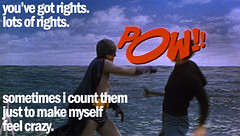
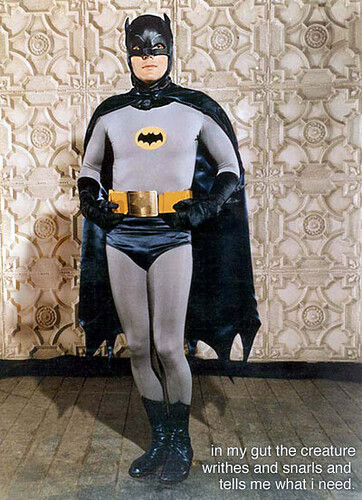
Far superior, as a mashup of Adam West and The Dark Knight Returns, is this work of genius. Excerpts:

west_dkr_4
west_dkr_9

Labels: ,

7.21.2008

Who Watches The Watchmen Adaptation?

This is, obliquely, another comics-y post, but with much more generic concerns.
 
I've often said that films should adapt short stories rather than novels.  As a matter of course, they do sometimes adapt short stories - I gather that this was more common several decades ago than it is now - and of course a very high profile recent Oscar nominee (Brokeback Mountain) was adapted from a "novella," I don't know how long.  The crux of my argument is that it takes, on average, two hours to experience a film, and depending on length it might take anywhere from twenty minutes to two hours to experience a "short" story.  A 350-page novel probably takes me about seven or eight hours to read, less if it's breezy or I've read it before, more if it's got any kind of density.  You simply cannot put the contents of a novel into a film; there must be abridgements of something.  I think there is a real art to adaptation (I'll come back to this in a minute) and recognizing how the strengths of one medium are not the strengths of another, and what must be done to compensate.  But when "adaptation" means "cutting out at least 50% of the content" then something is wrong with your conception.  Or your source material.  One of my favorite movies, Fight Club, was adapted from a novel, but it's not in my estimation a very good novel.  Airport books, techno thrillers, and so forth can make compelling source material because much of the content winds up being purely descriptive and/or marking time.  A two-page disquisition on the merits of an Uzi vs. a H&K submachine gun may or may not be interesting in text but is ultimately best shed in the transition to film; likewise a lengthy explanation of a tactical team's deployment as they prepare to assault a warehouse/terrorist training center is effectively compressed into three seconds' worth of camerawork.
 
But for the most part either plot or characterization or dialogue - and the three are all caught up in each other, of course - needs to be severely compromised to make for a bearable running time.  And so: why?  The market for a particular book is much much smaller than the market for a movie adaptation of same.  I can't imagine that Wonder Boys, one of my favorite adaptations of a novel - and yet which cut my favorite scenes from the book - and which lost money while grossing about $33 million, rose or fell based on the book's status as a bestseller (which it was).  I can't at the moment find sales stats for the book (Evan? do you know where to look?) but it surely didn't gross $33 million for its publisher, which would imply that it sold well over a million copies.  I have a hard time imagining that it sold as many copies as the movie sold tickets, though I could be wrong (call it around 350K tickets?).  For the movie to have turned a significant profit its audience would have needed to be much larger than that of the book.  So even in the best case scenario, the popularity of a book (unless we're talking about a cultural phenomenon like Harry Potter) can't really have much to do with its success as a film.  What's the appeal, then?
 
I presume it's something like cachet.  Film culture is heavily invested (mistakenly, in my opinion) in turning to prose literature for its source material, and the novel is the prestige format for prose material (who reads short stories these days outside of MFA programs? and who writes them except people who went to MFA programs? I'm exaggerating, but only so much), and so that's where the film industry turns.  And why do all these books and their publishers/authors want to be turned into movies?  Well, $.  Excuse me: $$$.  But also because the feature film that opened in a cinema was and is the prestige format for the filmed medium.  I happen to think that to the extent there should be a prestige format at all vs. a recognition that different things work best in different circumstances, it *shouldn't* be the cinema, but the point isn't worth arguing.  I think it should be TV, but that's based entirely on what I perceive to be the potential of television vs. the reality.  It's only over the past fifteen or so years that (American) television has started cashing in on its artistic capabilities on a regular basis and routinely turning out product that's easily as strong as the best Hollywood has to offer, if not stronger. Still, the advertising mandates and seasonal structure that continue to undergird network prime time programming are semi-permanent barriers to television's full flowering as an artistic medium; so be it. The point remains that if you're going to adapt a story that took eight or ten hours to read, if you think it's worth adapting to another medium in the first place, shouldn't you want to preserve as much of it as possible? Why did the network TV miniseries die? (because they haven't done an interesting book since Roots, aside from all those late 90s classics adaptations like the Odyssey and Gulliver's Travels?) - why hasn't anyone done before now what the guy who wrote Generation Kill (a nonfiction book about Marines in Iraq) did, and spin it into, essentially, a one-season series for HBO?
...

All of this is in response to the newly available trailer for the movie adaptation of Watchmen, coming out next March:


The trailer says it's the most acclaimed graphic novel of all time, and you might quibble about Maus, which after all won a damn Pulitzer, but I'll quibble back and say that Maus is to some ostensible extent nonfiction. Watchmen was also included in Time's list of the 100 best English language novels since 1923, which is a grossly stupid thing to do, but I guess we're supposed to take it where we can get it. (Watchmen is, in my opinion, better than any number of great novels, but it's not a fucking novel; it's also better than any number of great paintings, movies, albums, and so forth.)

So: Watchmen is really fucking good. It's not my personal favorite work in the comics medium, but I (neophyte fan yet) haven't yet read anything that I would critically argue surpassed it. The trailer also looks pretty good; I'm not crazy about some of the aesthetic updates in the costuming, but several of the shots are ripped straight from the panels as drawn by Dave Gibbons. I'm also, a priori, impressed that they chose to keep the period setting. However, first we can turn to the author, Alan Moore, who is famously curmudgeonly about his work being turned into movies, but if you'd written V for Vendetta, From Hell, and League of Extraordinary Gentlemen, all highly acclaimed works in the comics medium, and watched them get turned into, well, V for Vendetta, From Hell, and League of Extraordinary Gentlemen, you'd be a curmudgeon too. Moore: "You get people saying, 'Oh, yes, Watchmen is very cinematic,' when actually it's not. It's almost the exact opposite of cinematic...I didn't design it to show off the similarities between cinema and comics, which are there, but in my opinion are fairly unremarkable. It was designed to show off the things that comics could do that cinema and literature couldn't." He's, oh, at least 95% right about that.

I should also say that if they actually manage to get the ending from the book into a major theatrical release, I'll have to tip my hat to them regardless of how shitty the movie might otherwise be. I don't believe they'll do it, but I guess I could be wrong. Supposedly the ending scripted and shot is faithful to the book, but I wouldn't be surprised if the studio "tinkered" with it between now and March. Let me put it this way, in no uncertain terms: I'm fairly certain that if they faithfully reproduce the true ending to Watchmen it will be the most unsettling, morally confounding, dark, potentially divisive conclusion to a (semi) major Hollywood film. Ever.

But anyway: Watchmen was twelve issues of 32 pages apiece. Total of 384 pages. Out of those 384 pages, 46 are primarily prose text (with some illustration), non-story elements inserted at the end of each issue which enrich the overall texture of the work and provide some background, but I guess you could skip them and not miss anything you "needed to know". So that's 338 pages of actual comic. Out of those 338 pages, roughly twelve to fifteen pages' worth tell the intertextual "Tale of the Black Freighter," which is being animated for a feature on the DVD but excised from the theatrical release. This comic-within-the-comic is thematically and aesthetically tied into the rest of the work and comments on it, but you can cut it out and, again, "not miss anything". Let's say we've got an even 320 pages of comic left. I would have guessed that it took about a minute on average to faithfully reproduce the action and/or dialogue of a page, which would leave us with 320 minutes, or 5 hours and 20 minutes, of film. However, I'm obsessive enough on this point that I've actually, on several different occasions, acted out one or more of the twelve chapters, trying to be honest to what I think it would take up if you filmed everything (and, look, in Watchmen, and really in anything of Watchmen's caliber, in my opinion, in any genre or medium, everything is important). I came up with about 20 minutes per chapter, which is a little shorter than the real content of a 30-minute program on network TV (22 minutes and [I think] change, by standard; the "hour" is canonically something like 44:20 or 44:40). That would translate to a total of 240 minutes, or 4 hours. I do think I probably short-changed what you'd need to make some of the quieter passages work effectively. But let's say 4 hours; Zack Snyder's first cut was apparently three hours, and to make the film more topical he introduced a subplot about energy resources. So we're already short of my proposed time for a faithful adaptation and yet there's been other material added. The final cut is supposedly going to be 145 minutes long. That paces out to twelve minutes per chapter. I'm really not kidding about the time it takes to do this justice.

So if Zack Snyder loooooves this material so much, why is he cutting it in half? If he wants to make a movie (and not, say, a miniseries) that reflects his love for this material, why not write and direct his own script where he touches on the things about Watchmen that are important to him? Because Hollywood wouldn't want to bankroll some newly created "superhero" movie? If everyone who's read Watchmen goes to see this movie in theaters twice it will not break even; I can't believe that a clever marketing campaign couldn't create comparable buzz for a movie with no pre-existing source material. Why not just write a fucking movie that captures what you love about this comic in a format and length that works for film? Why butcher the thing you're so in love with you just had to make it into a movie, even if that means you can't make almost HALF of it into a movie?

Labels: , ,

7.20.2008

Sighs.

Apparently I'm trying to turn this into the Most Under-Qualified Comics Blog on the Internets.

I haven't yet seen The Dark Knight. I very very much want to. I want to enjoy it to a degree that's almost painful and probably guarantees disappointment; the last film I wanted to see this badly, The Departed, was a monumental let down because, basically, it wasn't the best movie I'd ever seen. It's a good, strong film, but it should have been my favorite movie of all time (that cast, that setting, that subject matter, that director). What I do want to express to the void, here, are two reactions I have to the cycle of reading online reviews and then reading comments on them.

(1) You cannot post a negative review of the movie, even a mildly critical one, without being flooded by, literally, dozens to hundreds of comments, about half of them anonymous, from people who by and large have never previously commented on your blog. It's really upsetting, especially because these comments so routinely whirl around nothing but insult and idiocy. If you wrote a negative review of the movie it's because you're trying to get attention for being contrary, or because you know nothing about film and aren't qualified to be a reviewer, possibly both. It's also quite likely that you abused your thesaurus in the composition of your "review" and aren't aware that masturbating over the dictionary doesn't constitute film criticism.

You think I'm joking about the characterization here; I'm not. This is the clearest example yet of the various iterations of the equation that "normal person + opinion + internet + anonymity = fuckwad."

(2) Many of the reviews evince some levels of ignorance about Batman or the history of the character and his characterization. There are a lot of reviews which seem to question the darkness of the film (often in relation to the question I'm still not getting into about the value of trying to make superhero comics realistic and/or take them seriously) or question the presentation of the character. Look: for better or worse there is no unitary "Batman" characterization. The character first appeared in May, 1939, and in the 69 years of publication history since then there have been at least five major interpretations presented in the comics, let alone the tie-in media:

(a) Batman as ruthless vigilante in pulp crime stories w/semi-frequent supernatural overtones. This is the character as introduced in 1939, a Batman who occasionally kills people (!) and on a regular basis semi-advertantly causes their deaths, and is happy to watch them die without helping them (!!!). The comics are crude and brightly colored, but the morality on display here is, somewhat childishly, much darker than any presentation of the character since. I've just bought a book that collects the first year or so of Batman stories; I haven't yet gotten to the first issue of Batman itself, which introduces the Joker, but I'm running through his initial appearances in Detective Comics. In the first ten stories (including one two-parter for eleven different appearances) he: knocks a guy into an acid tank which almost certainly kills him, kicks another dude off a roof, may or may not kill someone when he snares their neck with a lasso, breaks a guy's neck with a kick, kills two vampires, is semi-responsible for someone getting killed by a death-ray, causes someone's plane to crash into a bay, where it presumably kills him, causes a guy's car to crash and go over the side of a bridge, presumably killing him, throws a man onto another man's sword which may or may not kill him, throws a small but heavy statue at a guy's head which knocks him out a window and kills him, allows someone to get stabbed to death so he doesn't blow his cover, and punches a dude so hard that he falls backward onto a sword which had previously been run through a door. That's, in the most expansive counting, thirteen deaths (including the vampires) that are directly or indirectly Batman's fault in one year of publication, which is probably more deahts of that sort than appeared in all the Batman comics of the 60s combined. I'm glad Batman was revised away from being the sort of guy who's happy to punch a guy into a vat of acid and call it "a fitting end for his kind" - the dialogue isn't so much with the goodness, here - but there are dark, dark roots to the character.

(b) Batman as campy adventurer with lots of supernatural/silly foes. This was a big influence on the Adam West TV show, dominated much of the 50s, and this is where everything Batman uses has a Bat-prefix, he's got a Bat-dog, etc. All but one or two of the Batman comics I read as a kid were originally my dad's, and half of those fell into this category.

(c) Batman as the world's greatest detective, in somewhat more grounded stories with a darker tone but still relatively kid-appropriate. The fantasy aspects as such are cut way back and there's a lot of Batman saying things like, "Hmm, this tire tread can only be found on Ford automobiles manufactured between 1957 and 1959!" Subsequent Batman-as-detective representations sadly tend to get away from the investigative heritage the creators, especially in this era, had him share with Holmes and Poirot, and for the past twenty years his detective skills are largely based on knowing who to beat up for information which will lead him to the next guy out of whom he can beat some knowledge. This presentation was prevalent in the 60s and maybe the 70s, and constitutes much of the rest of the comics I read as a kid.

(d) Batman as superhero in the DC tradition of superheroes; this is a thread that runs throughout the history of the character, but probably came to the fore in the 70s, which was apparently (I'm less personally familiar with this era) when the character started being brought out of the confines of Gotham and made more of a worldwide figure. Though not superpowered, this is the Batman who's on par with Superman and Wonder Woman inside the fictional world of the comics, and though I just said he came to the fore in the 1970s, this is also how I think of the Batman who showed up in various crossover, Justice League type titles. Comics genius Grant Morrison refers to this Bruce Wayne as a globetrotting hairy-chested love god. My personal take on Batman is a combination of (c) and (d) with a judicious smattering of:

(e) Frank Miller's Batman, and the semi-regrettable twenty years of post-Miller influence that have largely dominated the character since. This is an attempt to take Batman dark dark dark again. And he is dark - if we think of what I've said about talking the comics seriously and at face value, what happened to Bruce Wayne is superdark, and the decision to funnel his rage into a hopeless quest to defeat Crime in the abstract speaks to some serious mental imbalances.* However, Frank Miller's monumental The Dark Knight Returns - which is not a story set in the DC continuity - is about a Batman at the end of his life, and even Miller himself seems to have ignored that going forward. Batman in TDKR is broken and bitter and nasty, because he's been choking on his own rage for at least the decade since he "retired". There's no reason to believe that this is what he was like thirty years ago, but that's the direction the character was taken in the wake of this story. The idea becomes that Batman is the real man and Bruce Wayne is the alter-ego, and the many voices who deride this characterization say (funny, true) things like "Batman's superpower is being more badassed than anyone else" and "Batman's true power is being a massive dick." I, personally, like the idea of a Bruce Wayne who's idly given some thought to what he'd do if for some reason all his superpowered friends went bad. I don't, personally, like the idea of a Batman who's actually developed plans for how he'd defeat Superman, Wonder Woman, The Flash, The Green Lantern, and all the rest. It's a little too much like the idea that the US continues to maintain plans for invading Canada - you know, just in case.

So who's the "real" Batman? Even as a fictional character, there isn't a "real" Batman in the way that there's a "real" Sherlock Holmes or a "real" Quentin Compson or whomever. That the Batman portrayed in one movie or the other doesn't match the reviewer's conception of the who the character is cannot be considered a failure of the film. There is no Ür-Batman to compare to, so the films' portrayals must be considered on their own merits as they relate to their own goals.

* Some, maybe lots, of people don't like this idea either, considering it part and parcel of the unpleasant notion that Bruce Wayne is the mask and the real man is the psycho vigilante who roams the streets dealing out nonlethal but highly unpleasant violence. I'm OK with it as long as it's not pushed too hard; the Joker is enough irredeemable psychopath for one story. Someone suggested a storyline where while investigating a murder a young detective never finds out that Bruce Wayne is Batman but does find out that Wayne's actually got his fingers all over Gotham in highly questionable ways, with the implication that Wayne's real goal isn't an ethically questionable and practically unreasonable quest to end crime, but an ethically questionable and practically achievable quest to turn Gotham into the sort of city that no longer needs a Batman. It's a neat idea. I like my Bruce Wayne pretty much how Christian Bale presents him in Batman Begins - clearly not 100% psychologically healthy, but a man doing constant war with his demons, never consumed by them.

Labels: ,

7.18.2008

...In Fair Marvelverse Where We Lay Our Scene: Hulk, More Or Less

I intended to write this closer to the "first half", but, well, I didn't.

My impulse as ever is to follow every digressive thread down the line to its logical conclusion, but I'll try to keep it to just one, this time, and have more focused posts on those other topics, tangential to the movie(s) at hand, when I have some other occasion. And, extra special benefit, I'll put my digression right up front. A preamble, more like.

In the other post I refer to The Incredible Hulk (that's the one with Edward Norton) presenting it's revamped origin story "quite artfully". By revamped I actually mean "more faithful to the comic," but I'll come to that later. It takes place entirely over the opening credits, lasts no more than a few minutes, and basically tells us what we need to know - in the unlikely event that anyone walking into that movie didn't know what it was about. There's a mania in the latest run, at least, of superhero movies to do the origin story; every hero has to have their origin laid out for us on film, and every villain needs to have the same, in somewhat less time, but preferably entertwined with the hero for maximum cinematic and thematic impact. Thus Sandman (not the DC character, or the other DC character, or, actually, the other DC character, by that name, but rather the Marvel character) turns into the guy who, pre-Sandman, killed Uncle Ben in Spider-Man 3 and the Joker is turned into the guy who, pre-Joker, killed Mr. and Mrs. Wayne in Batman (the Tim Burton / Michael Keaton film), neither of which is true to the comics. There are exceptions - the X-Men films have a cast much too large to give this treatment to uniformly, but the first one is about how Logan and Rogue come to join the team, and the second one is in part about exploring Logan's origins (plus one of the films offers a glimpse of young Magneto). This is actually all pretty true to the comic, in that one of the essences of the X-Men is that there's a lot of mutants, more are always being found, and they need to be helped/recruited/saved or what-have you. (Although I note with some wryness that the reason the original X-Men [Professor X, Cyclops, Angel, Beast, Iceman, and Jean Grey] were a team of mutants because Stan Lee figured making them mutants would free him from having to come up with clever ways for each of them to get exposed to gamma radiation.) Batman Begins is entirely origin story, and finds its justification in the fact that no portrayal in any medium had previously covered the period prior to Bruce Wayne's return to Gotham as a young man, so the story of how he determined to become Batman was actually completely fresh. (There are, actually, flashbacks scattered around the DC continuity that show him getting trained here or there, but I believe this is right.) The second half of the film draws heavily from Frank Miller's Batman: Year One, which also filled a gap by covering the period directly after Wayne returned to Gotham and his first adventures as Batman; the elements of the mob and the city-wide corruption are drawn from this canonical source, with the roles of the Scarecrow and R'as al Ghul being interpolations. But what I'm driving at is that these films are all taken up with origins and for the most part it's unnecessary. How the Hulk got to be the Hulk isn't important in any way for telling a story about him; the same goes for lots of characters. I haven't seen either Fantastic Four movie, but I know the first one takes the time to get through the origin onscreen, when all you need to know to get the necessary dramatic resonance is that: Reed Richards feels guilty for causing his friends' changes, and (optional but probably a good idea) Reed can be an overconfident and conceited dick (which is why he's guilty for his friends' changes). Unless there's something specially compelling about an origin (whether you show it literally or not, you can't get away from the murder of the Waynes or that of Uncle Ben), the audience, largely composed of people who basically know who these characters are anyway, is capable of picking up the explanatory history as you sprinkle it artfully through the actual story you're trying to tell. Triple goes for the villains; the obsession with not being able to throw a major super-character out unless he's gotten at least fifteen minutes of screen time to show us how he got to be super winds up reading to me like studio contempts for the audience's intelligence.

Hulk is the poster-child here; it's positively steeped in origin. Probably ten minutes go by before we see the adult Bruce Banner, let alone the Hulk (who shows up somewhere around the forty minute mark, if i recall). Moreover, the origin is drastically altered so that Bruce Banner's father plays a huge role in the story, both of how Banner came to be the Hulk, and by eventually become the film's final antagonist. This is one of the central problems with the film; there's a lot to be said, and I won't say it here, about the push and pull between people who want comics to be serious or not, "realistic" or not, and so forth. I don't think trying to make a comic "realistic" is the same thing as trying to make a comic that "takes itself seriously" (and taking itself seriously has nothing to do with how funny or dull it is), but the Hulk script confuses taking the idea of the Hulk seriously for trying to make a self-consciously serious movie. Therefore it's not enough to explore the rage that drives the Hulk - and by implication the rage that's in Banner - and take seriously Banner's feelings about who he is and why. An Oedipal (in the father-killing, not the mother-fucking, sense) dimension is added for Serious Dramatic Heft. Now, Bruce's dad is, canonically, an abusive asshole and he did kill Bruce's mom, and he was a genetic researcher who believed (the film makes clear he's correct, which I believe the comics do not) that his experiments had infected his son, but he never becomes a supervillain as Nolte's character - named in the credits only as "The Father" [eyeroll] - does at the end of the film. (On the other hand, before the final battle Nolte provides the most interesting acting moment in either Hulk film, when he mocks Bruce by making a face at him, going "nyaaehe," and stomping his feet like a petulant child. It's a weird and arresting choice that almost redeems a lot.) It's not enough for Bruce Banner to be an angry guy, and it's not enough for him to be angry because his dad was a horrible person, he has to literally fight and kill his dad, who made him not only as Bruce Banner but also made it possible for him to be made as the Hulk.

Okay, to be fair I'm reaching a little bit because Bruce Banner, in comics, does kill his dad, accidentally, during a fight at the late Mrs. Banner's grave. The point isn't to deny that Bruce's dad was a major asshole who played, in the end, a major role in shaping Bruce's personality, the point is that this was something that came out over a long time in a comic that's been running for forty years, and it isn't one of the dozen most important things to know about the character of the Hulk. The canonical conflict between Bruce and pére must be inflated and elevated to operatic heights for the movie to become "serious." This is no better an aspiration than The Incredible Hulk's desire to be completely lightweight; neither film is content to take the character and his story in his/its own terms and play them honestly and true.

What makes Hulk a much more interesting movie than its non-sequel is its technical and formal ambition. Not the ambition of the script, which confuses dramatic heft for added ponderance, but the ambition of the camerawork and the editing. This is why I think Hulk is worth watching, for the most creative and ambitious use of the camera I've ever seen in a comic book movie. It almost doesn't matter that the ambition fails and falls flat. I'm not a particular fan (or non-fan) of Ang Lee as a director, but Hulk reminds me of something I often say about Spike Lee, which is that even in the movies of his that I can't stand (Mo' Better Blues, e.g.), I'm captivated and feel my time was well spent, because Spike Lee's failures are braver and more interesting than most director's successes. What Hulk tries to do, with a variety of focus tricks, cutting tricks, split-screen montages, and so forth is replicate the panel structure of a comic book. It's a brave and clever idea and I'm honestly surprised no one ever tried it before - at least, never to such an obvious degree. It's fascinating stuff and a lot of the technique Lee developed here could surely be put to good use in a more successful film, more moderately. Because the problem is that it doesn't work; in trying to recreate the page of a comic book, the film actively and explicitly subverts the experience of reading a comic.

Despite presumptions that, being marriages of image and word, comics and films are a lot alike, they're not, because the method of experience is so different. A filmed work substitutes the camera for the viewer's eye; sure, we can look around in the frame, particularly on still shots, but what the camera does is force us to look here and not there, and most importantly it does so in time. You can't look at the expression on a face we just cut away from, because it's not there anymore. This is where the moving split screens don't work as well as you'd hope, because the eye/brain hookup is, by eons of design, keyed in to movement, so suddenly introducing a new window on the movie screen forces us to look at it at the moment of introduction, and we're always pulled one way or another by wherever the most new activity is occurring. The panels on a comic book page, by contrast, are there to be read as we please, sped or lingered over as the impulse strikes, and most importantly they control time in a very different way than a camera does. Shutter speed can accelerate or decelerate, and jump cuts to somewhere or somewhen else are viable film techniques, but a sequence that, in five seconds of audience time, goes into slow motion, then fast-forward, then freeze frames, then cuts to a memorable image from a character's past, then back to the freeze frame, then back into regular time, would be near-intolerable. Its use, if effective, could only be to force the audience to experience a character's subjectivity, and we would process that subjectivity primarily as confusion. Comics do this sort of shit all the time and do it well. The possibilities inherent in sequential and/or overlapping panels of illustration provide for an incredibly rich variety of effects that can be exploited for storytelling and emotive purposes, and most of them are completely unique to comics. In some ways the quintissential comic-book effect, the thing that only it can do, is interpose a panel in which nothing is, image-wise, different from the one before or after it (or both), save that there is no text. As in: in panel one, we're closeup on a character's face and he says something; in panel two, we're in the same closeup and nothing is said; in panel three either we stick to the closeup but something is said again, or we move on to something else. What happens in that middle panel? He's thinking (or remembering, or feeling, or, zen-like, just existing in his own moment of stillness). But it's a completely unique method for portraying this fact. Why? Because the second question is How long did that panel take? and the answer is "as long as it needed to". !!! This is what film emphatically cannot do, because time is always in motion. The camera cannot hold a literal freeze frame for more than a second or two without antagonizing the audience, but a comic book panel can use that image to represent an hour's isolation or a vital nanosecond in which the character decides his new course of action, the moment of stillness in a storm of activity. Prose can't do this either, because it can't communicate indeterminate time without telling you it's communicating indeterminate time, which is almost always on the nose and doesn't work. And the other point is that unless the rest of the context clearly forces you into making a presumption about how much time that panel took, there is no answer. It takes as long as it needed to, which means as long as the reader wanted or needed it to. Comics can render time as indeterminate in a way that film cannot, and trying to use the techniques of comic layout in a film's editing room robs those techniques of most of what they can do while compromising much of what makes film effective.

But it's a really cool idea, Ang.

Wrapping up (!) this Hulk of a post, let's come back to the last thing I didn't say in the prior post. I indicated that the movie's third failure was one of technical capacity: the Hulk in The Incredible Hulk just doesn't look that good. Neither, really, does the Hulk in Hulk. If "not that good" is taken to be "doesn't look realistic in the context of the rest of the film's visual texture," both films fail. Hulk, though, intentionally or not, renders the big green fella as a cartoon; he looks a lot like something you'd see in the pages of Marvel comics dropped, Roger Rabbit-style, into a live action movie. Whether it works for you or not - my attitudes are mixed - the film made a virtue of its inability to get a "realistic" Hulk. The newer film's Hulk, despite five years' worth of CG advances, doesn't look any realer, and fatally it clearly so much wants to. The Incredible Hulk, so to speak, isn't remotely on par with Gollum from the Lord of the Rings movies as a fully integrated and lifelike CG character. Partly that's because I don't like the character design and partly that's because, I think, CG characters still struggle to convincingly look like they're obeying the laws of physics. Gollum was like a seventy-pound wraith, insubstantial except in his moments of hissing aggression. Gollum is physically there (storywise) in a literal sense, but he's rarely a physical presence. The Hulk is supposed to be huge, to walk heavily, and to lift heavy objects. That physical presence just doesn't come across. This might actually not just be a CG problem; in general film struggles to portray superstrength. The movie Hulk is about nine feet tall, but he's much much much stronger than the proportional relationship to a normal adult male that would imply, even accounting for his outsized musculature. Buffy the Vampire Slayer never really sold Sarah Michelle Gellar's punches well because even if the stunt was brilliantly executed, the eye doesn't want to believe that those arms and shoulders could generate that effect; the leap of suspended disbelief is a little too far (whereas her kicks, equally improbably in objective terms, are much less troublesome). Wolverine is supposed to be like 5'3" or something, but the movies were probably right in casting Hugh Jackman, who stands a foot taller. Not only could you not find a white actor with the appropriate physique to portray the Wolveirne of the comics - a male gymnast would come closest - but an audience is just not going to believe the presentation of a 5'3" guy who's also supposed to weigh 200 pounds (all that adamantium fused to his skeleton) and be able to lift multiple guys over his head simultaneously. Wolverine's superstrength is modest by the Hulk's standards, but he's much much much stronger than a normal person could ever be, and a burly 6'3" Aussie simply sells that to the eye better than a burly 5'3" dude. This is one of many problems live action has over illustrations or animation; the eye is more skeptical about the realism of what it sees.

Labels: ,

7.08.2008

Interlude Of The Bat

My attempt to solicit a pithy comment from one of my few and precious readers (by referencing her in laudatory fashion in a post that was tangentially related to a host of issues she's quite interested in) failed, but instead she wanted to know my thoughts on the Michael Keaton / Tim Burton Batman and how those two movies would rank in the ordering I provided below. The ranking is reproduced here:

Batman Begins
Iron Man
Spider-Man 2
X-Men 2
Spider-Man
Spider-Man 3
Hulk
The Incredible Hulk
X-Men

Based on memory of my responses to Batman and Batman Returns, I'd rate the former around X-Men 2 and the latter around Spider-Man 2 or Iron Man; reflection leads me to believe that if I were going to watch them right now, I'd probably knock each one a slot or two down. I'm not that big a fan of Tim Burton's schtick at the end of the day, and I'm pretty sure that if we're grabbing from childhood memories of Batman-on-screen, I'd take the acclaimed and semi-legendary animated series from the early 90s and probably put it up there with Iron Man. It was REALLY good.

Aside from thinking/remembering that I'd prefer the aesthetic of the Christopher Nolan movies to the Burton ones, by memory I also feel like Batman Begins is trying to push the concept as far as it can go within the confines of an origin story; unlike Iron Man, it's not simply passively suggesting questions by virtue of the subject matter, it's actively engaging with them. Because of his human scale - and the primarily human scale of his rogue's gallery - Batman is a lot easier to grapple with on an intellectual/philosophical/dramatic level than most other superheroes, because there's that much less to overcome in trying to take the concept seriously. I'm not putting this well; Iron Man took the concept fairly seriously while also having fun with it (and Batman Begins certainly had fun with itself) but it would be tonally difficult for most superheroes (I actually think Iron Man is an exception along the lines of Batman) to really engage with whatever latent philosophical or psychological material is available because they also have to sell you on the outsized fantasy of the whole thing. Batman Begins, to my mind, suggested an approach that was much more ambitious in terms of pushing the potential of the character-on-film to its limits, and I hope that The Dark Knight will make good on that promise.

Labels: ,

7.07.2008

Two Hulks Both Alike In Dignity...: The Incredible Hulk, More Or Less

[This was initially to be one post, but is now Part One of a projected Two.]

Hey, here's my impression of the film The Incredible Hulk:

RRRRRRRRRRRRRRRRRRRRRRRRRRRAAAAAAAAAAAAAAAAAAAAAAAAAAAAWWWWWWWWWWWWWWWWWWWWWWWWWWRRRRRRRRRRRRRRRRRRRRRRRRRRRRRRR.

Ahem.

Seriously, though. I haven't particularly read any Hulk comics so I don't know if that's really true to the source material, but if it is, it really didn't work on film; each time the Hulk took advantage of a lull in the action to unleash a lengthy roar in the direction of an antagonist (or, occasionally, the sky), I got a little more bored and the movie got a little more ridiculous.

Assuming you've seen both movies, it's impossible to watch the new Edward Norton / Louis Leterrier The Incredible Hulk without thinking a lot about the pre-owned Eric Bana / Ang Lee Hulk. The fact that I'm sitting there in the theater thinking about it is already a failure of the movie, in a sense; not to be harsh, but I judge a movie based on how successfully (in my estimation) it achieves its own goals, and one of the goals of The Incredible Hulk was to pretend that Hulk didn't exist. It didn't have to be that way; according to the unimpeachable source that is Wikipedia, Marvel intially intended to present The Incredible Hulk as a straightforward sequel that maybe asked you not to think too hard about its predecessor; supposedly Bana was offered another crack at the role and he declined. Once you're heavily (and then entirely) recasting the film ties get more tenuous, and when you bring a guy like Edward Norton on board, whose talents are equalled if not outweighed by his own estimation of same, he's gonna be inclined to do things like rewrite the script. Norton's rewrite was the difference between a sequel and a reboot, and the origin story which is (quite artfully) presented in the credits sequence is much simpler, much different, and much more true to the comics than what we saw in Hulk.

Cutting to the chase, I think both of these movies are failures; Hulk had the distinction of being a very interesting failure, and The Incredible Hulk is a reasonably entertaining failure. They're distinct, opposed takes on the idea of how one should undertake the making of a comic book movie, and neither really gets it right.

(Cards on the table: here's my rank ordering, in my opinion, of the movies I've seen [no Fantastic Four or Superman yet] in the recent Major Comic Character Movie boom:

Batman Begins
Iron Man
Spider-Man 2
X-Men 2
Spider-Man
Spider-Man 3
Hulk
The Incredible Hulk
X-Men

That's approximate, not absolute, although there's a big gap for me between the Batman and Iron Man films.)

So. The Incredible Hulk is by far the less ambitious of the two HulkFlicks. It wants to be a Rock-Em-Sock-Em Good Time Ride, Celluloid Fun, etc. It's serviceable for that purpose, but it's not remotely up to the standards of Iron Man in this regard. Look, Iron Man doesn't have creative/challenging aesthetic goals and it doesn't ask difficult questions.

(Important point here: Iron Man asks interesting questions of himself, and the movie passively suggests those questions. Which is to say that you can deposit onto the film a discussion of the ethics of violence and the corporatized manufacture of same and the role exporting such violence plays in promoting world peace. Tony Stark pithily presents his latest weapon design by modifying the bon mot that "the best weapon is the one you never need use" to his own ends: the best weapon [the Jericho missile] is the one you need fire only once. Stark seems to genuinely believe and defend the position that making weapons to strengthen the US military is, via the mechanism of deterrence, a positive contribution to the cause of peace. His experience in Afghanistan and the revelations about what his corporation has been doing behind his back profoundly alter Stark's ethic in this regard, but the result of his ethical realignment is to narrow his creative focus and turn it inward: now Stark designs and engineers himself as a weapon and exports himself as a violent solution to the problem of violence, up to and including the destruction of his own company's weapons. So something's changed, but what? And to what end? These are things you can discuss in light of Iron Man, and I'll roll my eyes at someone who thinks we shouldn't have these thoughts because "it's just a movie," but the movie itself isn't trying to investigate these issues, it's using these issues - with some care, I believe - as a jumping-off point for Celluloid Fun, a Rock-Em-Sock-Em Good Time Ride. There's a legitimate difference, and faulting Iron Man for not being more philosophically curious is like faulting Remains of the Day for not having superpowered exo-skeleton fighting suits.)

So, long parenthetical concluded, Iron Man doesn't have creative/challenging aesthetic goals and it doesn't ask difficult questions, but it does give you compelling acting, witty dialogue, humor, mild suspense, and pretty cool action sequences in a tightly wrapped package that's a lot of fun and had me grinning on my way out of the theater. I think it's a great movie because (a) I like that sort of movie, and (b) it executes its own goals to near perfection. The Incredible Hulk has the same outline but pales in execution; it offers fine acting, passable dialogue, disappointing humor (one scene excepted), no suspense, and serviceable action sequences. Essentially there are three separate failures (aside from having to cope with the unwanted specter of Hulk): of ambition, of tonal execution, and of technical capacity.

The ambition one is the easiest to plow through; The Incredible Hulk reads, inevitably, as a reaction to the so-called commercial and possibly aesthetic failure of its red-headed step-predecessor, a retrenchment where the powers that be said "Let's just make a fun movie." That "just" is everything: it doesn't define the boundaries of your goals so much as it limits the distance to which you will stretch yourself in pursuit of them. The most evident creative ambition in The Incredible Hulk is an aspiration to the adept deployment of bombast in its action sequences, but bombast is a suspect quailty of entertainment, and the film suffers from limited expectations of its characters and its plot.

Those same limitations are what hamper what I called the film's "tonal execution" - its ability to be funny and moving when it wants to be funny and moving. With two exceptions I'll list below, there's like one truly funny moment in the film: like Hulk, The Incredible Hulk doesn't want to just give us the character's great immortal catchphrase. The prior movie gave it as the last line (or started to?), in Spanish, while this one has Norton's Bruce Banner trying to say it in Portuguese but ineptly swapping "hungry" for "angry." Other moments of potential humor, like Norton's quest for pants that fit both him and his Hulk, are too muted to really work. I smiled, but I didn't laugh, because the film is too constrained to really go there. This is best exemplified by the abortive sex scene. Banner cuts off activities when he notices his heart rate escalating into dangerous territory, and fears that if he keeps going he'll turn into the Hulk. I can't stand Armond White, and I can't stand his review of the movie, but he's right that in its complete failure to try and get anything interesting out of the moment, the scene fails to add anything to "The Simpsons' Paul Bunyan episode where Marge cautioned, 'Just let me do a few more yoga lessons.'" I smiled in the theater because it's a funny idea, but what I saw onscreen wasn't pushed for laughs despite the rich comic possibilities. (And if you haven't read Larry Niven's immortal "Man of Steel, Woman of Kleenex", DO IT NOW.) The same idea in Ang Lee's movie (actually in Lee's movie, the transformation is triggered purely by anger, so Banner would've been fine as long as he didn't get into roleplaying and BDSM) probably would've been played for a pathos this movie equally won't let itself access. Instead the moment just lies there flat and limp. Ahem.

(This is the Listed Below: There are two scenes, one long and one brief, that are really funny and have a completely different energy, because they feel like they're actually from a somewhat different movie, powered by the performances of actors behaving like they're in a different movie. In the case of the film's last scene, a Robert Downey, Jr. cameo in character as Tony Stark, it feels that way because he literally is from another movie, and he's here to help set up yet another movie or five, and half the excitement and energy of the scene comes from the perpetuation of Marvel's ground-laying for the eventual Avengers movie. His performance also casts unfavorable light on Norton; I probably prefer Downey, Jr. as an actor anyway, but part of the charm of Iron Man is that they let a supremely talented actor completely absorb and commandeer the role, providing an honest to God interpretation that makes actual choices and charges the movie with Downey's own nervy energy. Tony Stark doesn't have to be played that way to be successful as a movie character, but the act of committing to really playing it (and Downey, Jr.'s particular bent helps) makes Stark pop off the screen with vitality. Norton's own script didn't really give him anything to do but competently execute the motions and dialogue required of him, and he doesn't invest the character with any of the life he brought even to such a bland cipher as his role in Fight Club. I don't rate Eric Bana as highly as Edward Norton, but his Banner is the more interesting and more accomplished performance. The longer scene-from-another-film is the set-piece with Tim Blake Nelson, who decides to completely gun for the humor of his situation, and becomes the movie's primary breath of fresh air amidst lot of dull reciting and occasional RRRRAAAAAWWWWRRRRing.)

And, finally, the Hulk just doesn't look that good, but I'm going to save that for another day, when I resume this mammoth overlong posting and wrap it around to a consideration of Hulk.

Labels: ,

6.29.2008

Providing An Example Of My Utter Uselessness

If I'm ever going to take control of my life, motivate myself, get some momentum, take some risks, try to do something with myself that would actually have a shot at providing me something like fulfillment or even happiness or, at the least, engagement: I need to get over two related character flaws that dominate my lack of a life. The first is my characterological paralysis, the second is my intellectual/creative restlessness.

"Intellectual/creative restlessness" sounds like I might be self-aggrandizing: "Ooh, my brain is so interesting and high-powered it can't possibly concern itself with any one thing for too long." No, my brain is so scattered and short-attention-spanned that despite my best efforts I can't concern myself with any one thing for too long. To wit:

This weekend, I didn't do anything constructive. I didn't work on - either in writing or in conceptual development - any of the viable ideas I have in my head for novels. I certainly didn't do any work on realizing the idea I was supergungho about only .. one month ago. No, instead I finished reading Volume I of Runaways, which got me thinking about comics, which I hadn't done in a while, so I pulled some off the shelf and then:

(Sidebar: Runaways, at least Volume I, is really good. Really really good. My default aesthetic sensibility, especially in a medium like comics, is usually "I would've made it darker," so I'm always delighted - and you know it's good - when my favorite character in a comic turns out to be the mildly obnoxious twelve year old mutant with superstrength who needs a nap after using her powers and is nicknamed "Bruiser" by her friends but would prefer to go by the name PRINCESS POWERFUL. Awesome.)

I spent the majority of my intellectual energy coming up with what I'd do if I got to write Batman.

Not, like, "huh, those are some cool ideas if that unlikely event ever comes to pass." I mean, I thought out a two-year story arc of twenty-four issues with three major plotlines, and went so far as to break down the story details for the first plot and first seven issues. I didn't write any of it down, it's all in my head, but a lot of thinking went into it. And it's all useless. It would've been worthwhile as a pie-in-the-sky thing to say "hey, these are some neat ideas" and file them away for future enjoyment, but pretending it was worth my time to think about in this detail is ridiculous, and yet I couldn't possibly make myself think about anything else of more immediate utility: I HAD to work this shit out, and I'm going to be completely uninterested in continuing to work it out within the next two days.

Let me not say that "I'll never get to write an issue of a Batman comic." Maybe I'll become a famous an noterietous writer who drops enough hints in interviews that he'd love to try his hand at writing comics such that eventually, like a less famous Kevin Smith or Joss Whedon, I'm given some cool opportunities, and maybe some of those would eventually lead to writing something for Batman. That would be YEARS away. Half the characters I'd want to use might be dead (or resurrected) by then. It'll probably never happen. I have no reason to think I'd be any good at writing comics. Hell, I'd probably be the least invested comics author of all time, which is why I'm not interested in actually being a comics writer; certainly not in the sense that a guy like Brian Michael Bendis' entire career has become writing exclusively for Marvel, in all sorts of capacities. I'm not, in the relevant ways, THAT big a fan of comics - or rather, a lot of what I like about comics is tangential to, or sometimes contrary to, the evolved imperatives of being in either the DC or Marvel universe. The idea that I have a cool twenty-four issues' worth of cool shit for Batman represents the entirety of everything I have to say, and would want to say, about hands down by a country mile my favorite comic book character and in some respects one of my favorite literary characters of all time. Even if I were superfamous and an automatic draw for lots of readers in the way that, say, Whedon's run on Astonishing X-Men or the various shuttlings of artist Jim Lee around the DCverse have guaranteed those titles bestseller status, I would not want, nor should the editorial departments of the two big houses want, someone like me to spend too long in their worlds. I might elaborate on why I'm always at odds with superhero comics despite really liking them some other time; the point is to indicate that I don't have a lifelong dream of becoming a great comics writer in the mold of Bendis or Brian K. Vaughan or Alan Moore or even Neil Gaiman (to pick someone who's worked in a lot more media), I just think I have some cool ideas for a limited run at Batman. (And I could probably find stuff that I found interesting to say about most of the major figures in the Marvelverse, but again for very limited periods of time.) I do have a lifelong dream of being a writer of novels, and yet I wasted my time planning out the first arc of my very special Batman engagement instead of figuring out what I needed to do to execute one of my much more realistically executable novel ideas.

I will never amount to anything if I can't get my own head under control.

(If you stuck with me this long:

Arc One (seven issues): Batman investigates the murder of a former lover [of Bruce Wayne], is bored with run of the mill crimefighting, worries about getting old, has all kinds of borderline misogynistic issues with the women in his life that Catwoman calls him on.

Arc Two: Less of a coherent multi-issue plot, Batman tries to get back into the normal swing of things but is increasingly haunted by emotional fallout from Arc One. Also, the Scarecrow takes this opportunity to seriously fuck with Batman's shit. When I was a kid most of the comics I read were actually 60s comics my dad had owned; I bought relatively few modern day comics, but one that made a huge impression on me was this one, which I don't remember the plot of at all but the last page and especially the last panel of which is burned into my brain. It came out when I was just older than four years old, and I refuse to believe that I was that young when I read it, so I have no clue how it came into my possession probably a year or two later, but I read it over and over. When I realized that the Scarecrow was one of the primary antagonists in Batman Begins I simultaneously giggled happily and sucked my breath in saying "oh god oh fuck SCARY" while flashbacking to reading that particular issue on my childhood bed.

Arc Three: The Joker unleashes diabolical plan, Batman fights him, regains some measure of his [white man's definition!] mojo.

Yes, the descriptions get increasingly generic, but trust me, they're really cool ideas in my head. And a lot of it is tone - plus a kind of tone-related arrogance: "My Joker is going to be fucking pants-shittingly frightening and more wicked than those everyday writers could ever dream of." Remember what I said about going darker. But the murder mystery is worked out in some good detail. Sigh.)

Labels: , ,